
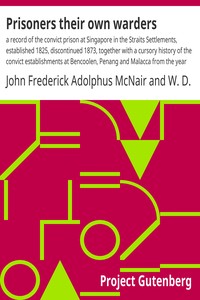
Prisoners their own warders : a record of the convict prison at Singapore in…
I stumbled across Prisoners their own warders at an old book sale, and I couldn’t stop talking about it for weeks. This is the kind of true history that makes your jaw drop: a Singapore prison from the late 1800s where convicts were given real power over each other. The title isn’t a joke. Bayliss, who worked for the British authority in the Straits Settlements, wrote this to document a system that might sound more like fiction than fact.
The Story
Bayliss doesn’t just lay out policies. He paints a daily picture: hundreds of male prisoners from across Southeast Asia, jailed for crimes like petty robbery or rebellion, forced to build roads, public buildings, and even the prison itself. The hottest controversy? Prisoners were put in charge of guarding other prisoners. Of course, arrests and violence still happen—especially when lifers try to escape. But outside these gates, the free locals are both terrified and fascinated by these lawmen in chains. Through missing letters, smuggling tools, and broken alliances, Bayliss pieces together the chaos hidden beneath a placid colonial facade.
Why You Should Read It
This isn’t a dry government report. Bayliss is a fair but curious colonial bureaucrat who understands that gossip can be evidence. His voice is direct and conversational, feeling more like a diary than an account written for bureaucrats in London. The most compelling part is the moral sickness: giving men ultimate authority over others with barely any rules, sheer trust, and fate. As the system unravels—caused more by stupidity than malice—you realize it says more about who we are when we wear the uniform, crown, or not.
I also loved getting to peek inside Chinese secret societies (pre-Triad, trippy), Tamil lifers who just gave up, and Javanese corsair leaders suddenly put on probation as debtors. The whole book screams “what were they thinking?!”—and makes you Google furiously while gripping your tea. Some heavy reads try to be important; this one is simply memorable.
Final Verdict
Think of it like a episode of Human Resources crossed with Escape from Alcatraz, if written from 110 years ago. It’s fantastic for true crime nerd history, especially of Asia, or anyone asking, “Does putting a mirror up to criminals actually stop anything?” Bayliss says “maybe,” but even he can’t convince himself or spare you from the depressing elegance of prisoners and jailers looking identical. I found it short (< 190 pages), breezy, and unputdownable. Perfect vacation read if you hang with bureaucrat ghosts and justice pivots.
This is a copyright-free edition. Enjoy reading and sharing without restrictions.
Elizabeth Hernandez
6 months agoIt’s refreshing to see such a high standard of digital publishing.
Barbara Thompson
2 years agoThought-provoking and well-organized content.
George Thomas
10 months agoUnlike many other resources I've purchased before, it manages to maintain a consistent flow even when discussing difficult topics. Thanks for making such a high-quality version available.
Elizabeth Perez
7 months agoI was particularly interested in the case studies mentioned here, the narrative arc keeps the reader engaged while delivering factual content. A solid investment for anyone's personal development.






Mary Lee
1 year agoI was particularly interested in the case studies mentioned here, the way the author breaks down the core concepts is remarkably clear. I appreciate the effort that went into this curation.