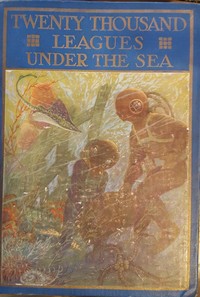

Twenty Thousand Leagues under the Sea — Story, Setting & Ideas

(0 User reviews)   54
Verne, Jules, 1828-1905 Project Gutenberg 1994 Not confirmed
Science fiction; Submarines (Ships) -- Fiction; Sea stories; Adventure stories; Underwater exploration -- Fiction Readers of public-domain and historical texts
Project Gutenberg digital edition en

Edition facts

Words 108,976
Reading time 474 min
Text sections 47

The catalog record for Twenty Thousand Leagues under the Sea — Story, Setting & Ideas provides practical reading context through 108,976 words, 7 hr 54 min estimated reading time, and 47 detected text sections.

The text analysis averages about 16.5 words per sentence, while the detected sections provide another way to judge how the source is divided.

Project Gutenberg metadata also associates the work with “Science fiction,” connecting these edition facts with the source record’s subject description.

Jules Verne's novel uses precise nautical diction, a first-person narrator who is a scientist, and detailed descriptions of underwater technology to create a sense of authentic exploration. The excerpts show a careful balance between technical exposition and narrative tension, with Captain Nemo's enigmatic presence shaping the tone.
Share
Editorial Edition Score 4.9/5

Calculated from edition completeness, EPUB availability, text structure and catalogue metadata. Not a user rating.

How this score is calculated
  • Description quality20 pts
  • Title & short description10 pts
  • Source metadata20 pts
  • Text length15 pts
  • Chapters / structure15 pts
  • EPUB file integrity20 pts

Total of 100 points, scaled to a 2.5-5.0 range. Editions with an empty description or a missing EPUB file are not scored.

Edition quality

Read the Text

m this moment all unlucky casualties which could not be otherwise accounted for were put down to the monster. Upon this imaginary creature rested the responsibility of all these shipwrecks, which unfortunately were considerable; for of three thousand ships whose loss was annually recorded at Lloyd’s, the number of sailing and steam ships supposed to be totally lost, from the absence of all news, amounted to not less than two hundred!

Now, it was the “monster” who, justly or unjustly, was accused of their disappearance, and, thanks to it, communication between the different continents became more and more dangerous. The public demanded peremptorily that the seas should at any price be relieved from this formidable cetacean.

CHAPTER II PRO AND CON

At the period when these events took place, I had just returned from a scientific research in the disagreeable territory of Nebraska, in the United States. In virtue of my office as Assistant Professor in the Museum of Natural History in Paris, the French Government had attached me to that expedition. After six months in Nebraska, I arrived in New York towards the end of March, laden with a precious collection. My departure for France was fixed for the first days in May. Meanwhile, I was occupying myself in classifying my mineralogical, botanical, and zoological riches, when the accident happened to the _Scotia_.

I was perfectly up in the subject which was the question of the day. How could I be otherwise? I had read and re-read all the American and European papers without being any nearer a conclusion. This mystery puzzled me. Under the impossibility of forming an opinion, I jumped from one extreme to the other. That there really was something could not be doubted, and the incredulous were invited to put their finger on the wound of the _Scotia_.

On my arrival at New York the question was at its height. The hypothesis of the floating island, and the unapproachable sandbank, supported by minds little competent to form a judgment, was abandoned. And, indeed, unless this shoal had a machine in its stomach, how could it change its position with such astonishing rapidity?

From the same cause, the idea of a floating hull of an enormous wreck was given up.

There remained then only two possible solutions of the question, which created two distinct parties: on one side, those who were for a monster of colossal strength; on the other, those who were for a submarine vessel of enormous motive power.

But this last hypothesis, plausible as it was, could not stand against inquiries made in both worlds. That a private gentleman should have such a machine at his command was not likely. Where, when, and how was it built? and how could its construction have been kept secret? Certainly a Government might possess such a destructive machine. And in these disastrous times, when the ingenuity of man has multiplied the power of weapons of war, it was possible that, without the knowledge of others, a state might try to work such a formidable engine. After the chassepots came the torpedoes, after the torpedoes the submarine rams, then—the reaction. At least, I hope so.

But the hypothesis of a war machine fell before the declaration of Governments. As public interest was in question, and transatlantic communications suffered, their veracity could not be doubted. But, how admit that the construction of this submarine boat had escaped the public eye? For a private gentleman to keep the secret under such circumstances would be very difficult, and for a state whose every act is persistently watched by powerful rivals, certainly impossible.

After inquiries made in England, France, Russia, Prussia, Spain, Italy, and America, even in Turkey, the hypothesis of a submarine monitor was definitely rejected.

Upon my arrival in New York several persons did me the honour of consulting me on the phenomenon in question. I had published in France a work in quarto, in two volumes, entitled “Mysteries of the Great Submarine Grounds.” This book, highly approved of in the learned world, gained for me a special reputation in this rather obscure branch of Natural History. My advice was asked. As long as I could deny the reality of the fact, I confined myself to a decided negative. But soon, finding myself driven into a corner, I was obliged to explain myself categorically. And even “the Honourable Pierre Aronnax, Professor in the Museum of Paris,” was called upon by the _New York Herald_ to express a definite opinion of some sort. I did something. I spoke, for want of power to hold my tongue. I discussed the question in all its forms, politically and scientifically; and I give here an extract from a carefully-studied article which I published in the number of the 30th of April. It ran as follows:—

“After examining one by one the different hypotheses, rejecting all other suggestions, it becomes necessary to admit the existence of a marine animal of enormous power.

“The great depths of the ocean are entirely unknown to us. Soundings cannot reach them. What passes in those remote depths—what beings live, or can live, twelve or fifteen miles beneath the surface of the waters—what is the organisation of these animals, we can scarcely conjecture. However, the solution of the problem submitted to me may modify the form of the dilemma. Either we do know all the varieties of beings which people our planet, or we do not. If we do _not_ know them all—if Nature has still secrets in ichthyology for us, nothing is more conformable to reason than to admit the existence of fishes, or cetaceans of other kinds, or even of new species, of an organisation formed to inhabit the strata inaccessible to soundings, and which an accident of some sort, either fatastical or capricious, has brought at long intervals to the upper level of the ocean.

“If, on the contrary, we _do_ know all living kinds, we must necessarily seek for the animal in question amongst those marine beings already classed; and, in that case, I should be disposed to admit the existence of a gigantic narwhal.

“The common narwhal, or unicorn of the sea, often attains a length of sixty feet. Increase its size fivefold or tenfold, give it strength proportionate to its size, lengthen its destructive weapons, and you obtain the animal required. It will have the proportions determined by the officers of the _Shannon_, the instrument required by the perforation of the _Scotia_, and the power necessary to pierce the hull of the steamer.

“Indeed, the narwhal is armed with a sort of ivory sword, a halberd, according to the expression of certain naturalists. The principal tusk has the hardness of steel. Some of these tusks have been found buried in the bodies of whales, which the unicorn always attacks with success. Others have been drawn out, not without trouble, from the bottoms of ships, which they had pierced through and through, as a gimlet pierces a barrel. The Museum of the Faculty of Medicine of Paris possesses one of these defensive weapons, two yards and a quarter in length, and fifteen inches in diameter at the base.

“Very well! suppose this weapon to be six times stronger and the animal ten times more powerful; launch it at the rate of twenty miles an hour, and you obtain a shock capable of producing the catastrophe required. Until further information, therefore, I shall maintain it to be a sea-unicorn of colossal dimensions, armed not with a halberd, but with a real spur, as the armoured frigates, or the ‘rams’ of war, whose massiveness and motive power it would possess at the same time. Thus may this puzzling phenomenon be explained, unless there be something over and above all that one has ever conjectured, seen, perceived, or experienced; which is just within the bounds of possibility.”

These last words were cowardly on my part; but, up to a certain point, I wished to shelter my dignity as Professor, and not give too much cause for laughter to the Americans, who laugh well when they do laugh.

I reserved for myself a way of escape. In effect, however, I admitted the existence of the “monster.” My article was warmly discussed, which procured it a high reputation. It rallied round it a certain number of partisans. The solution it proposed gave, at least, full liberty to the imagination. The human mind delights in grand conceptions of supernatural beings. And the sea is precisely their best vehicle, the only medium through which these giants (against which terrestrial animals, such as elephants or rhinoceroses, are as nothing) can be produced or developed.

The industrial and commercial papers treated the question chiefly from this point of view. The _Shipping and Mercantile Gazette_, the _Lloyd’s List_, the _Packet-Boat_, and the _Maritime and Colonial Review_, all papers devoted to insurance companies which threatened to raise their rates of premium, were unanimous on this point. Public opinion had been pronounced. The United States were the first in the field; and in New York they made preparations for an expedition destined to pursue this narwhal. A frigate of great speed, the _Abraham Lincoln_, was put in commission as soon as possible. The arsenals were opened to Commander Farragut, who hastened the arming of his frigate; but, as it always happens, the moment it was decided to pursue the monster, the monster did not appear. For two months no one heard it spoken of. No ship met with it. It seemed as if this unicorn knew of the plots weaving around it. It had been so much talked of, even through the Atlantic cable, that jesters pretended that this slender fly had stopped a telegram on its passage and was making the most of it.

So when the frigate had been armed for a long campaign, and provided with formidable fishing apparatus, no one could tell what course to pursue. Impatience grew apace, when, on the 2nd of July, they learned that a steamer of the line of San Francisco, from California to Shanghai, had seen the animal three weeks before in the North Pacific Ocean. The excitement caused by this news was extreme. The ship was revictualled and well stocked with coal.

Three hours before the _Abraham Lincoln_ left Brooklyn pier, I received a letter worded as follows:—

“To M. ARONNAX, Professor in the Museum of Paris, Fifth Avenue Hotel, New York.

“SIR,—If you will consent to join the _Abraham Lincoln_ in this expedition, the Government of the United States will with pleasure see France represented in the enterprise. Commander Farragut has a cabin at your disposal.

“Very cordially yours, “J.B. HOBSON, “Secretary of Marine.”

CHAPTER III I FORM MY RESOLUTION

Three seconds before the arrival of J. B. Hobson’s letter, I no more thought of pursuing the unicorn than of attempting the passage of the North Sea. Three seconds after reading the letter of the honourable Secretary of Marine, I felt that my true vocation, the sole end of my life, was to chase this disturbing monster, and purge it from the world.

But I had just returned from a fatiguing journey, weary and longing for repose. I aspired to nothing more than again seeing my country, my friends, my little lodging by the Jardin des Plantes, my dear and precious collections. But nothing could keep me back! I forgot all—fatigue, friends and collections—and accepted without hesitation the offer of the American Government.

“Besides,” thought I, “all roads lead back to Europe (for my particular benefit), and I will not hurry me towards the coast of France. This worthy animal may allow itself to be caught in the seas of Europe (for my particular benefit), and I will not bring back less than half a yard of his ivory halberd to the Museum of Natural History.” But in the meanwhile I must seek this narwhal in the North Pacific Ocean, which, to return to France, was taking the road to the antipodes.

“Conseil,” I called in an impatient voice.

Conseil was my servant, a true, devoted Flemish boy, who had accompanied me in all my travels. I liked him, and he returned the liking well. He was phlegmatic by nature, regular from principle, zealous from habit, evincing little disturbance at the different surprises of life, very quick with his hands, and apt at any service required of him; and, despite his name, never giving advice—even when asked for it.

Conseil had followed me for the last ten years wherever science led. Never once did he complain of the length or fatigue of a journey, never make an objection to pack his portmanteau for whatever country it might be, or however far away, whether China or Congo. Besides all this, he had good health, which defied all sickness, and solid muscles, but no nerves; good morals are understood. This boy was thirty years old, and his age to that of his master as fifteen to twenty. May I be excused for saying that I was forty years old?

But Conseil had one fault: he was ceremonious to a degree, and would never speak to me but in the third person, which was sometimes provoking.

“Conseil,” said I again, beginning with feverish hands to make preparations for my departure.

Certainly I was sure of this devoted boy. As a rule, I never asked him if it were convenient for him or not to follow me in my travels; but this time the expedition in question might be prolonged, and the enterprise might be hazardous in pursuit of an animal capable of sinking a frigate as easily as a nutshell. Here there was matter for reflection even to the most impassive man in the world. What would Conseil say?

“Conseil,” I called a third time.

“Did you call, sir?” said he, entering.

“Yes, my boy; make preparations for me and yourself too. We leave in two hours.”

“As you please, sir,” replied Conseil, quietly.

“Not an instant to lose;—lock in my trunk all travelling utensils, coats, shirts, and stockings—without counting, as many as you can, and make haste.”

“And your collections, sir?” observed Conseil.

“We will think of them by and by.”

“What! the archiotherium, the hyracotherium, the oreodons, the cheropotamus, and the other skins?”

“They will keep them at the hotel.”

“And your live Babiroussa, sir?”

“They will feed it during our absence; besides, I will give orders to forward our menagerie to France.”

“We are not returning to Paris, then?” said Conseil.

“Oh! certainly,” I answered, evasively, “by making a curve.”

“Will the curve please you, sir?”

“Oh! it will be nothing; not quite so direct a road, that is all. We take our passage in the _Abraham Lincoln_.”

“As you think proper, sir,” coolly replied Conseil.

“You see, my friend, it has to do with the monster—the famous narwhal. We are going to purge it from the seas. The author of a work in quarto in two volumes, on the ‘Mysteries of the Great Submarine Grounds’ cannot forbear embarking with Commander Farragut. A glorious mission, but a dangerous one! We cannot tell where we may go; these animals can be very capricious. But we will go whether or no; we have got a captain who is pretty wide-awake.”

I opened a credit account for Babiroussa, and, Conseil following, I jumped into a cab. Our luggage was transported to the deck of the frigate immediately. I hastened on board and asked for Commander Farragut. One of the sailors conducted me to the poop, where I found myself in the presence of a good-looking officer, who held out his hand to me.

“Monsieur Pierre Aronnax?” said he.

“Himself,” replied I; “Commander Farragut?”

“You are welcome, Professor; your cabin is ready for you.”

I bowed, and desired to be conducted to the cabin destined for me.

The _Abraham Lincoln_ had been well chosen and equipped for her new destination. She was a frigate of great speed, fitted with high-pressure engines which admitted a pressure of seven atmospheres. Under this the _Abraham Lincoln_ attained the mean speed of nearly eighteen knots and a third an hour—a considerable speed, but, nevertheless, insufficient to grapple with this gigantic cetacean.

The interior arrangements of the frigate corresponded to its nautical qualities. I was well satisfied with my cabin, which was in the after part, opening upon the gunroom.

“We shall be well off here,” said I to Conseil.

“As well, by your honour’s leave, as a hermit-crab in the shell of a whelk,” said Conseil.

I left Conseil to stow our trunks conveniently away, and remounted the poop in order to survey the preparations for departure.

At that moment Commander Farragut was ordering the last moorings to be cast loose which held the _Abraham Lincoln_ to the pier of Brooklyn. So in a quarter of an hour, perhaps less, the frigate would have sailed without me. I should have missed this extraordinary, supernatural, and incredible expedition, the recital of which may well meet with some scepticism.

But Commander Farragut would not lose a day nor an hour in scouring the seas in which the animal had been sighted. He sent for the engineer.

“Is the steam full on?” asked he.

“Yes, sir,” replied the engineer.

“Go ahead,” cried Commander Farragut.

The quay of Brooklyn, and all that part of New York bordering on the East River, was crowded with spectators. Three cheers burst successively from five hundred thousand throats; thousands of handkerchiefs were waved above the heads of the compact mass, saluting the _Abraham Lincoln_, until she reached the waters of the Hudson, at the point of that elongated peninsula which forms the town of New York. Then the frigate, following the coast of New Jersey along the right bank of the beautiful river, covered with villas, passed between the forts, which saluted her with their heaviest guns. The _Abraham Lincoln_ answered by hoisting the American colours three times, whose thirty-nine stars shone resplendent from the mizzen-peak; then modifying its speed to take the narrow channel marked by buoys placed in the inner bay formed by Sandy Hook Point, it coasted the long sandy beach, where some thousands of spectators gave it one final cheer. The escort of boats and tenders still followed the frigate, and did not leave her until they came abreast of the lightship, whose two lights marked the entrance of New York Channel.

Six bells struck, the pilot got into his boat, and rejoined the little schooner which was waiting under our lee, the fires were made up, the screw beat the waves more rapidly, the frigate skirted the low yellow coast of Long Island; and at eight bells, after having lost sight in the north-west of the lights of Fire Island, she ran at full steam on to the dark waters of the Atlantic.

Captain Farragut was a good seaman, worthy of the frigate he commanded. His vessel and he were one. He was the soul of it. On the question of the cetacean there was no doubt in his mind, and he would not allow the existence of the animal to be disputed on board. He believed in it, as certain good women believe in the leviathan—by faith, not by reason. The monster did exist, and he had sworn to rid the seas of it. He was a kind of Knight of Rhodes, a second Dieudonné de Gozon, going to meet the serpent which desolated the island. Either Captain Farragut would kill the narwhal, or the narwhal would kill the captain. There was no third course.

The officers on board shared the opinion of their chief. They were ever chatting, discussing, and calculating the various chances of a meeting, watching narrowly the vast surface of the ocean. More than one took up his quarters voluntarily in the cross-trees, who would have cursed such a berth under any other circumstances. As long as the sun described its daily course, the rigging was crowded with sailors, whose feet were burnt to such an extent by the heat of the deck as to render it unbearable; still the _Abraham Lincoln_ had not yet breasted the suspected waters of the Pacific. As to the ship’s company, they desired nothing better than to meet the unicorn, to harpoon it, hoist it on board, and despatch it. They watched the sea with eager attention.

Besides, Captain Farragut had spoken of a certain sum of two thousand dollars, set apart for whoever should first sight the monster, were he cabin-boy, common seaman, or officer.

I leave you to judge how eyes were used on board the _Abraham Lincoln_.

From its opening sentence, Twenty Thousand Leagues under the Sea establishes a tone of scientific inquiry mixed with mystery. The narrator, Professor Aronnax, describes the year 1866 as “signalised by a remarkable incident, a mysterious and puzzling phenomenon,” immediately framing the story as an investigation. Verne’s diction is precise and technical—words like “spindle-shaped,” “phosphorescent,” and “log-books” ground the fantastic premise in credible detail. The narrative voice is that of a naturalist, carefully cataloging observations while hinting at the unknown.

The excerpts reveal a structure built around measured pacing: the boat’s oarsmen stroke “only followed each other every ten seconds,” and the description of dawn in tropical regions notes its “rapidity peculiar to tropical regions, which know neither dawn nor twilight.” This attention to temporal and physical detail creates a world that feels both real and wondrous.

A Scientist’s Voice

The narrative is filtered through Professor Aronnax, whose professional habits shape every observation. He notes the “shape of the object or creature in question, the untiring rapidity of its movements, its surprising power of locomotion” with the detachment of a field researcher. Even when describing the Nautilus’s departure, he records the “liquid drops struck the dark depths of the waves crisply like spats of melted lead”—a simile that blends scientific precision with literary imagery. This voice never wavers into pure adventure; it remains analytical, which paradoxically heightens the strangeness of the events.

Verne uses Aronnax’s expertise to deliver exposition naturally. When Captain Nemo explains the pearl bank, Aronnax does not simply report the information; he frames it as a lesson: “Here, in a month will be assembled the numerous fishing boats of the exporters.” The reader learns alongside the narrator, making the technical details feel integral to the plot rather than digressive.

Dialogue as Revelation

Captain Nemo’s speech is clipped and authoritative, revealing character through what he does not say. His question, “M. Aronnax, are you ready to start?” is followed by a series of brief commands: “Then please to follow me.” When Aronnax asks about diving dresses, Nemo replies with a practical explanation, not a philosophical one. This economy of dialogue contrasts with the narrator’s more expansive internal commentary, creating a dynamic where Nemo remains an enigma even as he speaks.

The Canadian harpooner Ned Land is given fewer lines in the excerpts, but his presence is felt through Aronnax’s observations: “contrary to the Canadian’s opinion, who thought it too far off.” This indirect characterization—showing conflict through reported thought rather than direct speech—is a subtle technique that builds tension without melodrama.

Description as World-Building

Verne’s descriptive passages do more than set scenes; they construct a believable underwater world through careful selection of detail. The boat’s movement is described with nautical precision: “the chain scarcely ran, for it was little more than a yard deep.” The sea is “never very rough here,” a fact that serves both plot (safe diving) and atmosphere (a sheltered, almost secretive location).

Color and light are used sparingly but effectively. The night is “dark” with “layers of clouds,” and dawn arrives “with that rapidity peculiar to tropical regions.” These observations are not decorative; they anchor the reader in a specific time and place. The “dark line enclosing three parts of the horizon” gives a sense of isolation, while the “samphire reeds flapped before it” adds a tactile, botanical detail that reinforces the setting’s authenticity.

Pacing and Suspense Through Structure

The excerpts demonstrate Verne’s control of narrative rhythm. The opening chapter builds public excitement through a list of affected groups: “Merchants, common sailors, captains of vessels… naval officers of all countries.” This cumulative structure mimics the spread of a rumor. Later, the journey to the pearl bank is paced with deliberate slowness—the boat’s oarsmen stroke every ten seconds, and the narrator notes the time (half-past five, six o’clock) to mark the passage.

Suspense is created by what is withheld. When Captain Nemo rises to watch the sea, the action is described without explanation: “At a sign from him the anchor was dropped.” The reader, like Aronnax, must infer the reason. This technique of showing without telling keeps the narrative taut, even in passages of exposition.

Readers attentive to Verne’s authorial choices will notice how he balances the scientific and the mysterious. The narrator’s voice is a lens that magnifies detail while leaving the larger enigma—Captain Nemo’s motives—intact. Pay attention to what is not said: the gaps in dialogue, the withheld explanations, the moments when description replaces action. These silences are where the novel’s true depth lies.

Reading Verne’s precise, patient accounts of the Nautilus reminded me of another kind of quiet voyage — the slow, muddy passage up a river in a very different century. There is the same careful attention to detail, the same sense of being far from home but utterly absorbed. It made me think of On the Irrawaddy: A Story of the First Burmese War — Reading Notes, and how both books feel less like adventures and more like confided, unhurried journals.

There are no reviews for this eBook.

0
0 out of 5 (0 User reviews )

Add a Review

Your Rating *
  • ...
    Joshua Morgan Wright - 1 month ago
    Twenty Thousand Leagues Under The Sea is a timeless masterpiece that takes readers on an unforgettable journey beneath the waves. Jules Verne's imaginative vision is breathtaking, from the Nautilus to the wonders of the deep. The character of Captain Nemo is enigmatic and compelling, and the blend of adventure, science, and philosophy keeps the story deeply engaging. A fantastic read for all ages.

  • ...
    Crystal Zuniga - 1 week ago
    Twenty Thousand Leagues Under The Sea is an engaging and imaginative novel that showcases Verne's genius. The underwater scenes are wonderfully detailed, and the plot is full of excitement. My only minor quibble is that some of the scientific explanations feel a bit dated, but they don't detract much from the overall experience. A must-read for any fan of classic adventure.

  • ...
    Paige Fernandez - 1 week ago
    Twenty Thousand Leagues Under The Sea is often celebrated, but I found it underwhelming. The narrative is padded with long, technical descriptions that slow the story to a crawl. The characters are also not deeply developed, leaving the reader detached from their fate. While it's an influential work, it doesn't hold up as a page-turner today. I'd suggest abridged versions.


Reader reflection

Take a moment to reflect on this book

Create a short personal record of your experience with this book.

Your progress 0 / 10
1

Have you finished this book?

2

Did this book hold your interest?

3

Would you encourage someone else to read it?

4

What was the reading difficulty like?

Related eBooks