
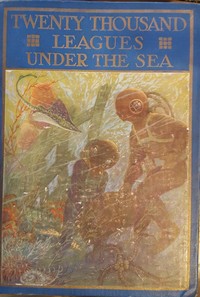
Twenty Thousand Leagues Under the Seas: An Underwater Tour of the World — A Reader’s Guide

(3 User reviews)   686
Verne, Jules, 1828-1905, Walter, Frederick Paul, 1943-2024 [Translator], Winter, Milo, 1888-1956 [Illustrator] Project Gutenberg 2001 Not confirmed
Science fiction; Submarines (Ships) -- Fiction; Sea stories; Adventure stories; Underwater exploration -- Fiction Readers of public-domain and historical texts
Project Gutenberg digital edition en

Edition facts

Words 149,804
Reading time 652 min
Text sections 14

Before opening Twenty Thousand Leagues Under the Seas: An Underwater Tour of the World — A Reader’s Guide, the edition data offers a quick orientation: 149,804 words, 10 hr 52 min estimated reading time, and 14 detected text sections.

The text analysis averages about 16.2 words per sentence, while the detected sections provide another way to judge how the source is divided.

Project Gutenberg metadata also associates the work with “Science fiction,” connecting these edition facts with the source record’s subject description.

Jules Verne's underwater tour, narrated by Professor Aronnax, contrasts scientific wonder with captivity aboard the Nautilus. The translation by F.P. Walter restores the original French title emphasizing seas, not depth. Excerpts reveal tensions between Aronnax's curiosity, Ned Land's resistance, and Captain Nemo's enigmatic control.
Share
Editorial Edition Score 4.9/5

Calculated from edition completeness, EPUB availability, text structure and catalogue metadata. Not a user rating.

How this score is calculated
  • Description quality20 pts
  • Title & short description10 pts
  • Source metadata20 pts
  • Text length15 pts
  • Chapters / structure15 pts
  • EPUB file integrity20 pts

Total of 100 points, scaled to a 2.5-5.0 range. Editions with an empty description or a missing EPUB file are not scored.

Edition quality

Read the Text

der responsibility for all derelict vessels, whose numbers are unfortunately considerable, since out of those 3,000 ships whose losses are recorded annually at the marine insurance bureau, the figure for steam or sailing ships supposedly lost with all hands, in the absence of any news, amounts to at least 200!

Now then, justly or unjustly, it was the “monster” who stood accused of their disappearance; and since, thanks to it, travel between the various continents had become more and more dangerous, the public spoke up and demanded straight out that, at all cost, the seas be purged of this fearsome cetacean.

DURING THE PERIOD in which these developments were occurring, I had returned from a scientific undertaking organized to explore the Nebraska badlands in the United States. In my capacity as Assistant Professor at the Paris Museum of Natural History, I had been attached to this expedition by the French government. After spending six months in Nebraska, I arrived in New York laden with valuable collections near the end of March. My departure for France was set for early May. In the meantime, then, I was busy classifying my mineralogical, botanical, and zoological treasures when that incident took place with the Scotia.

I was perfectly abreast of this question, which was the big news of the day, and how could I not have been? I had read and reread every American and European newspaper without being any farther along. This mystery puzzled me. Finding it impossible to form any views, I drifted from one extreme to the other. Something was out there, that much was certain, and any doubting Thomas was invited to place his finger on the Scotia’s wound.

When I arrived in New York, the question was at the boiling point. The hypothesis of a drifting islet or an elusive reef, put forward by people not quite in their right minds, was completely eliminated. And indeed, unless this reef had an engine in its belly, how could it move about with such prodigious speed?

Also discredited was the idea of a floating hull or some other enormous wreckage, and again because of this speed of movement.

So only two possible solutions to the question were left, creating two very distinct groups of supporters: on one side, those favoring a monster of colossal strength; on the other, those favoring an “underwater boat” of tremendous motor power.

Now then, although the latter hypothesis was completely admissible, it couldn’t stand up to inquiries conducted in both the New World and the Old. That a private individual had such a mechanism at his disposal was less than probable. Where and when had he built it, and how could he have built it in secret?

Only some government could own such an engine of destruction, and in these disaster-filled times, when men tax their ingenuity to build increasingly powerful aggressive weapons, it was possible that, unknown to the rest of the world, some nation could have been testing such a fearsome machine. The Chassepot rifle led to the torpedo, and the torpedo has led to this underwater battering ram, which in turn will lead to the world putting its foot down. At least I hope it will.

But this hypothesis of a war machine collapsed in the face of formal denials from the various governments. Since the public interest was at stake and transoceanic travel was suffering, the sincerity of these governments could not be doubted. Besides, how could the assembly of this underwater boat have escaped public notice? Keeping a secret under such circumstances would be difficult enough for an individual, and certainly impossible for a nation whose every move is under constant surveillance by rival powers.

So, after inquiries conducted in England, France, Russia, Prussia, Spain, Italy, America, and even Turkey, the hypothesis of an underwater Monitor was ultimately rejected.

And so the monster surfaced again, despite the endless witticisms heaped on it by the popular press, and the human imagination soon got caught up in the most ridiculous ichthyological fantasies.

After I arrived in New York, several people did me the honor of consulting me on the phenomenon in question. In France I had published a two-volume work, in quarto, entitled The Mysteries of the Great Ocean Depths. Well received in scholarly circles, this book had established me as a specialist in this pretty obscure field of natural history. My views were in demand. As long as I could deny the reality of the business, I confined myself to a flat “no comment.” But soon, pinned to the wall, I had to explain myself straight out. And in this vein, “the honorable Pierre Aronnax, Professor at the Paris Museum,” was summoned by The New York Herald to formulate his views no matter what.

I complied. Since I could no longer hold my tongue, I let it wag. I discussed the question in its every aspect, both political and scientific, and this is an excerpt from the well-padded article I published in the issue of April 30.

“Therefore,” I wrote, “after examining these different hypotheses one by one, we are forced, every other supposition having been refuted, to accept the existence of an extremely powerful marine animal.

“The deepest parts of the ocean are totally unknown to us. No soundings have been able to reach them. What goes on in those distant depths? What creatures inhabit, or could inhabit, those regions twelve or fifteen miles beneath the surface of the water? What is the constitution of these animals? It’s almost beyond conjecture.

“However, the solution to this problem submitted to me can take the form of a choice between two alternatives.

“Either we know every variety of creature populating our planet, or we do not.

“If we do not know every one of them, if nature still keeps ichthyological secrets from us, nothing is more admissible than to accept the existence of fish or cetaceans of new species or even new genera, animals with a basically ‘cast-iron’ constitution that inhabit strata beyond the reach of our soundings, and which some development or other, an urge or a whim if you prefer, can bring to the upper level of the ocean for long intervals.

“If, on the other hand, we do know every living species, we must look for the animal in question among those marine creatures already cataloged, and in this event I would be inclined to accept the existence of a giant narwhale.

“The common narwhale, or sea unicorn, often reaches a length of sixty feet. Increase its dimensions fivefold or even tenfold, then give this cetacean a strength in proportion to its size while enlarging its offensive weapons, and you have the animal we’re looking for. It would have the proportions determined by the officers of the Shannon, the instrument needed to perforate the Scotia, and the power to pierce a steamer’s hull.

“In essence, the narwhale is armed with a sort of ivory sword, or lance, as certain naturalists have expressed it. It’s a king-sized tooth as hard as steel. Some of these teeth have been found buried in the bodies of baleen whales, which the narwhale attacks with invariable success. Others have been wrenched, not without difficulty, from the undersides of vessels that narwhales have pierced clean through, as a gimlet pierces a wine barrel. The museum at the Faculty of Medicine in Paris owns one of these tusks with a length of 2.25 meters and a width at its base of forty-eight centimeters!

“All right then! Imagine this weapon to be ten times stronger and the animal ten times more powerful, launch it at a speed of twenty miles per hour, multiply its mass times its velocity, and you get just the collision we need to cause the specified catastrophe.

“So, until information becomes more abundant, I plump for a sea unicorn of colossal dimensions, no longer armed with a mere lance but with an actual spur, like ironclad frigates or those warships called ‘rams,’ whose mass and motor power it would possess simultaneously.

“This inexplicable phenomenon is thus explained away—unless it’s something else entirely, which, despite everything that has been sighted, studied, explored and experienced, is still possible!”

These last words were cowardly of me; but as far as I could, I wanted to protect my professorial dignity and not lay myself open to laughter from the Americans, who when they do laugh, laugh raucously. I had left myself a loophole. Yet deep down, I had accepted the existence of “the monster.”

My article was hotly debated, causing a fine old uproar. It rallied a number of supporters. Moreover, the solution it proposed allowed for free play of the imagination. The human mind enjoys impressive visions of unearthly creatures. Now then, the sea is precisely their best medium, the only setting suitable for the breeding and growing of such giants—next to which such land animals as elephants or rhinoceroses are mere dwarves. The liquid masses support the largest known species of mammals and perhaps conceal mollusks of incomparable size or crustaceans too frightful to contemplate, such as 100-meter lobsters or crabs weighing 200 metric tons! Why not? Formerly, in prehistoric days, land animals (quadrupeds, apes, reptiles, birds) were built on a gigantic scale. Our Creator cast them using a colossal mold that time has gradually made smaller. With its untold depths, couldn’t the sea keep alive such huge specimens of life from another age, this sea that never changes while the land masses undergo almost continuous alteration? Couldn’t the heart of the ocean hide the last-remaining varieties of these titanic species, for whom years are centuries and centuries millennia?

But I mustn’t let these fantasies run away with me! Enough of these fairy tales that time has changed for me into harsh realities. I repeat: opinion had crystallized as to the nature of this phenomenon, and the public accepted without argument the existence of a prodigious creature that had nothing in common with the fabled sea serpent.

Yet if some saw it purely as a scientific problem to be solved, more practical people, especially in America and England, were determined to purge the ocean of this daunting monster, to insure the safety of transoceanic travel. The industrial and commercial newspapers dealt with the question chiefly from this viewpoint. The Shipping & Mercantile Gazette, the Lloyd’s List, France’s Packetboat and Maritime & Colonial Review, all the rags devoted to insurance companies—who threatened to raise their premium rates—were unanimous on this point.

Public opinion being pronounced, the States of the Union were the first in the field. In New York preparations were under way for an expedition designed to chase this narwhale. A high-speed frigate, the Abraham Lincoln, was fitted out for putting to sea as soon as possible. The naval arsenals were unlocked for Commander Farragut, who pressed energetically forward with the arming of his frigate.

But, as it always happens, just when a decision had been made to chase the monster, the monster put in no further appearances. For two months nobody heard a word about it. Not a single ship encountered it. Apparently the unicorn had gotten wise to these plots being woven around it. People were constantly babbling about the creature, even via the Atlantic Cable! Accordingly, the wags claimed that this slippery rascal had waylaid some passing telegram and was making the most of it.

So the frigate was equipped for a far-off voyage and armed with fearsome fishing gear, but nobody knew where to steer it. And impatience grew until, on June 2, word came that the Tampico, a steamer on the San Francisco line sailing from California to Shanghai, had sighted the animal again, three weeks before in the northerly seas of the Pacific.

This news caused intense excitement. Not even a 24-hour breather was granted to Commander Farragut. His provisions were loaded on board. His coal bunkers were overflowing. Not a crewman was missing from his post. To cast off, he needed only to fire and stoke his furnaces! Half a day’s delay would have been unforgivable! But Commander Farragut wanted nothing more than to go forth.

I received a letter three hours before the Abraham Lincoln left its Brooklyn pier;* the letter read as follows:

*Author’s Note: A pier is a type of wharf expressly set aside for an individual vessel.

Pierre Aronnax Professor at the Paris Museum Fifth Avenue Hotel New York

If you would like to join the expedition on the Abraham Lincoln, the government of the Union will be pleased to regard you as France’s representative in this undertaking. Commander Farragut has a cabin at your disposal.

Very cordially yours,

J. B. HOBSON, Secretary of the Navy.

THREE SECONDS before the arrival of J. B. Hobson’s letter, I no more dreamed of chasing the unicorn than of trying for the Northwest Passage. Three seconds after reading this letter from the honorable Secretary of the Navy, I understood at last that my true vocation, my sole purpose in life, was to hunt down this disturbing monster and rid the world of it.

Even so, I had just returned from an arduous journey, exhausted and badly needing a rest. I wanted nothing more than to see my country again, my friends, my modest quarters by the Botanical Gardens, my dearly beloved collections! But now nothing could hold me back. I forgot everything else, and without another thought of exhaustion, friends, or collections, I accepted the American government’s offer.

“Besides,” I mused, “all roads lead home to Europe, and our unicorn may be gracious enough to take me toward the coast of France! That fine animal may even let itself be captured in European seas—as a personal favor to me—and I’ll bring back to the Museum of Natural History at least half a meter of its ivory lance!”

But in the meantime I would have to look for this narwhale in the northern Pacific Ocean; which meant returning to France by way of the Antipodes.

“Conseil!” I called in an impatient voice.

Conseil was my manservant. A devoted lad who went with me on all my journeys; a gallant Flemish boy whom I genuinely liked and who returned the compliment; a born stoic, punctilious on principle, habitually hardworking, rarely startled by life’s surprises, very skillful with his hands, efficient in his every duty, and despite his having a name that means “counsel,” never giving advice—not even the unsolicited kind!

From rubbing shoulders with scientists in our little universe by the Botanical Gardens, the boy had come to know a thing or two. In Conseil I had a seasoned specialist in biological classification, an enthusiast who could run with acrobatic agility up and down the whole ladder of branches, groups, classes, subclasses, orders, families, genera, subgenera, species, and varieties. But there his science came to a halt. Classifying was everything to him, so he knew nothing else. Well versed in the theory of classification, he was poorly versed in its practical application, and I doubt that he could tell a sperm whale from a baleen whale! And yet, what a fine, gallant lad!

For the past ten years, Conseil had gone with me wherever science beckoned. Not once did he comment on the length or the hardships of a journey. Never did he object to buckling up his suitcase for any country whatever, China or the Congo, no matter how far off it was. He went here, there, and everywhere in perfect contentment. Moreover, he enjoyed excellent health that defied all ailments, owned solid muscles, but hadn’t a nerve in him, not a sign of nerves—the mental type, I mean.

The lad was thirty years old, and his age to that of his employer was as fifteen is to twenty. Please forgive me for this underhanded way of admitting I had turned forty.

But Conseil had one flaw. He was a fanatic on formality, and he only addressed me in the third person—to the point where it got tiresome.

“Conseil!” I repeated, while feverishly beginning my preparations for departure.

To be sure, I had confidence in this devoted lad. Ordinarily, I never asked whether or not it suited him to go with me on my journeys; but this time an expedition was at issue that could drag on indefinitely, a hazardous undertaking whose purpose was to hunt an animal that could sink a frigate as easily as a walnut shell! There was good reason to stop and think, even for the world’s most emotionless man. What would Conseil say?

“Conseil!” I called a third time.

“Did master summon me?” he said, entering.

“Yes, my boy. Get my things ready, get yours ready. We’re departing in two hours.”

“As master wishes,” Conseil replied serenely.

“We haven’t a moment to lose. Pack as much into my trunk as you can, my traveling kit, my suits, shirts, and socks, don’t bother counting, just squeeze it all in—and hurry!”

“What about master’s collections?” Conseil ventured to observe.

“We’ll deal with them later.”

“What! The archaeotherium, hyracotherium, oreodonts, cheiropotamus, and master’s other fossil skeletons?”

“The hotel will keep them for us.”

“What about master’s live babirusa?”

“They’ll feed it during our absence. Anyhow, we’ll leave instructions to ship the whole menagerie to France.”

“Then we aren’t returning to Paris?” Conseil asked.

“Yes, we are . . . certainly . . . ,” I replied evasively, “but after we make a detour.”

“Whatever detour master wishes.”

“Oh, it’s nothing really! A route slightly less direct, that’s all. We’re leaving on the Abraham Lincoln.”

“As master thinks best,” Conseil replied placidly.

“You see, my friend, it’s an issue of the monster, the notorious narwhale. We’re going to rid the seas of it! The author of a two-volume work, in quarto, on The Mysteries of the Great Ocean Depths has no excuse for not setting sail with Commander Farragut. It’s a glorious mission but also a dangerous one! We don’t know where it will take us! These beasts can be quite unpredictable! But we’re going just the same! We have a commander who’s game for anything!”

“What master does, I’ll do,” Conseil replied.

“But think it over, because I don’t want to hide anything from you. This is one of those voyages from which people don’t always come back!”

A quarter of an hour later, our trunks were ready. Conseil did them in a flash, and I was sure the lad hadn’t missed a thing, because he classified shirts and suits as expertly as birds and mammals.

The hotel elevator dropped us off in the main vestibule on the mezzanine. I went down a short stair leading to the ground floor. I settled my bill at that huge counter that was always under siege by a considerable crowd. I left instructions for shipping my containers of stuffed animals and dried plants to Paris, France. I opened a line of credit sufficient to cover the babirusa and, Conseil at my heels, I jumped into a carriage.

For a fare of twenty francs, the vehicle went down Broadway to Union Square, took Fourth Ave. to its junction with Bowery St., turned into Katrin St. and halted at Pier 34. There the Katrin ferry transferred men, horses, and carriage to Brooklyn, that great New York annex located on the left bank of the East River, and in a few minutes we arrived at the wharf next to which the Abraham Lincoln was vomiting torrents of black smoke from its two funnels.

Our baggage was immediately carried to the deck of the frigate. I rushed aboard. I asked for Commander Farragut. One of the sailors led me to the afterdeck, where I stood in the presence of a smart-looking officer who extended his hand to me.

“Professor Pierre Aronnax?” he said to me.

“The same,” I replied. “Commander Farragut?”

“In person. Welcome aboard, professor. Your cabin is waiting for you.”

I bowed, and letting the commander attend to getting under way, I was taken to the cabin that had been set aside for me.

The Abraham Lincoln had been perfectly chosen and fitted out for its new assignment. It was a high-speed frigate furnished with superheating equipment that allowed the tension of its steam to build to seven atmospheres. Under this pressure the Abraham Lincoln reached an average speed of 18.3 miles per hour, a considerable speed but still not enough to cope with our gigantic cetacean.

The frigate’s interior accommodations complemented its nautical virtues. I was well satisfied with my cabin, which was located in the stern and opened into the officers’ mess.

“We’ll be quite comfortable here,” I told Conseil.

“With all due respect to master,” Conseil replied, “as comfortable as a hermit crab inside the shell of a whelk.”

Jules Verne's Twenty Thousand Leagues Under the Seas opens with Professor Aronnax admitting, “The deepest parts of the ocean are totally unknown to us,” a statement that frames the novel as a venture into the unknown. Yet the narrative quickly becomes a study in confinement: Aronnax, his servant Conseil, and harpooner Ned Land are prisoners aboard the Nautilus, a submarine commanded by the enigmatic Captain Nemo. The translation by F.P. Walter restores the original French title, emphasizing a tour of the seas rather than a descent into depth, and the excerpts show a constant interplay between scientific marvels and the tension of captivity.

The Harpooner's Skepticism vs. Scientific Enthusiasm

Ned Land, the Canadian harpooner, repeatedly punctures the professor's scientific awe with practical, often humorous skepticism. In a discussion about pearls, Aronnax explains that artificial pearls are made from “the scales of a European carp,” to which Ned replies, “That Essence of Orient must sell for quite a large sum.” When Aronnax dismisses the cost as “as little as zero,” Ned quips, “Maybe that’s why Kate Tender married somebody else.” This exchange reveals a recurring pattern: Ned's earthy pragmatism contrasts with Aronnax's didactic enthusiasm. Conseil, ever the loyal classifier, mediates between them, but Ned's resistance to Nemo's authority—and his constant plotting for escape—provides a counterpoint to the professor's wonder. The harpooner's fearlessness about sharks (“I’m a professional harpooner! It’s my job to make a mockery of them!”) is undercut by his dread of the Nautilus's captivity, a tension that drives much of the interpersonal drama.

Captain Nemo's Ambiguous Authority

Captain Nemo remains a shadowy figure in the excerpts, his motives and past largely concealed. The chapter titles hint at his dual nature: “Mobilis in Mobili” (moving within a moving element) suggests a philosophy of dynamic isolation, while “The Lightning Bolts of Captain Nemo” implies a capacity for violence. In the pearl scene, Aronnax estimates Nemo's pearl at “2,000,000 francs,” noting it cost the captain “the effort to pick it up.” This offhand remark underscores Nemo's detachment from worldly value—he possesses immense wealth but uses it for his own purposes. The narrative withholds Nemo's backstory, leaving readers to infer his motivations from his actions: his hospitality is tinged with menace, his generosity with control. The professor's attempts to understand Nemo are met with evasions, creating a persistent atmosphere of mystery that the excerpts do not resolve.

Underwater Wonders as Double-Edged Spectacle

Verne's descriptions of marine life serve both as scientific catalog and as a reminder of the characters' imprisonment. The chapter titles alone— “An Underwater Forest,” “The Coral Realm,” “The Sargasso Sea”—promise visual marvels, but the narrative context often undercuts them. When Aronnax marvels at a pearl worth millions, Ned Land immediately asks, “What good would a pearl worth millions do us here on the Nautilus?” The professor's reply—that such a pearl “would make the story of our adventures more authentic”—reveals his own awareness that their experiences are both extraordinary and untellable. The beauty of the underwater world is inseparable from the fact that it is viewed through the portholes of a prison. This duality is central to the novel's structure: each new wonder is shadowed by the question of whether the characters will ever be free to share it.

Readers should attend to the shifting power dynamics among the three captives and their captor. The novel's tension arises not from external threats alone—sharks, storms, or the ice bank—but from the unresolved question of Nemo's ultimate intentions. Verle's method is to immerse the reader in a world of marvels while never letting us forget that the narrator is not a tourist but a prisoner. The translation by F.P. Walter, based on the original French editions, preserves the period voice while clarifying the novel's geographical scope.

Reading about Aronnax pacing the Nautilus, torn between awe and confinement, I remembered long winter evenings with my father’s old copy of Through Three Campaigns: A Story of Chitral, Tirah and Ashanti — A Closer Reading—the same ache of watching strange lands from a locked vantage, wonder and restlessness tangled, the way a window can feel like both gift and cage. That feeling stays.

John Rivera
2 weeks ago

Sophia Torres
1 week ago

Anthony Perez
2 weeks ago

4.5
4.5 out of 5 (3 User reviews )

Add a Review

Your Rating *
  • ...
    Wendy Roberts - 4 weeks ago
    {'rating': 3, 'text': "Twenty Thousand Leagues Under the Seas is a pioneering work of science fiction with breathtaking descriptions of the ocean's depths. However, the pacing is uneven, with lengthy scientific digressions that can slow the narrative. The characters are somewhat stock, with Professor Aronnax being rather passive. Still, the imaginative journey is worth the read for its historical significance."}

  • ...
    Carly Rodriguez - 3 weeks ago
    {'rating': 2, 'text': "I found this book to be a tedious read. The endless catalogs of fish species and underwater geography overwhelm the plot, which is thin at best. Captain Nemo is intriguing, but his motivations are never fully explored, leaving him a mystery that doesn't payoff. The prose is dated and can be dry. While it's an important work in the genre, it didn't entertain me."}

  • ...
    Ashley Acosta - 1 week ago
    {'rating': 5, 'text': "Jules Verne's classic remains a masterpiece of adventure and imagination. The detailed descriptions of underwater life are mesmerizing, and the enigmatic Captain Nemo is a fascinating character. The sense of wonder and exploration is palpable, making it a timeless journey that captivates the reader from start to finish. A true classic that deserves its place in literary history."}


Reader reflection

Your personal reading reflection

Build a private reading journal entry for this title.

Your progress 0 / 10
1

Which reading stage best describes you?

2

What was your overall reaction to the book?

3

Would you pass this book on to a friend?

4

How much effort did this book require?

Related eBooks