Alice in Blunderland: An Iridescent Dream — Reading Notes

(0 User reviews)   641
Bangs, John Kendrick, 1862-1922, Levering, Albert, 1869-1929 [Illustrator] Project Gutenberg 2009 Not confirmed
Fantasy literature; Municipal ownership -- Fiction Readers of public-domain and historical texts
Project Gutenberg digital edition en

Edition facts

Words 19,446
Reading time 85 min
Text sections 3

Alice in Blunderland: An Iridescent Dream — Reading Notes can be approached with a clearer sense of reading commitment from its source measurements: 19,446 words, 1 hr 25 min estimated reading time, and 3 detected text sections.

The text analysis averages about 17.2 words per sentence, while the detected sections provide another way to judge how the source is divided.

Project Gutenberg metadata also associates the work with “Fantasy literature,” connecting these edition facts with the source record’s subject description.

John Kendrick Bangs sends Alice into a satirical dreamscape where municipal ownership of everything from trolleys to telephones produces absurd results, blending Lewis Carroll's characters with early 20th-century political humor.
Share

Read the complete public-domain text at its original source.

Read on Project Gutenberg

John Kendrick Bangs’s Alice in Blunderland: An Iridescent Dream (1907) borrows the framework of Lewis Carroll’s Alice’s Adventures in Wonderland but replaces fantasy logic with political satire. The opening chapter establishes a dreary, rainy day—Alice is locked in the nursery while her mother hosts a bridge party for the “M. O. Hot Tamale Company,” a charity for a failing municipal enterprise. This mundane setup quickly gives way to a dream where Alice encounters the Hatter, March Hare, and Cheshire Cat, now preoccupied with municipal ownership schemes. The Hatter boasts of inventions like the “Municipaphone,” a telephone with a hat-shaped mouthpiece, designed to moralize communication. Bangs’s humor targets Progressive Era debates about public utilities, using Carroll’s characters as mouthpieces for absurd bureaucratic logic.

Satirical Machinery: Trolleys, Gas Plants, and Municipaphones

The excerpts reveal a pattern of turning public services into sources of comedy. The “Immovable Trolley” (Chapter II) suggests a streetcar system so inefficient it cannot move. The “Aromatic Gas Plant” (Chapter III) promises odorless gas but produces something else entirely. Most elaborate is the Municipaphone (Chapter V), a city-owned telephone system whose mouthpiece is shaped like a hat because “funnels are apt to suggest alcoholic beverages.” The Hatter explains that the name change from “telephone” to “Municipaphone” signals municipal ownership, and he plans to store thunder in batteries for use as firecrackers. These inventions are never shown working properly; instead, they generate endless talk about their theoretical benefits. Bangs uses the Hatter’s grandiloquent speeches to mock the gap between political rhetoric and practical results.

Carroll’s Characters as Political Puppets

Bangs repurposes familiar Wonderland figures to voice conflicting views on municipal ownership. The Hatter is the chief advocate, speaking in lofty phrases about “Democraticising” and “the Municipal Ownership of Brains.” The March Hare whispers that the Hatter is “the biggest gander of the bunch,” while the Cheshire Cat’s grin expands skeptically. The Dormouse, when asked about the Copper Trust, winks and suggests the trust might own the copper. These asides create a layered satire: the Hatter’s schemes are undercut by other characters’ cynicism. Alice herself remains an observer, asking naive questions that expose logical holes—such as wondering why no one thought of saving thunder’s noise. Bangs does not let any character fully endorse or reject the system; instead, the dream’s iridescent surface keeps the political critique playful rather than didactic.

Wordplay and Nonsense Logic in Political Debate

The text is dense with puns and Carrollian wordplay applied to governance. The Hatter renames the telephone to emphasize city ownership, but the new name does not change its function. The White Knight claims that under municipal management “lightning doesn’t strike any more” because there are no strikes—a pun on labor strikes. Alice’s mother’s bridge party benefits the “M. O. Hot Tamale Company,” a nonsense name that satirizes charitable fundraising for failed public enterprises. Bangs also parodies legal language: the “Copperation Counsel’s opinion” authorizes the Hatter to do whatever he pleases. These verbal tricks mirror Carroll’s nonsense but target specific targets: municipal ownership, trusts, and bureaucratic jargon. The humor depends on recognizing the real-world referents—early 1900s debates over public utilities—while enjoying the absurdity of their dream-logic outcomes.

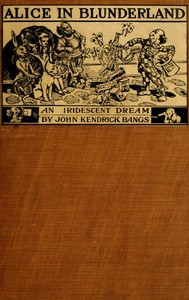
Readers familiar with Carroll will find Bangs’s version a pointed, period-specific satire rather than a children’s fantasy. The humor rewards attention to political context—the municipal ownership movement, trust-busting, and Progressive reform—but the nonsense structure keeps it accessible. The illustrations by Albert Levering, listed in the contents, likely amplify the visual comedy of the Hatter’s inventions and the Cheshire Cat’s grins. Approach Alice in Blunderland as a topical parody where the dream logic serves to expose the absurdities of real-world policies, not as a sequel to Wonderland.

Bangs’ Alice wanders through a world where ownership twists everything familiar into absurdity, and I kept thinking how we’re all just stumbling through our own dreams of control. It reminded me of that quieter, older feeling in Before Adam — Reading Companion, where the past itself feels like a strange, half-remembered place. Both left me with a soft ache—not for answers, but for the wondering itself.

There are no reviews for this eBook.

0
0 out of 5 (0 User reviews )

Add a Review

Your Rating *
There are no comments for this eBook.

Reader reflection

Your personal reading reflection

Build a private reading journal entry for this title.

Your progress 0 / 10
1

Where are you in your reading?

2

Was reading this book enjoyable?

3

Would you encourage someone else to read it?

4

What was the reading difficulty like?

Related eBooks