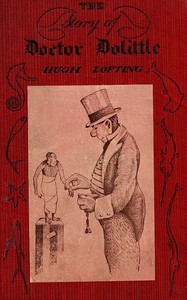
The Story of Doctor Dolittle — A Closer Reading
Edition facts
Before opening The Story of Doctor Dolittle — A Closer Reading, the edition data offers a quick orientation: 31,145 words, 2 hr 16 min estimated reading time, and 26 detected text sections.
The text analysis averages about 16.3 words per sentence, while the detected sections provide another way to judge how the source is divided.
Project Gutenberg metadata also associates the work with “Fantasy literature,” connecting these edition facts with the source record’s subject description.
Calculated from edition completeness, EPUB availability, text structure and catalogue metadata. Not a user rating.
How this score is calculated
- Description quality20 pts
- Title & short description10 pts
- Source metadata20 pts
- Text length15 pts
- Chapters / structure15 pts
- EPUB file integrity20 pts
Total of 100 points, scaled to a 2.5-5.0 range. Editions with an empty description or a missing EPUB file are not scored.
Read the Text
known even than he had been among the folks of the West Country. And he was happy and liked his life very much.
One afternoon when the Doctor was busy writing in a book, Polynesia sat in the window—as she nearly always did—looking out at the leaves blowing about in the garden. Presently she laughed aloud.
“What is it, Polynesia?” asked the Doctor, looking up from his book.
“I was just thinking,” said the parrot; and she went on looking at the leaves.
“What were you thinking?”
“I was thinking about people,” said Polynesia. “People make me sick. They think they’re so wonderful. The world has been going on now for thousands of years, hasn’t it? And the only thing in animal-language that _people_ have learned to understand is that when a dog wags his tail he means ‘I’m glad!’—It’s funny, isn’t it? You are the very first man to talk like us. Oh, sometimes people annoy me dreadfully—such airs they put on—talking about ‘the dumb animals.’ _Dumb!_—Huh! Why I knew a macaw once who could say ‘Good morning!’ in seven different ways without once opening his mouth. He could talk every language—and Greek. An old professor with a gray beard bought him. But he didn’t stay. He said the old man didn’t talk Greek right, and he couldn’t stand listening to him teach the language wrong. I often wonder what’s become of him. That bird knew more geography than people will ever know.—_People_, Golly! I suppose if people ever learn to fly—like any common hedge-sparrow—we shall never hear the end of it!”
“You’re a wise old bird,” said the Doctor. “How old are you really? I know that parrots and elephants sometimes live to be very, very old.”
“I can never be quite sure of my age,” said Polynesia. “It’s either a hundred and eighty-three or a hundred and eighty-two. But I know that when I first came here from Africa, King Charles was still hiding in the oak-tree—because I saw him. He looked scared to death.”
AND soon now the Doctor began to make money again; and his sister, Sarah, bought a new dress and was happy.
Some of the animals who came to see him were so sick that they had to stay at the Doctor’s house for a week. And when they were getting better they used to sit in chairs on the lawn.
And often even after they got well, they did not want to go away—they liked the Doctor and his house so much. And he never had the heart to refuse them when they asked if they could stay with him. So in this way he went on getting more and more pets.
Once when he was sitting on his garden wall, smoking a pipe in the evening, an Italian organ-grinder came round with a monkey on a string. The Doctor saw at once that the monkey’s collar was too tight and that he was dirty and unhappy. So he took the monkey away from the Italian, gave the man a shilling and told him to go. The organ-grinder got awfully angry and said that he wanted to keep the monkey. But the Doctor told him that if he didn’t go away he would punch him on the nose. John Dolittle was a strong man, though he wasn’t very tall. So the Italian went away saying rude things and the monkey stayed with Doctor Dolittle and had a good home. The other animals in the house called him “Chee-Chee”—which is a common word in monkey-language, meaning “ginger.”
And another time, when the circus came to Puddleby, the crocodile who had a bad toothache escaped at night and came into the Doctor’s garden. The Doctor talked to him in crocodile-language and took him into the house and made his tooth better. But when the crocodile saw what a nice house it was—with all the different places for the different kinds of animals—he too wanted to live with the Doctor. He asked couldn’t he sleep in the fish-pond at the bottom of the garden, if he promised not to eat the fish. When the circus-men came to take him back he got so wild and savage that he frightened them away. But to every one in the house he was always as gentle as a kitten.
But now the old ladies grew afraid to send their lap-dogs to Doctor Dolittle because of the crocodile; and the farmers wouldn’t believe that he would not eat the lambs and sick calves they brought to be cured. So the Doctor went to the crocodile and told him he must go back to his circus. But he wept such big tears, and begged so hard to be allowed to stay, that the Doctor hadn’t the heart to turn him out.
So then the Doctor’s sister came to him and said,
“John, you must send that creature away. Now the farmers and the old ladies are afraid to send their animals to you—just as we were beginning to be well off again. Now we shall be ruined entirely. This is the last straw. I will no longer be housekeeper for you if you don’t send away that alligator.”
“It isn’t an alligator,” said the Doctor—“it’s a crocodile.”
“I don’t care what you call it,” said his sister. “It’s a nasty thing to find under the bed. I won’t have it in the house.”
“But he has promised me,” the Doctor answered, “that he will not bite any one. He doesn’t like the circus; and I haven’t the money to send him back to Africa where he comes from. He minds his own business and on the whole is very well behaved. Don’t be so fussy.”
“I tell you I _will not_ have him around,” said Sarah. “He eats the linoleum. If you don’t send him away this minute I’ll—I’ll go and get married!”
“All right,” said the Doctor, “go and get married. It can’t be helped.” And he took down his hat and went out into the garden.
So Sarah Dolittle packed up her things and went off; and the Doctor was left all alone with his animal family.
And very soon he was poorer than he had ever been before. With all these mouths to fill, and the house to look after, and no one to do the mending, and no money coming in to pay the butcher’s bill, things began to look very difficult. But the Doctor didn’t worry at all.
“Money is a nuisance,” he used to say. “We’d all be much better off if it had never been invented. What does money matter, so long as we are happy?”
But soon the animals themselves began to get worried. And one evening when the Doctor was asleep in his chair before the kitchen-fire they began talking it over among themselves in whispers. And the owl, Too-Too, who was good at arithmetic, figured it out that there was only money enough left to last another week—if they each had one meal a day and no more.
Then the parrot said, “I think we all ought to do the housework ourselves. At least we can do that much. After all, it is for our sakes that the old man finds himself so lonely and so poor.”
So it was agreed that the monkey, Chee-Chee, was to do the cooking and mending; the dog was to sweep the floors; the duck was to dust and make the beds; the owl, Too-Too, was to keep the accounts, and the pig was to do the gardening. They made Polynesia, the parrot, housekeeper and laundress, because she was the oldest.
Of course at first they all found their new jobs very hard to do—all except Chee-Chee, who had hands, and could do things like a man. But they soon got used to it; and they used to think it great fun to watch Jip, the dog, sweeping his tail over the floor with a rag tied onto it for a broom. After a little they got to do the work so well that the Doctor said that he had never had his house kept so tidy or so clean before.
In this way things went along all right for a while; but without money they found it very hard.
Then the animals made a vegetable and flower stall outside the garden-gate and sold radishes and roses to the people that passed by along the road.
But still they didn’t seem to make enough money to pay all the bills—and still the Doctor wouldn’t worry. When the parrot came to him and told him that the fishmonger wouldn’t give them any more fish, he said,
“Never mind. So long as the hens lay eggs and the cow gives milk we can have omelettes and junket. And there are plenty of vegetables left in the garden. The Winter is still a long way off. Don’t fuss. That was the trouble with Sarah—she would fuss. I wonder how Sarah’s getting on—an excellent woman—in some ways—Well, well!”
But the snow came earlier than usual that year; and although the old lame horse hauled in plenty of wood from the forest outside the town, so they could have a big fire in the kitchen, most of the vegetables in the garden were gone, and the rest were covered with snow; and many of the animals were really hungry.
A MESSAGE FROM AFRICA
THAT Winter was a very cold one. And one night in December, when they were all sitting round the warm fire in the kitchen, and the Doctor was reading aloud to them out of books he had written himself in animal-language, the owl, Too-Too, suddenly said,
“Sh! What’s that noise outside?”
They all listened; and presently they heard the sound of some one running. Then the door flew open and the monkey, Chee-Chee, ran in, badly out of breath.
“Doctor!” he cried, “I’ve just had a message from a cousin of mine in Africa. There is a terrible sickness among the monkeys out there. They are all catching it—and they are dying in hundreds. They have heard of you, and beg you to come to Africa to stop the sickness.”
“Who brought the message?” asked the Doctor, taking off his spectacles and laying down his book.
“A swallow,” said Chee-Chee. “She is outside on the rain-butt.”
“Bring her in by the fire,” said the Doctor. “She must be perished with the cold. The swallows flew South six weeks ago!”
So the swallow was brought in, all huddled and shivering; and although she was a little afraid at first, she soon got warmed up and sat on the edge of the mantelpiece and began to talk.
When she had finished the Doctor said,
“I would gladly go to Africa—especially in this bitter weather. But I’m afraid we haven’t money enough to buy the tickets. Get me the money-box, Chee-Chee.”
So the monkey climbed up and got it off the top shelf of the dresser.
There was nothing in it—not one single penny!
“I felt sure there was twopence left,” said the Doctor.
“There _was_” said the owl. “But you spent it on a rattle for that badger’s baby when he was teething.”
“Did I?” said the Doctor—“dear me, dear me! What a nuisance money is, to be sure! Well, never mind. Perhaps if I go down to the seaside I shall be able to borrow a boat that will take us to Africa. I knew a seaman once who brought his baby to me with measles. Maybe he’ll lend us his boat—the baby got well.”
So early the next morning the Doctor went down to the sea-shore. And when he came back he told the animals it was all right—the sailor was going to lend them the boat.
Then the crocodile and the monkey and the parrot were very glad and began to sing, because they were going back to Africa, their real home. And the Doctor said,
“I shall only be able to take you three—with Jip the dog, Dab-Dab the duck, Gub-Gub the pig and the owl, Too-Too. The rest of the animals, like the dormice and the water-voles and the bats, they will have to go back and live in the fields where they were born till we come home again. But as most of them sleep through the Winter, they won’t mind that—and besides, it wouldn’t be good for them to go to Africa.”
So then the parrot, who had been on long sea-voyages before, began telling the Doctor all the things he would have to take with him on the ship.
“You must have plenty of pilot-bread,” she said—“‘hard tack’ they call it. And you must have beef in cans—and an anchor.”
“I expect the ship will have its own anchor,” said the Doctor.
“Well, make sure,” said Polynesia. “Because it’s very important. You can’t stop if you haven’t got an anchor. And you’ll need a bell.”
“What’s that for?” asked the Doctor.
“To tell the time by,” said the parrot. “You go and ring it every half-hour and then you know what time it is. And bring a whole lot of rope—it always comes in handy on voyages.”
Then they began to wonder where they were going to get the money from to buy all the things they needed.
“Oh, bother it! Money again,” cried the Doctor. “Goodness! I shall be glad to get to Africa where we don’t have to have any! I’ll go and ask the grocer if he will wait for his money till I get back—No, I’ll send the sailor to ask him.”
So the sailor went to see the grocer. And presently he came back with all the things they wanted.
Then the animals packed up; and after they had turned off the water so the pipes wouldn’t freeze, and put up the shutters, they closed the house and gave the key to the old horse who lived in the stable. And when they had seen that there was plenty of hay in the loft to last the horse through the Winter, they carried all their luggage down to the seashore and got on to the boat.
The Cat’s-meat-Man was there to see them off; and he brought a large suet-pudding as a present for the Doctor because, he said he had been told, you couldn’t get suet-puddings in foreign parts.
As soon as they were on the ship, Gub-Gub, the pig, asked where the beds were, for it was four o’clock in the afternoon and he wanted his nap. So Polynesia took him downstairs into the inside of the ship and showed him the beds, set all on top of one another like book-shelves against a wall.
“Why, that isn’t a bed!” cried Gub-Gub. “That’s a shelf!”
“Beds are always like that on ships,” said the parrot. “It isn’t a shelf. Climb up into it and go to sleep. That’s what you call ‘a bunk.’”
“I don’t think I’ll go to bed yet,” said Gub-Gub. “I’m too excited. I want to go upstairs again and see them start.”
“Well, this is your first trip,” said Polynesia. “You will get used to the life after a while.” And she went back up the stairs of the ship, humming this song to herself,
I’ve seen the Black Sea and the Red Sea; I rounded the Isle of Wight; I discovered the Yellow River, And the Orange too—by night. Now Greenland drops behind again, And I sail the ocean Blue. I’m tired of all these colors, Jane, So I’m coming back to you.
They were just going to start on their journey, when the Doctor said he would have to go back and ask the sailor the way to Africa.
But the swallow said she had been to that country many times and would show them how to get there.
So the Doctor told Chee-Chee to pull up the anchor and the voyage began.
NOW for six whole weeks they went sailing on and on, over the rolling sea, following the swallow who flew before the ship to show them the way. At night she carried a tiny lantern, so they should not miss her in the dark; and the people on the other ships that passed said that the light must be a shooting star.
As they sailed further and further into the South, it got warmer and warmer. Polynesia, Chee-Chee and the crocodile enjoyed the hot sun no end. They ran about laughing and looking over the side of the ship to see if they could see Africa yet.
But the pig and the dog and the owl, Too-Too, could do nothing in such weather, but sat at the end of the ship in the shade of a big barrel, with their tongues hanging out, drinking lemonade.
Dab-Dab, the duck, used to keep herself cool by jumping into the sea and swimming behind the ship. And every once in a while, when the top of her head got too hot, she would dive under the ship and come up on the other side. In this way, too, she used to catch herrings on Tuesdays and Fridays—when everybody on the boat ate fish to make the beef last longer.
When they got near to the Equator they saw some flying-fishes coming towards them. And the fishes asked the parrot if this was Doctor Dolittle’s ship. When she told them it was, they said they were glad, because the monkeys in Africa were getting worried that he would never come. Polynesia asked them how many miles they had yet to go; and the flying-fishes said it was only fifty-five miles now to the coast of Africa.
And another time a whole school of porpoises came dancing through the waves; and they too asked Polynesia if this was the ship of the famous doctor. And when they heard that it was, they asked the parrot if the Doctor wanted anything for his journey.
And Polynesia said, “Yes. We have run short of onions.”
“There is an island not far from here,” said the porpoises, “where the wild onions grow tall and strong. Keep straight on—we will get some and catch up to you.”
So the porpoises dashed away through the sea. And very soon the parrot saw them again, coming up behind, dragging the onions through the waves in big nets made of seaweed.
The next evening, as the sun was going down, the Doctor said,
“Get me the telescope, Chee-Chee. Our journey is nearly ended. Very soon we should be able to see the shores of Africa.”
And about half an hour later, sure enough, they thought they could see something in front that might be land. But it began to get darker and darker and they couldn’t be sure.
Then a great storm came up, with thunder and lightning. The wind howled; the rain came down in torrents; and the waves got so high they splashed right over the boat.
Presently there was a big BANG! The ship stopped and rolled over on its side.
“What’s happened?” asked the Doctor, coming up from downstairs.
“I’m not sure,” said the parrot; “but I think we’re ship-wrecked. Tell the duck to get out and see.”
So Dab-Dab dived right down under the waves. And when she came up she said they had struck a rock; there was a big hole in the bottom of the ship; the water was coming in; and they were sinking fast.
“We must have run into Africa,” said the Doctor. “Dear me, dear me!—Well—we must all swim to land.”
But Chee-Chee and Gub-Gub did not know how to swim.
“Get the rope!” said Polynesia. “I told you it would come in handy. Where’s that duck? Come here, Dab-Dab. Take this end of the rope, fly to the shore and tie it on to a palm-tree; and we’ll hold the other end on the ship here. Then those that can’t swim must climb along the rope till they reach the land. That’s what you call a ‘life-line.’”
From its opening pages, Hugh Lofting's The Story of Doctor Dolittle establishes a distinctive narrative voice that treats the extraordinary with casual precision. The Doctor's decision to learn animal languages is presented not as fantasy but as practical problem-solving: his parrot Polynesia teaches him 'the language of the animals' by pointing out that 'you have only to make the proper sounds.' This matter-of-fact approach extends to the dialogue, where Polynesia speaks in elaborate theatrical asides—calling herself 'Tripsitinka, the Queen of the Fairies'—while the Doctor responds with scientific mutterings about 'liberated chlorine on animal-pigment.' The juxtaposition of fairy-tale rhetoric and clinical vocabulary creates a unique tonal blend that defines the book's humor.
The Parrot's Voice: Dialogue as Deception
Polynesia's dialogue reveals a sharp intelligence that drives the plot through verbal trickery. When she impersonates a fairy queen to manipulate Prince Bumpo, her speech adopts a mock-archaic register: 'Worthy Prince,' 'thou sayest winged words of truth,' and 'I must now go back to Fairyland.' The parrot's performance is layered—she mimics a child's storybook language while executing a calculated escape plan. Lofting underscores the comedy by having Bumpo respond with equal formality, clasping his hands 'in joy' and addressing her as 'Fairy-Queen.' The scene works because both characters commit fully to the invented roles, with Polynesia's practical cunning hidden beneath flowery phrases.
The Doctor's Diction: Science Meets Storybook
Doctor Dolittle's speech oscillates between clinical precision and gentle bewilderment. When Polynesia demands he turn Bumpo white, he protests with a biblical quotation—'Shall the leopard change his spots, or the Ethiopian his skin'—then immediately shifts to pharmaceutical speculation: 'liberated chlorine on animal-pigment—perhaps zinc-ointment, as a temporary measure, spread thick—.' This blend of scripture and chemistry reveals a mind that treats magic as an extension of medicine. Lofting never explains how the Doctor's potions work; instead, the narrative trusts the reader to accept that a man who talks to animals might also concoct a skin-whitening cream. The Doctor's hesitant, thoughtful murmuring contrasts with Polynesia's impatient commands, establishing a comic dynamic between theory and action.
Setting Through Description: Puddleby and Beyond
The excerpts offer only glimpses of setting, but those glimpses are carefully chosen. The opening line—'A little town called Puddleby-on-the-Marsh'—anchors the story in a specific, slightly absurd English locale. Later, the prison window allows Gub-Gub to sniff 'cooking-smells that came from the palace-kitchen,' a sensory detail that grounds the African kingdom in everyday experience. Lofting builds foreign settings through small, concrete observations rather than exotic catalogues: the prince's 'shining armor and gauntlets of steel' evoke a generic fairy-tale chivalry, while the 'rose-bud' where Polynesia pretends to hide suggests a miniature, domestic scale. These details imply that the fantastic world operates by the same logic as Puddleby—a place where pigs worry about dinner and parrots stage elaborate deceptions.
Narrative Structure: The Interruption of Adventure
Lofting's chapter structure relies on abrupt transitions between action and reflection. In the excerpt, Polynesia's successful trick is followed immediately by the Doctor's nap and his skeptical response to her plan. The narrative pauses for the Doctor to 'think hard' and murmur over his medicine bag, delaying the promised escape. This rhythm—crisis, hesitation, solution—characterizes the book's pacing. The Doctor is rarely proactive; he is pushed into adventure by his animal companions. Polynesia's line 'Think of a way—think hard' encapsulates the pattern: the parrot supplies urgency, the Doctor supplies reluctant expertise. The result is a story that feels both spontaneous and carefully orchestrated, with each character contributing a distinct narrative function.
Readers attentive to Lofting's word choices will notice how the book balances childlike wonder with a dry, understated humor. The Doctor's scientific mutterings and Polynesia's theatrical speeches are not mere decoration—they define how the story solves problems and creates comedy. Pay particular attention to the moments when characters speak at cross-purposes: the Doctor quoting scripture while the parrot demands action, or Bumpo accepting a fairy queen hiding in a rose-bud without question. These collisions of register are where the book's charm resides.
Rereading how Polynesia teaches the Doctor that animals speak in dialects, with all their practical little inflections, I found myself drifting toward that other dreamlike book with its own curious logic. There's a similar unassuming charm in how its narrator treats the absurd as perfectly ordinary. I think of Alice in Blunderland: An Iridescent Dream — Reading Notes when I recall that quiet patience, waiting for the world to explain itself on its own terms.
Your personal reading reflection
Build a private reading journal entry for this title.
Noah Jones
1 month ago