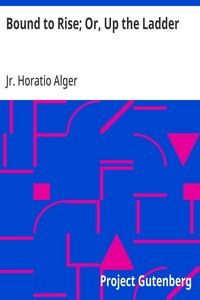
Bound to Rise; Or, Up the Ladder — Reading Notes
Edition facts
The source record for Bound to Rise; Or, Up the Ladder — Reading Notes measures this digital text at 50,235 words, 3 hr 39 min estimated reading time, and 8 detected text sections.
The text analysis averages about 11.1 words per sentence, while the detected sections provide another way to judge how the source is divided.
Project Gutenberg metadata also associates the work with “Apprentices -- Fiction,” connecting these edition facts with the source record’s subject description.
Calculated from edition completeness, EPUB availability, text structure and catalogue metadata. Not a user rating.
How this score is calculated
- Description quality20 pts
- Title & short description10 pts
- Source metadata20 pts
- Text length15 pts
- Chapters / structure15 pts
- EPUB file integrity20 pts
Total of 100 points, scaled to a 2.5-5.0 range. Editions with an empty description or a missing EPUB file are not scored.
Read the Text
CHAPTER II. A CALAMITY
Efforts for the recovery of the cow went on. Elihu Perkins exhausted all his science in her behalf. I do not propose to detail his treatment, because I am not sure whether it was the best, and possibly some of my readers might adopt it under similar circumstances, and then blame me for its unfortunate issue. It is enough to say that the cow grew rapidly worse in spite of the hot-water treatment, and about eleven o'clock breathed her last. The sad intelligence was announced by Elihu, who first perceived it.
"The critter's gone," he said. "'Tain't no use doin' anything more."
"The cow's dead!" repeated Mr. Walton, sorrowfully. He had known for an hour that this would be the probable termination of the disease. Still while there was life there was hope. Now both went out together.
"Yes, the critter's dead!" said Elihu, philosophically, for he lost nothing by her. "It was so to be, and there wa'n't no help for it. That's what I thought from the fust, but I was willin' to try."
"Wasn't there anything that could have saved her?"
Elihu shook his head decidedly.
"If she could a-been saved, I could 'ave done it," he said. "What I don't know about cow diseases ain't wuth knowin'."
Everyone is more or less conceited. Elihu's conceit was as to his scientific knowledge on the subject of cows and horses and their diseases. He spoke so confidently that Mr. Walton did not venture to dispute him.
"I s'pose you're right, Elihu," he said; "but it's hard on me."
"Yes, neighbor, it's hard on you, that's a fact. What was she wuth?"
"I wouldn't have taken forty dollars for her yesterday."
"Forty dollars is a good sum."
"It is to me. I haven't got five dollars in the world outside of my farm."
"I wish I could help you, neighbor Walton, but I'm a poor man myself."
"I know you are, Elihu. Somehow it doesn't seem fair that my only cow should be taken, when Squire Green has got ten, and they're all alive and well. If all his cows should die, he could buy as many more and not feel the loss."
"Squire Green's a close man."
"He's mean enough, if he is rich."
"Sometimes the richest are the meanest."
"In his case it is true."
"He could give you a cow just as well as not. If I was as rich as he, I'd do it."
"I believe you would, Elihu; but there's some difference between you and him."
"Maybe the squire would lend you money to buy a cow. He always keeps money to lend on high interest."
Mr. Walton reflected a moment, then said slowly, "I must have a cow, and I don't know of any other way, but I hate to go to him."
"He's the only man that's likely to have money to lend in town."
"Good luck to you, neighbor Walton."
"I need it enough," said Hiram Walton, soberly. "If it comes, it'll be the first time for a good many years."
"Well, I'll be goin', as I can't do no more good."
Hiram Walton went into the house, and a look at his face told his wife the news he brought before his lips uttered it.
"Is she dead, Hiram?"
"Yes, the cow's dead. Forty dollars clean gone," he said, rather bitterly.
"Don't be discouraged, Hiram. It's bad luck, but worse things might happen."
"Why, the house might burn down, or--or some of us might fall sick and die. It's better that it should be the cow."
"You're right there; but though it's pleasant to have so many children round, we shan't like to see them starving."
"They are not starving yet, and please God they won't yet awhile. Some help will come to us."
Mrs. Walton sometimes felt despondent herself, but when she saw her husband affected, like a good wife she assumed cheerfulness, in order to raise his spirits. So now, things looked a little more hopeful to him, after he had talked to his wife. He soon took his hat, and approached the door.
"Where are you going, Hiram?" she asked.
"Going to see if Squire Green will lend me money; enough to buy another cow."
"That's right, Hiram. Don't sit down discouraged, but see what you can do to repair the loss."
"I wish there was anybody else to go to. Squire Green is a very mean man, and he will try to take advantage of any need."
"It is better to have a poor resource than none at all."
"Well, I'll go and see what can be done."
Squire Green was the rich man of the town. He had inherited from his father, just as he came of age, a farm of a hundred and fifty acres, and a few hundred dollars.
The land was not good, and far from productive; but he had scrimped and saved and pinched and denied himself, spending almost nothing, till the little money which the farm annually yielded him had accumulated to a considerable sum. Then, too, as there were no banks near at hand to accommodate borrowers, the squire used to lend money to his poorer neighbors. He took care not to exact more than six per cent. openly, but it was generally understood that the borrower must pay a bonus besides to secure a loan, which, added to the legal interest, gave him a very handsome consideration for the use of his spare funds. So his money rapidly increased, doubling every five or six years through his shrewd mode of management, and every year he grew more economical. His wife had died ten years before. She had worked hard for very poor pay, for the squire's table was proverbially meager, and her bills for dress, judging from her appearance, must have been uncommonly small.
The squire had one son, now in the neighborhood of thirty, but he had not been at home for several years. As soon as he attained his majority he left the homestead, and set out to seek his fortune elsewhere. He vowed he wouldn't any longer submit to the penurious ways of the squire. So the old man was left alone, but he did not feel the solitude. He had his gold, and that was company enough. A time was coming when the two must part company, for when death should come he must leave the gold behind; but he did not like to think of that, putting away the idea as men will unpleasant subjects. This was the man to whom Hiram Walton applied for help in his misfortune.
"Is the squire at home?" he asked, at the back door. In that household the front door was never used. There was a parlor, but it had not been opened since Mrs. Green's funeral.
"He's out to the barn," said Hannah Green, a niece of the old man, who acted as maid of all work.
The barn was a few rods northeast of the house, and thither Mr. Walton directed his steps.
Entering, he found the old man engaged in some light work.
"Good morning, Squire Green."
"Good morning, Mr. Walton," returned the squire.
He was a small man, with a thin figure, and a face deep seamed with wrinkles, more so than might have been expected in a man of his age, for he was only just turned of sixty; but hard work, poor and scanty food and sharp calculation, were responsible for them.
"How are you gettin' on?" asked the squire.
This was rather a favorite question of his, it being so much the custom for his neighbors to apply to him when in difficulties, so that their misfortune he had come to regard as his harvests..
"I've met with a loss," answered Hiram Walton.
"You don't say so," returned the squire, with instant attention. "What's happened?"
"What was the matter?"
"I don't know. I didn't notice but that she was welt enough last night; but this morning when I went out to the barn, she was lying down breathing heavily."
"I called in Elihu Perkins, and we worked over her for three hours; but it wasn't of any use; she died half an hour ago."
"I hope it isn't any disease that's catchin'," said the squire in alarm, thinking of his ten. "It would be a bad job if it should get among mine."
"It's a bad job for me, squire. I hadn't but one cow, and she's gone."
"Just so, just so. I s'pose you'll buy another."
"Yes, I must have a cow. My children live on bread and milk mostly. Then there's the butter and cheese, that I trade off at the store for groceries."
"Just so, just so. Come into the house, neighbor Walton."
The squire guessed his visitor's business in advance, and wanted to take time to talk it over. He would first find out how great his neighbor's necessity was, and then he accommodated him, would charge him accordingly.
CHAPTER III. HIRAM'S MOTTO
There was a little room just off the kitchen, where the squire had an old-fashioned desk. Here it was that he transacted his business, and in the desk he kept his papers. It was into this room that he introduced Mr. Walton.
"Set down, set down, neighbor Walton," he said. "We'll talk this thing over. So you've got to have a cow?"
"Yes, I must have one."
The squire fixed his eyes cunningly on his intended victim, and said, "Goin' to buy one in town?"
"I don't know of any that's for sale."
"How much do you calc'late to pay?"
"I suppose I'll have to pay thirty dollars."
Squire Green shook his head.
"More'n that, neighbor Walton. You can't get a decent cow for thirty dollars. I hain't got one that isn't wuth more, though I've got ten in my barn."
"Thirty dollars is all I can afford to pay, squire."
"Take my advice, and get a good cow while you're about it. It don't pay to get a poor one."
"I'm a poor man, squire. I must take what I can get."
"I ain't sure but I've got a cow that will suit you, a red with white spots. She's a fust-rate milker."
"She's turned of five."
"How much do you ask for her?"
"Are you going to pay cash down?" asked the squire, half shutting his eyes, and looking into the face of his visitor.
"I can't do that. I'm very short of money."
"So am I," chimed in the squire. He had two hundred dollars in his desk at that moment waiting for profitable investment; but then he didn't call it exactly a lie to misrepresent for a purpose. "So am I. Money's tight, neighbor."
"Money's always tight with me, squire," returned Hiram Walton, with a sigh.
"Was you a-meanin' to pay anything down?" inquired the squire.
"I don't see how I can."
"That alters the case, you know. I might as well keep the cow, as to sell her without the money down."
"I am willing to pay interest on the money."
"Of course that's fair. Wall, neighbor, what do you say to goin' out to see the cow?"
"Is she in the barn?"
"No, she's in the pastur'. 'Tain't fur."
"I'll go along with you."
They made their way by a short cut across a cornfield to the pasture--a large ten-acre lot, covered with a scanty vegetation. The squire's cows could not be said to live in clover.
"That's the critter," he said, pointing out one of the cows which was grazing near by. "Ain't she a beauty?"
"She looks pretty well," said Mr. Walton, dubiously, by no means sure that she would equal his lost cow.
"She's one of the best I've got. I wouldn't sell ef it wasn't to oblige. I ain't at all partic'lar, but I suppose you've got to hev a cow."
"What do you ask for her, squire?"
"She's wuth all of forty dollars," answered the squire, who knew perfectly well that a fair price would be about thirty. But then his neighbor must have a cow, and had no money to pay, and so was at his mercy.
"That seems high," said Hiram.
"She's wuth every cent of it; but I ain't nowise partic'lar about sellin' her."
"Couldn't you say thirty-seven?"
"I couldn't take a dollar less. I'd rather keep her. Maybe I'd take thirty-eight, cash down."
Hiram Walton shook his head.
"I have no cash," he said. "I must buy on credit."
"Wall, then, there's a bargain for you. I'll let you have her for forty dollars, giving you six months to pay it, at reg'lar interest, six per cent. Of course I expect a little bonus for the accommodation."
"I hope you'll be easy with me--I'm a poor man, squire."
"Of course, neighbor; I'm always easy."
"That isn't your reputation," thought Hiram; but he knew that this was a thought to which he must not give expression.
"All I want is a fair price for my time and trouble. We'll say three dollars extra for the accommodation--three dollars down."
Hiram Walton felt that it was a hard bargain the squire was driving with him, but there seemed no help for it.
He must submit to the imposition, or do without a cow. There was no one else to whom he could look for help on any terms. As to the three dollars, his whole available cash amounted to but four dollars, and it was for three quarters of this sum that the squire called. But the sacrifice must be made.
"Well, Squire Green, if that is your lowest price, I suppose I must come to it," he answered, at last.
"You can't do no better," said the squire, with alacrity.
"If so be as you've made up your mind, we'll make out the papers."
"Come back to the house. When do you want to take the cow?"
"I'll drive her along now, if you are willing."
"Why, you see," said the squire, hesitating, while a mean thought entered his, mind, "she's been feedin' in my pastur' all the mornin', and I calc'late I'm entitled to the next milkin', you'd better come 'round to-night, just after milkin', and then you can take her."
"I didn't think he was quite so mean," passed through Hiram Walton's mind, and his lip curved slightly in scorn, but he knew that this feeling must be concealed.
"Just as you say," he answered. "I'll come round tonight, or send Harry."
"How old is Harry now?"
"He's got to be quite a sizable lad--ought to earn concid'able. Is he industrious?"
"Yes, Harry is a good worker--always ready to lend a hand."
"That's good. Does he go to school?"
"Yes, he's been going to school all the term."
"Seems to me he's old enough to give up larnin' altogether. Don't he know how to read and write and cipher?"
"Yes, he's about the best scholar in school."
"Then, neighbor Walton, take my advice and don't send him any more. You need him at home, and he knows enough to get along in the world."
"I want him to learn as much as he can. I'd like to send him to school till he is sixteen."
"He's had as much schoolin' now as ever I had," said the squire, "and I've got along pooty well. I've been seleckman, and school committy, and filled about every town office, and I never wanted no more schoolin'. My father took me away from school when I was thirteen."
"It wouldn't hurt you if you knew a little more," thought Hiram, who remembered very well the squire's deficiencies when serving on the town school committee.
"I believe in learning," he said. "My father used to say, 'Live and learn.' That's a good motto, to my thinking."
"It may be carried too far. When a boy's got to be of the age of your boy, he'd ought to be thinking of workin.' His time is too valuable to spend in the schoolroom."
"I can't agree with you, squire. I think no time is better spent than the time that's spent in learning. I wish I could afford to send my boy to college."
"It would cost a mint of money; and wouldn't pay. Better put him to some good business."
That was the way he treated his own son, and for this and other reasons, as soon as he arrived at man's estate, he left home, which had never had any pleasant associations with him. His father wanted to convert him into a money-making machine--a mere drudge, working him hard, and denying him, as long as he could, even the common recreations of boyhood--for the squire had an idea that the time devoted in play was foolishly spent, inasmuch as it brought him in no pecuniary return. He was willfully blind to the faults and defects of his system, and their utter failure in the case of his own son, and would, if could, have all the boys in town brought up after severely practical method. But, fortunately for Harry, Mr. Walton had very different notions. He was compelled to keep his son home the greater part of the summer, but it was against his desire.
"No wonder he's a poor man," thought the squire, after his visitor returned home. "He ain't got no practical idees. Live and learn! that's all nonsense. His boy looks strong and able to work, and it's foolish sendin' him school any longer. That wa'n't my way, and see where I am," he concluded, with complacent remembrance of bonds and mortgages and money out at interest. "That was a pooty good cow trade," he concluded. "I didn't calc' late for to get more'n thirty-five dollars for the critter; but then neighbor Walton had to have a cow, and had to pay my price."
Now for Hiram Walton's reflections.
"I'm a poor man," he said to himself, as he walked slowly homeward, "but I wouldn't be as mean as Tom Green for all the money he's worth. He's made a hard bargain with me, but there was no help for it."
CHAPTER IV. A SUM IN ARITHMETIC
Harry kept on his way to school, and arrived just the bell rang. Many of my readers have seen a country schoolhouse, and will not be surprised to learn that the one in which our hero obtained his education was far from stately or ornamental, architecturally speaking. It was a one-story structure, about thirty feet square, showing traces of having been painted once, but standing greatly in need of another coat. Within were sixty desks, ranged in pairs, with aisles running between them. On one side sat the girls, on the other the boys. These were of all ages from five to sixteen. The boys' desks had suffered bad usage, having been whittled and hacked, and marked with the initials of the temporary occupants, with scarcely an exception. I never knew a Yankee boy who was not the possessor of a knife of some kind, nor one who could resist the temptation of using it for such unlawful purposes. Even our hero shared the common weakness, and his desk was distinguished from the rest by "H. W." rudely carved in a conspicuous place.
The teacher of the school for the present session was Nathan Burbank, a country teacher of good repute, who usually taught six months in a year, and devoted the balance of the year to surveying land, whenever he could get employment in that line, and the cultivation of half a dozen acres of land, which kept him in vegetables, and enabled him to keep a cow. Altogether he succeeded in making a fair living, though his entire income would seem very small to many of my readers. He was not deeply learned, but his education was sufficient to meet the limited requirements of a country school.
This was the summer term, and it is the usual custom in New England that the summer schools should be taught by females. But in this particular school the experiment had been tried, and didn't work. It was found that the scholars were too unruly to be kept in subjection by a woman, and the school committee had therefore engaged Mr. Burbank, though, by so doing, the school term was shortened, as he asked fifty per cent. higher wages than a female teacher would have done. However, it was better to have a short school than an unruly school, and so the district acquiesced.
Eight weeks had not yet passed since the term commenced, and yet this was the last day but one. To-morrow would be examination day. To this Mr. Burbank made reference in a few remarks which he made at the commencement of the exercises.
Harry Walton, the young protagonist of Bound to Rise, is introduced not through dramatic incident but through a family crisis: a cow has been purchased on credit from Squire Green, and the note must be paid. The opening chapters establish a pattern that recurs throughout the excerpts—Harry's decisions are framed as arithmetic problems. When he considers a sleighing excursion that costs three dollars, he calculates that it represents a week's wages and declines, earning the sneer "miser" from a friend. Alger presents this not as deprivation but as purposeful self-denial, a theme reinforced by Harry's father's letter, which regrets his own limited education and hopes his son will escape "narrow poverty."
The Motto as Method
Harry's personal motto, "Live and learn," appears in the excerpts as both a guiding principle and a writing assignment. When his editor-mentor suggests he write a composition on the subject, Harry eagerly revises his draft after receiving corrections. The scene is typical of Alger's method: a concrete task (writing an essay) becomes the vehicle for moral and practical instruction. The father's letter that follows explicitly links education to economic advancement, stating that learning "in a pecuniary way" will open a more prosperous career. This direct equation of self-improvement with financial reward is a hallmark of the Alger formula, and the excerpts show it operating at the level of daily choices—Harry denies himself pleasure not out of asceticism but because he has "undertaken to meet the note."
The Arithmetic of Thrift
Alger embeds economic reasoning into the narrative through repeated calculations. Harry's savings of thirty-three dollars by December are the result of "the strictest economy," and the reader is told the exact amount needed for the note. When Luke Harrison pressures Harry to join the sleighing party, the cost is stated precisely: three dollars, or a week's wages. The pocketbook that falls from Harry's pocket—containing all his savings—becomes a plot device that threatens his goal. These details are not incidental; they form the book's structural logic. Every decision is weighed against a ledger, and the excerpts make clear that Harry's virtue is not innate but practiced, a series of small refusals that accumulate into the promised reward of competence.
Mentorship and the Printing Office
The excerpts introduce a mentor figure—the editor who advises Harry on composition—but the relationship is transactional rather than sentimental. The editor offers to correct Harry's writing, and Harry responds by rewriting the essay entirely. This scene mirrors the broader apprenticeship plot: Harry leaves home to learn a trade, and the printing office becomes the setting where his motto is tested. The editor's advice—"Don't be too ambitious but select something upon which you have some ideas of your own"—is practical rather than inspirational. Alger's world is one where advancement comes through specific, teachable skills, and the excerpts show Harry acquiring them one by one, from composition to saving money to resisting peer pressure.
The Threat of Exposure
A moment of vulnerability occurs when Harry's pocketbook falls unnoticed, and Luke Harrison suspects its contents. The excerpt cuts off before the consequences unfold, but the setup is clear: Harry's secret savings are now at risk. This incident introduces the possibility that his careful plan may be undone by a single accident or by another's dishonesty. The excerpts do not reveal whether Luke returns the pocketbook or steals it, but the tension is characteristic of Alger's plotting, where external threats (swindlers, temptations, accidents) test the hero's resolve. The reader is left to wonder whether Harry's thrift will be rewarded or whether he must learn a harder lesson about trust and vigilance.
The excerpts from Bound to Rise reveal a story built on small, concrete decisions rather than grand adventures. Readers attentive to the recurring arithmetic—the cost of a sleigh ride, the amount saved, the date the note is due—will find that Alger's moral is embedded in the numbers. The pocketbook incident, left unresolved in the excerpts, suggests that the ladder of success is not climbed without risk. First-time readers may wish to track how Harry's motto "Live and learn" applies not only to his education but to the setbacks that inevitably follow.
That rain fell all afternoon while Harry counted his pennies in Bound to Rise, and I kept thinking how thrift often feels like loneliness. Later, shelving books, my fingers caught a spine—The Works of Robert Louis Stevenson - Swanston Edition, Vol. 07 — Story, Setting & Ideas. Strange, how treasure-hunting boys and restless island wanderers both measure a life by what they choose to carry forward.
Isaac Brown
2 weeks agoOwen King
1 month agoMadison Smith
1 week agoLeo Wilson
4 weeks ago-
Andrew Jordan - 1 month ago
An inspiring rags-to-riches story that kept me hooked from start to finish. The protagonist's journey is relatable and motivating, with vivid descriptions and a fast-paced plot. I loved how the author weaved in lessons about hard work and perseverance without being preachy. Highly recommended for anyone needing a boost of optimism. -
Anna Dean - 1 month ago
The book delivers a solid moral message about rising through hard work, and the protagonist's determination is commendable. However, the pacing feels uneven at times, with some sections dragging. Still, it's an enjoyable read for fans of classic motivational fiction. -
Alyssa Figueroa - 4 weeks ago
The story is predictable and relies on outdated tropes about success. The characters are one-dimensional, and the writing feels stilted. While some might find it charming, I found it preachy and slow. A better editor could have trimmed the excess and added more nuance.
How will you remember this book?
Save your reaction, strongest insight, and memorable passage.
Michael Hall
1 month ago