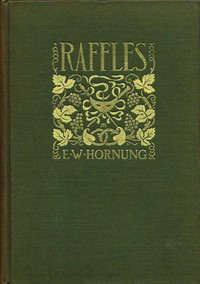
Raffles: Further Adventures of the Amateur Cracksman — Text and Context
Edition facts
The source record for Raffles: Further Adventures of the Amateur Cracksman — Text and Context measures this digital text at 59,565 words, 4 hr 19 min estimated reading time, and 9 detected text sections.
The text analysis averages about 17.6 words per sentence, while the detected sections provide another way to judge how the source is divided.
Project Gutenberg metadata also associates the work with “Raffles (Fictitious character) -- Fiction,” connecting these edition facts with the source record’s subject description.
Read the complete public-domain text at its original source.
Read on Project GutenbergIn Raffles: Further Adventures of the Amateur Cracksman, E. W. Hornung builds his narratives through a narrator who is both participant and chronicler. The opening of “No Sinecure” immediately establishes Bunny’s voice—self-deprecating, observant, and caught between resentment and loyalty. His description of the telegram from his “distinguished relative” is laden with precise, sardonic detail: “meanly elliptical, ludicrously precise, saving half-pence at the expense of sense.” This is not mere scene-setting; it is a deliberate authorial choice to ground the reader in Bunny’s perspective, where every object and utterance carries weight.
Bunny’s Voice as a Filter
Hornung gives Bunny a distinctive narrative register: colloquial yet literate, peppered with self-mockery and sharp observation. In “No Sinecure,” Bunny recounts his poverty with a mix of bitterness and wry humor: “I had to cash it to obtain a Daily Mail.” The phrasing is economical, the irony understated. His descriptions of Raffles’s actions are filtered through his own anxiety and admiration, as when he notes Raffles’s “childish pique and puerile bravado” while whirling Indian clubs. This is not objective reportage; it is a character’s judgment, and Hornung uses it to create tension between what Bunny sees and what the reader infers.
Raffles’s Calculated Speech
Raffles’s dialogue is marked by a clipped, commanding tone that reveals his control and intelligence. In the same story, he issues orders without explanation: “Put it out again!” he says fiercely when Bunny switches on a light. His speech is often elliptical, leaving Bunny—and the reader—to catch up. When he says, “My good Bunny, what do you suppose I’ve been doing all this while?” the rhetorical question dismisses Bunny’s concern while asserting Raffles’s superior planning. Hornung uses such exchanges to show Raffles’s mind at work, his words carefully chosen to manage both the situation and his accomplice.
Precise Details of Setting and Action
Hornung’s descriptions are functional and specific, grounding the stories in tangible spaces. In “No Sinecure,” the flat in King John’s Mansions is rendered through details that serve the plot: the extra bolt on the bedroom door, the iron ladder to the window “in case of fire,” the Chippendale furniture with locks “you could pick with a penknife.” These are not decorative flourishes; they are clues to Raffles’s method and the risks he takes. Similarly, Bunny’s attic in Holloway is evoked through a single detail—“unwashen but at work before the day grew hot”—that conveys his circumstances without sentimentality.
The Rhythm of Tension and Release
Hornung structures his scenes around alternating currents of suspense and banter. In “No Sinecure,” the search of Lord Ernest’s flat builds through a series of false leads—the empty bathroom, the unproductive wardrobe—punctuated by Raffles’s growing irritation and Bunny’s defensive retorts. The dialogue crackles with mutual provocation: “I certainly shan’t leave you,” Bunny retorts, “to be knocked into the middle of next week by a better man than yourself.” This back-and-forth not only reveals character but also controls pacing, delaying the climax while heightening the reader’s anticipation.
Hornung’s authorial choices in these stories reward attention to the interplay between what is said and what is left unsaid. Bunny’s narration is never fully reliable, and Raffles’s motives remain partly opaque. Readers attuned to the nuances of dialogue and descriptive detail will find a layered portrait of a partnership built on mutual need and unspoken tensions.
Reading about Bunny’s deference to Raffles, I remembered the quiet thrill of my grandfather’s study, where I first met a different kind of gentleman-criminal in The political novel — Text and Context. Both books share that same hush of watching someone operate just outside the rules, the intimacy of knowing their secrets without ever being asked to join.
There are no reviews for this eBook.
What did you think of this book?
Answer a few questions and save a private reflection on this device.