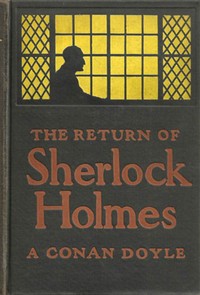
The Return of Sherlock Holmes — Inside the Classic
Edition facts
The source record for The Return of Sherlock Holmes — Inside the Classic measures this digital text at 117,196 words, 8 hr 30 min estimated reading time, and 15 detected text sections.
The text analysis averages about 14.8 words per sentence, while the detected sections provide another way to judge how the source is divided.
Project Gutenberg metadata also associates the work with “Holmes, Sherlock (Fictitious character) -- Fiction,” connecting these edition facts with the source record’s subject description.
Read the complete public-domain text at its original source.
Read on Project GutenbergThe opening of The Return of Sherlock Holmes immediately establishes a structural pattern that recurs throughout the collection: a sudden, violent crime disrupts the ordinary life of London, and Watson’s narrative voice bridges the gap between public knowledge and private revelation. In “The Adventure of the Empty House,” the murder of Ronald Adair is presented as a puzzle that only Holmes—believed dead—can solve. This pattern of disruption and restoration is mirrored in the physical movement between the safety of 221B Baker Street and the dangerous, often nocturnal, scenes of investigation.
The Architecture of Return
The collection’s title signals a structural preoccupation with recurrence. Holmes’s reappearance in “The Empty House” is not merely a plot point but a formal device: the narrative itself returns to the familiar rhythm of client arrival, deduction, and chase. Yet Doyle varies this pattern by embedding each story within a seasonal or temporal frame—spring in the first tale, winter in others—that subtly alters the mood. The recurring image of the empty house, whether literal (the vacant building where Holmes hides) or metaphorical (the gap left by his absence), becomes a spatial emblem of loss and recovery. Watson’s retrospective narration, written “at the end of nearly ten years,” adds a layer of temporal distance that frames the entire collection as a reconstruction of past events.
Disguise and the Double Life
Holmes’s use of disguise—as a plumber named Escott in “Charles Augustus Milverton”—illustrates a key structural tension: the detective must adopt a criminal persona to combat crime. This doubling is mirrored in the settings, which often juxtapose respectable facades with hidden corruption. The movement between Holmes’s Baker Street rooms and Milverton’s opulent house is a journey from moral clarity into moral ambiguity. Watson’s reaction—his “catching of the breath” and cold skin—marks a moment where the narrative pauses to register the ethical cost of Holmes’s methods. The scene’s lightning-flash simile (“as a flash of lightning in the night shows up every detail”) encapsulates how Doyle uses sudden, vivid imagery to punctuate transitions between domestic dialogue and action.
Surveillance and the Urban Landscape
Doyle repeatedly stages scenes of watching and being watched. In “The Empty House,” Holmes observes the criminal from a vacant building; in “The Norwood Builder,” the detective’s scrutiny of a crime scene reverses the expected gaze. This motif of surveillance extends to the city itself: London is presented as a network of streets, houses, and hidden passages that both conceal and reveal. The movement between interior and exterior spaces—from the cluttered comfort of Baker Street to the foggy, dangerous streets—creates a rhythm of containment and exposure. Watson’s role as observer-narrator reinforces this structure; he often records details that Holmes later interprets, making the reader complicit in the act of looking.
The Unreliable Return
Despite the title, the collection does not simply restore the status quo. Several stories, such as “The Adventure of the Dancing Men” and “The Priory School,” end with ambiguous or tragic outcomes that resist neat resolution. The structural pattern of return is thus complicated by a persistent undercurrent of loss. Holmes himself acknowledges the limits of his methods: in “Charles Augustus Milverton,” he admits that his actions are “technically criminal,” and the narrative leaves the reader to weigh moral justification against legal transgression. This tension between order and disorder, between the detective’s return and the world’s continued unpredictability, gives the collection a darker, more unsettled texture than earlier Holmes adventures.
Readers approaching The Return of Sherlock Holmes should attend to the ways Doyle uses setting and movement to dramatize the detective’s re-entry into a world that has changed in his absence. The stories reward attention to the interplay between public and private spaces, and to the moments when Holmes’s disguise or surveillance blurs the line between hunter and hunted. Rather than a simple restoration, this collection offers a more complex meditation on what it means to return.
Reading about Holmes’s quiet return made me think of the slow afternoons I spent as a child, revisiting a worn copy of Bound to Rise; Or, Up the Ladder — Reading Notes. There was the same patient feeling of coming home to a familiar voice, the calm certainty that order would be restored—not dramatically, but gently, like light through a curtain.
There are no reviews for this eBook.
Before you leave, reflect on the book
Use these questions to collect your thoughts before moving on.