1

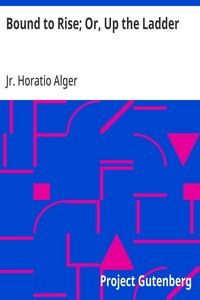
Bound to Rise; Or, Up the Ladder — Reading Notes
(0 User reviews)
1108
Project Gutenberg
2004
Not confirmed
Apprentices -- Fiction; Swindlers and swindling -- Fiction; New Hampshire -- History -- 19th century -- Fiction; Friendship -- Fiction; Conduct of life -- Fiction
Readers of public-domain and historical texts
Project Gutenberg digital edition
en
Edition facts
Words
50,235
Reading time
219 min
Text sections
8
The source record for Bound to Rise; Or, Up the Ladder — Reading Notes measures this digital text at 50,235 words, 3 hr 39 min estimated reading time, and 8 detected text sections.
The text analysis averages about 11.1 words per sentence, while the detected sections provide another way to judge how the source is divided.
Project Gutenberg metadata also associates the work with “Apprentices -- Fiction,” connecting these edition facts with the source record’s subject description.
Source:
Project Gutenberg record #5977
Horatio Alger's 1872 novel follows Harry Walton, a New Hampshire farm boy who leaves home to apprentice as a printer, saving money to pay off his father's debt. The excerpts show Alger's characteristic blend of moral instruction, practical arithmetic, and the tension between thrift and peer pressure.
Editorial Edition Score
4.7/5
★★★★★
★★★★★
Calculated from edition completeness, EPUB availability, text structure and catalogue metadata. Not a user rating.
How this score is calculated
- Description quality20 pts
- Title & short description10 pts
- Source metadata20 pts
- Text length15 pts
- Chapters / structure15 pts
- EPUB file integrity20 pts
Total of 100 points, scaled to a 2.5-5.0 range. Editions with an empty description or a missing EPUB file are not scored.
Edition quality
Read the complete public-domain text at its original source.
Read on Project GutenbergHarry Walton, the young protagonist of Bound to Rise, is introduced not through dramatic incident but through a family crisis: a cow has been purchased on credit from Squire Green, and the note must be paid. The opening chapters establish a pattern that recurs throughout the excerpts—Harry's decisions are framed as arithmetic problems. When he considers a sleighing excursion that costs three dollars, he calculates that it represents a week's wages and declines, earning the sneer "miser" from a friend. Alger presents this not as deprivation but as purposeful self-denial, a theme reinforced by Harry's father's letter, which regrets his own limited education and hopes his son will escape "narrow poverty."
The Motto as Method
Harry's personal motto, "Live and learn," appears in the excerpts as both a guiding principle and a writing assignment. When his editor-mentor suggests he write a composition on the subject, Harry eagerly revises his draft after receiving corrections. The scene is typical of Alger's method: a concrete task (writing an essay) becomes the vehicle for moral and practical instruction. The father's letter that follows explicitly links education to economic advancement, stating that learning "in a pecuniary way" will open a more prosperous career. This direct equation of self-improvement with financial reward is a hallmark of the Alger formula, and the excerpts show it operating at the level of daily choices—Harry denies himself pleasure not out of asceticism but because he has "undertaken to meet the note."
The Arithmetic of Thrift
Alger embeds economic reasoning into the narrative through repeated calculations. Harry's savings of thirty-three dollars by December are the result of "the strictest economy," and the reader is told the exact amount needed for the note. When Luke Harrison pressures Harry to join the sleighing party, the cost is stated precisely: three dollars, or a week's wages. The pocketbook that falls from Harry's pocket—containing all his savings—becomes a plot device that threatens his goal. These details are not incidental; they form the book's structural logic. Every decision is weighed against a ledger, and the excerpts make clear that Harry's virtue is not innate but practiced, a series of small refusals that accumulate into the promised reward of competence.
Mentorship and the Printing Office
The excerpts introduce a mentor figure—the editor who advises Harry on composition—but the relationship is transactional rather than sentimental. The editor offers to correct Harry's writing, and Harry responds by rewriting the essay entirely. This scene mirrors the broader apprenticeship plot: Harry leaves home to learn a trade, and the printing office becomes the setting where his motto is tested. The editor's advice—"Don't be too ambitious but select something upon which you have some ideas of your own"—is practical rather than inspirational. Alger's world is one where advancement comes through specific, teachable skills, and the excerpts show Harry acquiring them one by one, from composition to saving money to resisting peer pressure.
The Threat of Exposure
A moment of vulnerability occurs when Harry's pocketbook falls unnoticed, and Luke Harrison suspects its contents. The excerpt cuts off before the consequences unfold, but the setup is clear: Harry's secret savings are now at risk. This incident introduces the possibility that his careful plan may be undone by a single accident or by another's dishonesty. The excerpts do not reveal whether Luke returns the pocketbook or steals it, but the tension is characteristic of Alger's plotting, where external threats (swindlers, temptations, accidents) test the hero's resolve. The reader is left to wonder whether Harry's thrift will be rewarded or whether he must learn a harder lesson about trust and vigilance.
The excerpts from Bound to Rise reveal a story built on small, concrete decisions rather than grand adventures. Readers attentive to the recurring arithmetic—the cost of a sleigh ride, the amount saved, the date the note is due—will find that Alger's moral is embedded in the numbers. The pocketbook incident, left unresolved in the excerpts, suggests that the ladder of success is not climbed without risk. First-time readers may wish to track how Harry's motto "Live and learn" applies not only to his education but to the setbacks that inevitably follow.
That rain fell all afternoon while Harry counted his pennies in Bound to Rise, and I kept thinking how thrift often feels like loneliness. Later, shelving books, my fingers caught a spine—The Works of Robert Louis Stevenson - Swanston Edition, Vol. 07 — Story, Setting & Ideas. Strange, how treasure-hunting boys and restless island wanderers both measure a life by what they choose to carry forward.
There are no reviews for this eBook.
There are no comments for this eBook.
Reader reflection
How will you remember this book?
Save your reaction, strongest insight, and memorable passage.
Your progress
0
/
10
2
How did the book work for you overall?
3
How likely are you to recommend this book?
4
How much effort did this book require?
5
Would you read this book again?
6
Which part made the strongest impression?
7
Would this book work well in a reading group?
8
How did the pace of the book feel?
9
Which lesson or insight stayed with you?
10