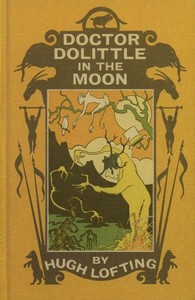
Doctor Dolittle in the Moon — Context and Discussion

(0 User reviews)   51
Lofting, Hugh, 1886-1947 Project Gutenberg 2024 Not confirmed
Fantasy fiction; Animals -- Juvenile fiction; Children's stories; Insects -- Juvenile fiction; Moon -- Juvenile fiction Readers of public-domain and historical texts
Project Gutenberg digital edition en

Edition facts

Words 42,586
Reading time 186 min
Text sections 6

This digital edition of Doctor Dolittle in the Moon — Context and Discussion is described by source-level measurements including 42,586 words, 3 hr 6 min estimated reading time, and 6 detected text sections.

The text analysis averages about 17.0 words per sentence, while the detected sections provide another way to judge how the source is divided.

Project Gutenberg metadata also associates the work with “Fantasy fiction,” connecting these edition facts with the source record’s subject description.

Hugh Lofting's 1928 lunar adventure follows Doctor Dolittle and his animal companions as they explore a talking-plant world, blending botanical linguistics, giant footprints, and the haunting legend of Otho Bludge, a prehistoric artist. The narrative shifts between scientific curiosity and mythic storytelling.
Share
Editorial Edition Score 4.7/5

Calculated from edition completeness, EPUB availability, text structure and catalogue metadata. Not a user rating.

How this score is calculated
  • Description quality20 pts
  • Title & short description10 pts
  • Source metadata20 pts
  • Text length15 pts
  • Chapters / structure15 pts
  • EPUB file integrity20 pts

Total of 100 points, scaled to a 2.5-5.0 range. Editions with an empty description or a missing EPUB file are not scored.

Edition quality

Read the Text

time get used to this new air and soon do without the bells altogether.

The gravity too was very confusing. It required hardly any effort to rise from a sitting position to a standing one. Walking was no effort at all—for the muscles—but for the lungs it was another question. The most extraordinary sensation was jumping. The least little spring from the ankles sent you flying into the air in the most fantastic fashion. If it had not been for this problem of breathing properly (which the Doctor seemed to feel we should approach with great caution on account of its possible effect on the heart) we would all have given ourselves up to this most light-hearted feeling which took possession of us. I remember, myself, singing songs—the melody was somewhat indistinct on account of a large mouthful of chocolate—and I was most anxious to get down off the moth’s back and go bounding away across the hills and valleys to explore this new world.

But I realize now that John Dolittle was very wise in making us wait. He issued orders (in the low whispers which we found necessary in this new clear air) to each and all of us that for the present the flowers were _not_ to be left behind for a single moment.

They were cumbersome things to carry but we obeyed orders. No ladder was needed now to descend by. The gentlest jump sent one flying off the insect’s back to the ground where you landed from a twenty-five-foot drop with ease and comfort.

Zip! The spring was made. And we were wading in the sands of a new world.

THE SECOND CHAPTER The Land of Colors and Perfumes

We were after all, when you come to think of it, a very odd party, this, which made the first landing on a new world. But in a great many ways it was a peculiarly good combination. First of all, Polynesia: she was the kind of bird which one always supposed would exist under any conditions, drought, floods, fire or frost. I’ve no doubt that at that time in my boyish way I exaggerated Polynesia’s adaptability and endurance. But even to this day I can never quite imagine any circumstances in which that remarkable bird would perish. If she could get a pinch of seed (of almost any kind) and a sip of water two or three times a week she would not only carry on quite cheerfully but would scarcely even remark upon the strange nature or scantiness of the rations.

Then Chee-Chee: he was not so easily provided for in the matter of food. But he always seemed to be able to provide for himself anything that was lacking. I have never known a better forager than Chee-Chee. When every one was hungry he could go off into an entirely new forest and just by smelling the wild fruits and nuts he could tell if they were safe to eat. How he did this even John Dolittle could never find out. Indeed Chee-Chee himself didn’t know.

Then myself: I had no scientific qualifications but I had learned how to be a good secretary on natural history expeditions and I knew a good deal about the Doctor’s ways.

Finally there was the Doctor. No naturalist has ever gone afield to grasp at the secrets of a new land with the qualities John Dolittle possessed. He never claimed to know anything, beforehand, for certain. He came to new problems with a child-like innocence which made it easy for himself to learn and the others to teach.

Yes, it was a strange party we made up. Most scientists would have laughed at us no doubt. Yet we had many things to recommend us that no expedition ever carried before.

As usual the Doctor wasted no time in preliminaries. Most other explorers would have begun by planting a flag and singing national anthems. Not so with John Dolittle. As soon as he was sure that we were all ready he gave the order to march. And without a word Chee-Chee and I (with Polynesia who perched herself on my shoulder) fell in behind him and started off.

I have never known a time when it was harder to shake loose the feeling of living in a dream as those first few hours we spent on the Moon. The knowledge that we were treading a new world never before visited by Man, added to this extraordinary feeling caused by the gravity, of lightness, of walking on air, made you want every minute to have some one tell you that you were actually awake and in your right senses. For this reason I kept constantly speaking to the Doctor or Chee-Chee or Polynesia—even when I had nothing particular to say. But the uncanny booming of my own voice every time I opened my lips and spoke above the faintest whisper merely added to the dream-like effect of the whole experience.

However, little by little, we grew accustomed to it. And certainly there was no lack of new sights and impressions to occupy our minds. Those strange and ever changing colors in the landscape were most bewildering, throwing out your course and sense of direction entirely. The Doctor had brought a small pocket compass with him. But on consulting it, we saw that it was even more confused than we were. The needle did nothing but whirl around in the craziest fashion and no amount of steadying would persuade it to stay still.

Giving that up, the Doctor determined to rely on his Moon maps and his own eyesight and bump of locality. He was heading towards where he had seen that tree—which was at the end of one of the ranges. But all the ranges in this section seemed very much alike. The maps did not help us in this respect in the least. To our rear we could see certain peaks which we thought we could identify on the charts. But ahead nothing fitted in at all. This made us feel surer than ever that we were moving toward the Moon’s other side which earthly eyes had never seen.

“It is likely enough, Stubbins,” said the Doctor as we strode along lightly forward over loose sand which would ordinarily have been very heavy going, “that it is _only_ on the other side that water exists. Which may partly be the reason why astronomers never believed there was any here at all.”

For my part I was so on the lookout for extraordinary sights that it did not occur to me, till the Doctor spoke of it, that the temperature was extremely mild and agreeable. One of the things that John Dolittle had feared was that we should find a heat that was unbearable or a cold that was worse than Arctic. But except for the difficulty of the strange new quality of the air, no human could have asked for a nicer climate. A gentle steady wind was blowing and the temperature seemed to remain almost constantly the same.

We looked about everywhere for tracks. As yet we knew very little of what animal life to expect. But the loose sand told nothing, not even to Chee-Chee, who was a pretty experienced hand at picking up tracks of the most unusual kind.

Of odors and scents there were plenty—most of them very delightful flower perfumes which the wind brought to us from the other side of the mountain ranges ahead. Occasionally a very disagreeable one would come, mixed up with the pleasant scents. But none of them, except that of the moon-bells the moth had brought with us, could we recognize.

On and on we went for miles, crossing ridge after ridge and still no glimpse did we get of the Doctor’s tree. Of course crossing the ranges was not nearly as hard traveling as it would have been on Earth. Jumping and bounding both upward and downward was extraordinarily easy. Still we had brought a good deal of baggage with us and all of us were pretty heavy-laden; and after two and a half hours of travel we began to feel a little discouraged. Polynesia then volunteered to fly ahead and reconnoiter but this the Doctor was loath to have her do. For some reason he wanted us all to stick together for the present.

However, after another half hour of going he consented to let her fly straight up so long as she remained in sight, to see if she could spy out the tree’s position from a greater height.

THE THIRD CHAPTER Thirst!

So we rested on our bundles a spell while Polynesia gave an imitation of a soaring vulture and straight above our heads climbed and climbed. At about a thousand feet she paused and circled. Then slowly came down again. The Doctor, watching her, grew impatient at her speed. I could not quite make out why he was so unwilling to have her away from his side but I asked no questions.

Yes, she had seen the tree, she told us, but it still seemed a long way off. The Doctor wanted to know why she had taken so long in coming down and she said she had been making sure of her bearings so that she would be able to act as guide. Indeed, with the usual accuracy of birds, she had a very clear idea of the direction we should take. And we set off again, feeling more at ease and confident.

The truth of it was of course that seen from a great height, as the tree had first appeared to us, the distance had seemed much less than it actually was. Two more things helped to mislead us. One, that the Moon air, as we now discovered, made everything look nearer than it actually was in spite of the soft dim light. And the other was that we had supposed the tree to be one of ordinary earthly size and had made an unconscious guess at its distance in keeping with a fair-sized oak or elm. Whereas when we did actually reach it we found it to be unimaginably huge.

I shall never forget that tree. It was our first experience of moon life, _in_ the Moon. Darkness was coming on when we finally halted beneath it. When I say _darkness_ I mean that strange kind of twilight which was the nearest thing to night which we ever saw in the Moon. The tree’s height, I should say, would be at least three hundred feet and the width of it across the trunk a good forty or fifty. Its appearance in general was most uncanny. The whole design of it was different from any tree I have ever seen. Yet there was no mistaking it for anything else. It seemed—how shall I describe it?—_alive_. Poor Chee-Chee was so scared of it his hair just stood up on the nape of his neck and it was a long time before the Doctor and I persuaded him to help us pitch camp beneath its boughs.

Indeed we were a very subdued party that prepared to spend its first night on the Moon. No one knew just what it was that oppressed us but we were all conscious of a definite feeling of disturbance. The wind still blew—in that gentle, steady way that the moon winds always blew. The light was clear enough to see outlines by, although most of the night the Earth was invisible and there was no reflection whatever.

I remember how the Doctor, while we were unpacking and laying out the rest of our chocolate ration for supper, kept glancing uneasily up at those strange limbs of the tree overhead.

Of course it was the wind that was moving them—no doubt of that at all. Yet the wind was so deadly regular and even. And the movement of the boughs wasn’t regular at all. That was the weird part of it. It almost seemed as though the tree were doing some moving on its own, like an animal chained by its feet in the ground. And still you could never be sure—because after all the wind _was_ blowing all the time.

And besides it moaned. Well, we knew trees moaned in the wind at home. But this one did it differently—it didn’t seem in keeping with that regular even wind which we felt upon our faces.

I could see that even the worldly-wise practical Polynesia was perplexed and upset. And it took a great deal to disturb her. Yet a bird’s senses towards trees and winds are much keener than a man’s. I kept hoping she would venture into the branches of the tree; but she didn’t. And as for Chee-Chee, also a natural denizen of the forest, no power on earth, I felt sure, would persuade him to investigate the mysteries of this strange specimen of a Vegetable Kingdom we were as yet only distantly acquainted with.

After supper was despatched, the Doctor kept me busy for some hours taking down notes. There was much to be recorded of this first day in a new world. The temperature; the direction and force of the wind; the time of our arrival—as near as it could be guessed; the air pressure (he had brought along a small barometer among his instruments) and many other things which, while they were dry stuff for the ordinary mortal, were highly important for the scientist.

Often and often I have wished that I had one of those memories that seem to be able to recall all impressions no matter how small and unimportant. For instance I have often wanted to remember exactly the first awakening on the Moon. We had all been weary enough with excitement and exercise, when we went to bed, to sleep soundly. All I can remember of my waking up is spending at least ten minutes working out where I was. And I doubt if I could have done it even then if I had not finally realized that John Dolittle was awake ahead of me and already pottering around among his instruments, taking readings.

The immediate business now on hand was food. There was literally nothing for breakfast. The Doctor began to regret his hasty departure from the moth. Indeed it was only now, many, many hours after we had left him in our unceremonious haste to find the tree and explore the new world, that we realized that we had not as yet seen any signs of animal life. Still it seemed a long way to go back and consult him; and it was by no means certain that he would still be there.

Just the same, we needed food and food we were going to find. Hastily we bundled together what things we had unpacked for the night’s camping. Which way to go? Clearly if we had here reached one tree, there must be some direction in which others lay, where we could find that water which the Doctor was so sure must exist. But we could scan the horizon with staring eyes or telescope as much as we wished and not another leaf of a tree could we see.

This time without waiting to be ordered Polynesia soared into the air to do a little scouting.

“Well,” she said on her return, “I don’t see any actual trees at all. The beastly landscape is more like the Sahara Desert than any scenery I’ve ever run into. But over there behind that higher range—the one with the curious hat-shaped peak in the middle—you see the one I mean?”

“Yes,” said the Doctor. “I see. Go on.”

“Well, behind that there is a dark horizon different from any other quarter. I won’t swear it is trees. But myself, I feel convinced that there is something else there besides sand. We had better get moving. It is no short walk.”

Indeed it _was_ no short walk. It came to be a forced march or race between us and starvation. On starting out we had not foreseen anything of the kind. Going off without breakfast was nothing after all. Each one of us had done that before many a time. But as hour after hour went by and still the landscape remained a desert of rolling sand-dunes, hills and dead dry volcanoes, our spirits fell lower and lower.

This was one of the times when I think I saw John Dolittle really at his best. I know, although I had not questioned him, that he had already been beset with anxiety over several matters on the first steps of our march. Later he spoke of them to me: not at the time. And as conditions grew worse, as hunger gnawed at our vitals and the most terrible thirst parched our tongues—as strength and vitality began to give way and mere walking became the most terrible hardship, the Doctor grew cheerier and cheerier. He didn’t crack dry jokes in an irritating way either. But by some strange means he managed to keep the whole party in good mood. If he told a funny story it was always at the right time and set us all laughing at our troubles. In talking to him afterwards about this I learned that he had, when a young man, been employed on more than one exploration trip to keep the expedition in good humor. It was, he said, the only way he could persuade the chief to take him, since at that time he had no scientific training to recommend him.

Anyway I sincerely doubt whether our party would have held out if it had not been for his sympathetic and cheering company. The agonies of thirst were something new to me. Every step I thought must be my last.

Finally at what seemed to be the end of our second day, I vaguely heard Polynesia saying something about “Forests ahead!” I imagine I must have been half delirious by then. I still staggered along, blindly following the others. I know we _did_ reach water because before I fell and dozed away into a sort of half faint I remember Chee-Chee trickling something marvelously cool between my lips out of a cup made from a folded leaf.

THE FOURTH CHAPTER Chee-Chee the Hero

When I awoke I felt very much ashamed of myself. What an explorer! The Doctor was moving around already—and, of course, Chee-Chee and Polynesia. John Dolittle came to my side immediately he saw I was awake.

As though he knew the thoughts that were in my mind he at once started to reprimand me for feeling ashamed of my performance. He pointed out that after all Chee-Chee and Polynesia were accustomed to traveling in hot dry climates and that so, for that matter, was he himself.

“Taken all in all, Stubbins,” said he, “your own performance has been extremely good. You made the trip, the whole way, and only collapsed when relief was in sight. No one could ask for more than that. I have known many experienced explorers who couldn’t have done nearly as well. It was a hard lap—a devilish hard lap. You were magnificent. Sit up and have some breakfast. Thank goodness, we’ve reached food at last!”

Weak and frowsty, I sat up. Arranged immediately around me was a collection of what I later learned were fruits. The reliable Chee-Chee, scared though he might be of a moving tree or a whispering wind, had served the whole party with that wonderful sense of his for scenting out wild foodstuffs. Not one of the strange courses on the bill of fare had I or the Doctor seen before. But if Chee-Chee said they were safe we knew we need not fear.

Some of the fruits were as big as a large trunk; some as small as a walnut. But, starving as we were, we just dived in and ate and ate and ate. Water there was too, gathered in the shells of enormous nuts and odd vessels made from twisted leaves. Never has a breakfast tasted so marvelous as did that one of fruits which I could not name.

From the moment Doctor Dolittle and his companions land on the Moon, the narrative voice shifts between precise observation and wonder. The opening chapter, “We Land Upon a New World,” establishes a tone of careful documentation—compass readings, fruit-testing by smell, and the peculiar ease of jumping—that grounds the fantastical setting in tangible detail. Lofting’s prose often lingers on sensory specifics: the “yellow yam” that becomes a dietary staple, the “Umbrella Tree” with its distinctive shape, or the way “jumping was extraordinarily easy.” Yet this scientific curiosity is counterpointed by moments of mythic storytelling, as when Chee-Chee recounts the tale of Otho Bludge, a prehistoric artist who vanished after carving a portrait of a fairy woman. The book’s pace alternates between methodical exploration and sudden, eerie discoveries—giant footprints, singing trees, and the mysterious “Council” of lunar beings.

A Narrator Who Observes and Interprets

The story is told by Tommy Stubbins, the Doctor’s young assistant, whose first-person account blends boyish enthusiasm with a naturalist’s eye for detail. His descriptions of the lunar landscape are concrete: “some of the fruits were as big as a trunk,” “the flowers would be about eighteen inches across.” He notes the Doctor’s habits—leaning back to munch yam while listening to Chee-Chee’s stories, or “frowning” when puzzled by a clue. Stubbins rarely editorializes; instead, he lets the strangeness of the Moon emerge through accumulated observations. When the Doctor “passed his hand all around” a mysterious object, the gesture is reported without explanation, leaving the reader to share the character’s curiosity. This restrained voice gives the narrative a documentary feel, even as it describes impossible things.

The Doctor’s Botanical Linguistics

A central thread is the Doctor’s effort to communicate with lunar plants. The chapter “The Study of Plant Languages” signals his methodical approach: he sets up apparatus, makes daily expeditions, and returns before nightfall. The Vanity Lilies and Whispering Vines are not merely decorative; they provide information about other species and the Moon’s history. Lofting gives the plants distinct behaviors—the Vanity Lilies are described as “elaborate and lively,” and the Doctor uses mirrors to interact with them. This botanical linguistics is treated with the same seriousness as animal languages in earlier Dolittle books, but here the pace slows to accommodate careful experimentation. The narrator notes that “for nearly a week we had been making daily expeditions,” emphasizing the gradual, patient rhythm of scientific fieldwork.

Mythic Interludes and Shifting Pace

Chee-Chee’s tale of Otho Bludge, the prehistoric artist who carved a portrait of a fairy woman and then disappeared, introduces a different tempo. The story is told in a single, unbroken paragraph, with the monkey’s grandmother’s voice echoing through phrases like “In the Days Before There Was a Moon.” The narrative lingers on details—the “string of blue stone beads,” the reindeer’s antler—and ends with an unresolved disappearance. The Doctor’s response—“Humph! Have you any idea when?”—returns the scene to the present, but the mythic weight lingers. These interludes contrast with the Doctor’s empirical methods, suggesting that the Moon holds mysteries that resist scientific explanation. The pace here is slower, more reflective, and the language shifts from observation to legend.

Footprints and Foreboding

Not all discoveries are benign. The chapter “Tracks of a Giant” introduces an enormous footprint, and the narrator’s language becomes tense: “There was more movement in the limbs of the trees.” The Doctor “kept glancing up uneasily,” and the party’s usual confidence wavers. Lofting builds suspense through small details—a shadow disappearing into gloom, a sudden silence. The pace quickens as the characters move from investigation to caution. Yet the threat remains ambiguous; the giant is never fully described, and the narrative leaves room for both danger and wonder. This balance between scientific curiosity and primal fear gives the lunar setting an unpredictable quality, where every new discovery might be either a breakthrough or a warning.

Readers familiar with the earlier Dolittle books will notice a shift in tone: the Moon is not merely a new habitat but a place where language itself becomes strange. Pay attention to how Lofting uses Stubbins’s limited perspective—he often reports what he sees without fully understanding it, leaving the Doctor’s deductions implied rather than explained. The book rewards close attention to its pacing, from the leisurely botanical studies to the sudden, mythic digressions. Approach it as a naturalist’s journal written on the edge of the unknown.

Moon plants whispering in Lofting's invented tongue reminded me of summer afternoons spent puzzling over my uncle's old copy of All Aboard; or, Life on the Lake A Sequel to "The Boat Club" — A Closer Reading, where every quiet ripple seemed a private language too. Both worlds feel vast yet intimate, like secret conversations I only half-understand and never want to finish.

There are no reviews for this eBook.

0
0 out of 5 (0 User reviews )

Add a Review

Your Rating *
  • ...
    April Walker - 3 weeks ago
    The book maintains the series' charm with imaginative scenarios and a heartwarming tone. However, the plot is somewhat thin compared to earlier adventures, and the pacing is leisurely. Still, it's a pleasant read for Dolittle fans.

  • ...
    Howard Martinez - 3 weeks ago
    The magic of the earlier books is missing; the moon setting feels stale and the humor is repetitive. The characters lack depth, and the story meanders without a clear arc. This feels like a tired addition to the series, mainly for completists.

  • ...
    Ian Sarah Meyers - 6 days ago
    A charming and imaginative addition to the Doctor Dolittle series. The lunar setting is beautifully rendered, and the new animal characters are delightful. Lofting's whimsy and gentle humor make this a joy for readers of all ages who love a good adventure.


Reader reflection

Your personal reading reflection

Build a private reading journal entry for this title.

Your progress 0 / 10
1

How far have you progressed with this book?

2

How much did you enjoy the reading experience?

3

Is this a title you would suggest to others?

4

How demanding did the text feel?

Related eBooks