Fighting the Whales — Inside the Classic

(1 User reviews)   274
Ballantyne, R. M. (Robert Michael), 1825-1894 Project Gutenberg 2007 Not confirmed
Conduct of life -- Juvenile fiction; Adventure and adventurers -- Juvenile fiction; Voyages and travels -- Juvenile fiction; Seafaring life -- Juvenile fiction; Natural history -- Juvenile fiction; Sailors -- Juvenile fiction; Whaling -- Juvenile fiction; Whalers (Persons) -- Juvenile fiction Readers of public-domain and historical texts
Project Gutenberg digital edition en

Edition facts

Words 26,495
Reading time 116 min
Text sections 3

Before opening Fighting the Whales — Inside the Classic, the edition data offers a quick orientation: 26,495 words, 1 hr 56 min estimated reading time, and 3 detected text sections.

The text analysis averages about 22.0 words per sentence, while the detected sections provide another way to judge how the source is divided.

Project Gutenberg metadata also associates the work with “Conduct of life -- Juvenile fiction,” connecting these edition facts with the source record’s subject description.

An old whaleman, Bob Ledbury, recounts his first voyage and battles with sperm whales, blending awe at the monster's power with practical details of the fishery, from cutting blubber to the grim fate of shipwrecked crews.
Share
Editorial Edition Score 4.5/5

Calculated from edition completeness, EPUB availability, text structure and catalogue metadata. Not a user rating.

How this score is calculated
  • Description quality20 pts
  • Title & short description10 pts
  • Source metadata20 pts
  • Text length15 pts
  • Chapters / structure15 pts
  • EPUB file integrity20 pts

Total of 100 points, scaled to a 2.5-5.0 range. Editions with an empty description or a missing EPUB file are not scored.

Edition quality

Read the Text

Neptune was coming aboard, and we were to be ready to receive him. A minute after I saw a tremendous monster come up over the side of the ship and jump on the deck. He was crowned with seaweed, and painted in a wonderful fashion; his clothes were dripping wet, as if he had just come from the bottom of the sea. After him came another monster with a petticoat made of sailcloth and a tippet of a bit of old tarpaulin. This was Neptune's wife, and these two carried on the most remarkable antics I ever saw. I laughed heartily, and soon discovered, from the tones of their voices, which of my shipmates Neptune and his wife were. But my mirth was quickly stopped when I was suddenly seized by several men, and my face was covered over with a horrible mixture of tar and grease!

Six of us youngsters were treated in this way; then the lather was scraped off with a piece of old hoop-iron, and, after being thus shaved, buckets of cold water were thrown over us.

At last, after a prosperous voyage, we arrived at our fishing-ground in the South Seas, and a feeling of excitement and expectation began to show itself among the men, insomuch that our very eyes seemed brighter than usual.

One night those of us who had just been relieved from watch on deck were sitting on the lockers down below telling ghost stories.

It was a dead calm, and one of those intensely dark, hot nights, that cause sailors to feel uneasy, they scarce know why. I began to feel so uncomfortable at last, listening to the horrible tales which Tom Lokins was relating to the men, that I slipt away from them with the intention of going on deck. I moved so quietly that no one observed me; besides, every eye was fixed earnestly on Tom, whose deep low voice was the only sound that broke the stillness of all around. As I was going very cautiously up the ladder leading to the deck, Tom had reached that part of his story where the ghost was just appearing in a dark churchyard, dressed in white, and coming slowly forward, one step at a time, towards the terrified man who saw it. The men held their breath, and one or two of their faces turned pale as Tom went on with his description, lowering his voice to a hoarse whisper. Just as I put my head up the hatchway the sheet of one of the sails, which was hanging loose in the still air, passed gently over my head and knocked my hat off. At any other time I would have thought nothing of this, but Tom's story had thrown me into such an excited and nervous condition that I gave a start, missed my footing, uttered a loud cry, and fell down the ladder right in among the men with a tremendous crash, knocking over two or three oil-cans and a tin bread-basket in my fall, and upsetting the lantern, so that the place was instantly pitch-dark.

I never heard such a howl of terror as these men gave vent to when this misfortune befell me. They rushed upon deck with their hearts in their mouths, tumbling, and peeling the skin off their shins and knuckles in their haste; and it was not until they heard the laughter of the watch on deck that they breathed freely, and, joining in the laugh, called themselves fools for being frightened by a ghost story. I noticed, however, that, for all their pretended indifference, there was not one man among them--not even Tom Lokins himself--who would go down below to relight the lantern for at least a quarter of an hour afterwards!

Feeling none the worse for my fall, I went forward and leaned over the bow of the ship, where I was much astonished by the appearance of the sea. It seemed as if the water was on fire. Every time the ship's bow rose and fell, the little belt of foam made in the water seemed like a belt of blue flame with bright sparkles in it, like stars or diamonds. I had seen this curious appearance before, but never so bright as it was on that night.

"What is it, Tom?" said I, as my friend came forward and leaned over the ship's bulwark beside me.

"It's blue fire, Bob," replied Tom, as he smoked his pipe calmly.

"Come, you know I can't swallow that," said I; "everybody knows that fire, either blue or red, can't burn in the water."

"Maybe not," returned Tom; "but it's blue fire for all that. Leastwise if it's not, I don't know wot else it is."

Tom had often seen this light before, no doubt, but he had never given himself the trouble to find out what it could be. Fortunately the captain came up just as I put the question, and he enlightened me on the subject.

"It is caused by small animals," said he, leaning over the side.

"Small animals!" said I, in astonishment.

"Aye; many parts of the sea are full of creatures so small and so thin and colourless, that you can hardly see them even in a clear glass tumbler. Many of them are larger than others, but the most of them are very small."

"But how do they shine like that, sir?" I asked.

"That I do not know, boy. God has given them the power to shine, just as he has given us the power to walk or speak; and they do shine brightly, as you see; but how they do it is more than I can tell. I think, myself, it must be anger that makes them shine, for they generally do it when they are stirred up or knocked about by oars, or ships' keels, or tumbling waves. But I am not sure that that's the reason either, because, you know, we often sail through them without seeing the light, though of course they must be there."

"P'r'aps, sir," said Tom Lokins; "p'r'aps, sir, they're sleepy sometimes, an' can't be bothered gettin' angry."

"Perhaps!" answered the captain, laughing. "But then again, at other times, I have seen them shining over the whole sea when it was quite calm, making it like an ocean of milk; and nothing was disturbing them at that time, d'ye see."

"I don' know _that_," objected Tom; "they might have bin a-fightin' among theirselves."

"Or playing, maybe," said I.

The captain laughed, and, looking up at the sky, said: "I don't like the look of the weather, Tom Lokins. You're a sharp fellow, and have been in these seas before; what say you?"

"We'll have a breeze," replied Tom, briefly.

"More than a breeze," muttered the captain, while a look of grave anxiety overspread his countenance; "I'll go below and take a squint at the glass."

"What does he mean by that, Tom?" said I, when the captain was gone; "I never saw a calmer or a finer night. Surely there is no chance of a storm just now."

"Aye, that shows that you're a young feller, and han't got much experience o' them seas," replied my companion. "Why, boy, sometimes the fiercest storm is brewin' behind the greatest calm. An' the worst o' the thing is that it comes so sudden at times, that the masts are torn out o' the ship before you can say Jack Robinson."

"What! and without any warning?" said I.

"Aye, _almost_ without warnin'; but not _altogether_ without it. You heer'd the captain say he'd go an' take a squint at the glass?"

"Yes; what is the glass?"

"It's not a glass o' grog, you may be sure; nor yet a lookin'-glass. It's the weather-glass, boy. Shore-goin' chaps call it a barometer."

"And what's the meaning of barometer?" I enquired earnestly.

Tom Lokins stared at me in stupid amazement. "Why, boy," said he, "you're too inquisitive. I once asked the doctor o' a ship that question, and says he to me, 'Tom,' says he, 'a barometer is a glass tube filled with quicksilver or mercury, which is a metal in a soft or fluid state, like water, you know, and it's meant for tellin' the state o' the weather.'

"'Yes, sir,' I answers, 'I know that well enough.'

"'Then why did you ask?' says he, gettin' into a passion.

"'I asked what was the meanin' o' the _word_ barometer, sir,' said I.

"The doctor he looked grave at that, and shook his head. 'Tom,' says he, 'if I was to go for to explain that word, and all about the instrument, in a scientific sort o' way, d'ye see, I'd have to sit here an' speak to you right on end for six hours or more.'

"'Oh, sir,' says I, 'don't do it, then. _Please_, don't do it.'

"'No more I will,' says he; 'but it'll serve your turn to know that a barometer is a glass for measurin' the weight o' the air, and, _somehow or other_, that lets ye know wot's a-coming. If the mercury in the glass rises high, all's right. If it falls uncommon low very sudden, look out for squalls; that's all. No matter how smooth the sea may be, or how sweetly all natur' may smile, don't you believe it; take in every inch o' canvas at once.'"

"That was a queer explanation, Tom."

"Aye, but it was a true one, as you shall see before long."

As I looked out upon the calm sea, which lay like a sheet of glass, without a ripple on its surface, I could scarcely believe what he had said. But before many minutes had passed I was convinced of my error.

While I was standing talking to my messmate, the captain rushed on deck, and shouted:

"All hands tumble up! Shorten sail! Take in every rag! Look alive, boys, look alive."

I was quite stunned for a moment by this, and by the sudden tumult that followed. The men, who seemed never to take thought about anything, and who had but one duty, namely, to _obey orders_, ran upon deck, and leaped up the rigging like cats; the sheets of nearly all the principal sails were clewed up, and, ere long, the canvas was made fast to the yards. A few of the smaller sails only were left exposed, and even these were close-reefed. Before long a loud roar was heard, and in another minute the storm burst upon us with terrific violence. The ship at first lay over so much that the masts were almost in the water, and it was as impossible for anyone to walk the deck as to walk along the side of a wall. At the same time, the sea was lashed into white foam, and the blinding spray flew over us in bitter fury.

"Take in the topsails!" roared the captain. But his voice was drowned in the shriek of the gale. The men were saved the risk of going out on the yards, however, for in a few moments more all the sails, except the storm-trysail, were burst and blown to ribbons.

We now tried to put the ship's head to the wind and "lay to", by which landsmen will understand that we tried to face the storm, and remain stationary. But the gale was so fierce that this was impossible. The last rag of sail was blown away, and then there was nothing left for us but to show our stern to the gale, and "scud under bare poles".

The great danger now was that we might be "pooped", which means that a huge wave might curl over our stern, fall with terrible fury on our deck, and sink us.

Many and many a good ship has gone down in this way; but we were mercifully spared. As our safety depended very much on good steering, the captain himself took the wheel, and managed the ship so well, that we weathered the gale without damage, further than the loss of a few sails and light spars. For two days the storm howled furiously, the sky and sea were like ink, with sheets of rain and foam driving through the air, and raging billows tossing our ship about like a cork.

During all this time my shipmates were quiet and grave, but active and full of energy, so that every order was at once obeyed without noise or confusion. Every man watched the slightest motion of the captain. We all felt that everything depended on him.

As for me, I gave up all hope of being saved. It seemed impossible to me that anything that man could build could withstand so terrible a storm. I do not pretend to say that I was not afraid. The near prospect of a violent death caused my heart to sink more than once; but my feelings did not unman me. I did my duty quietly, but quickly, like the rest; and when I had no work to do, I stood holding on to the weather stanchions, looking at the raging sea, and thinking of my mother, and of the words of kindness and counsel she had so often bestowed upon me in vain.

The storm ceased almost as quickly as it began, and although the sea did not all at once stop the heavings of its angry bosom, the wind fell entirely in the course of a few hours, the dark clouds broke up into great masses that were piled up high into the sky, and out of the midst of these the glorious sun shone in bright rays down on the ocean, like comfort from heaven, gladdening our hearts as we busily repaired the damage that we had suffered from the storm.

I shall never forget the surprise I got the first time I saw a whale.

It was in the forenoon of a most splendid day, about a week after we arrived at that part of the ocean where we might expect to find fish. A light nor'-east breeze was blowing, but it scarcely ruffled the sea, as we crept slowly through the water with every stitch of canvas set.

As we had been looking out for fish for some time past, everything was in readiness for them. The boats were hanging over the side ready to lower, tubs for coiling away the ropes, harpoons, lances, &c., all were ready to throw in, and start away at a moment's notice. The man in the "crow's-nest", as they call the cask fixed up at the masthead, was looking anxiously out for whales, and the crew were idling about the deck. Tom Lokins was seated on the windlass smoking his pipe, and I was sitting beside him on an empty cask, sharpening a blubber-knife.

"Tom," said I, "what like is a whale?"

"Why, it's like nothin' but itself," replied Tom, looking puzzled. "Why, wot a queer feller you are to ax questions."

"I'm sure you've seen plenty of them. You might be able to tell what a whale is like."

"Wot it's like! Well, it's like a tremendous big bolster with a head and a tail to it."

"They're of all sizes, lad. I've seen one that was exactly equal to three hundred fat bulls, and its rate of goin' would take it round the whole world in twenty-three days."

"I don't believe you," said I, laughing.

"Don't you?" cried Tom; "it's a fact notwithstandin', for the captain himself said so, and that's how I came to know it."

Just as Tom finished speaking, the man in the crow's-nest roared at the top of his voice, "There she blows!"

That was the signal that a whale was in sight, and as it was the first time we had heard it that season, every man in the ship was thrown into a state of tremendous excitement.

"There she blows!" roared the man again.

"Where away?" shouted the captain.

"About two miles right ahead."

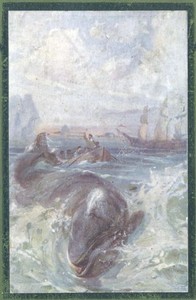
In another moment the utmost excitement prevailed on board. Suddenly, while I was looking over the side, straining my eyes to catch a sight of the whale, which could not yet be seen by the men on deck, I saw a brown object appear in the sea, not twenty yards from the side of the ship; before I had time to ask what it was, a whale's head rose to the surface, and shot up out of the water. The part of the fish that was visible above water could not have been less then thirty feet in length. It just looked as if our longboat had jumped out of the sea, and he was so near that I could see his great mouth quite plainly. I could have tossed a biscuit on his back easily. Sending two thick spouts of frothy water out of his blow-holes forty feet into the air with tremendous noise, he fell flat upon the sea with a clap like thunder, tossed his flukes or tail high into the air, and disappeared.

I was so amazed at this sight that I could not speak. I could only stare at the place where the huge monster had gone down.

"Stand by to lower," shouted the captain.

"Aye, aye, sir," replied the men, leaping to their appointed stations; for every man in a whale-ship has his post of duty appointed to him, and knows what to do when an order is given.

"Lower away," cried the captain, whose face was now blazing with excitement.

In a moment more three boats were in the water; the tubs, harpoons, &c., were thrown in, the men seized the oars, and away they went with a cheer. I was in such a state of flutter that I scarce knew what I did; but I managed somehow or other to get into a boat, and as I was a strong fellow, and a good rower, I was allowed to pull.

"There she blows!" cried the man in the crow's-nest, just as we shot from the side of the ship. There was no need to ask, "where away" this time. Another whale rose and spouted not more than three hundred yards off, and before we could speak a third fish rose in another direction, and we found ourselves in the middle of what is called a "school of whales".

"Now, lads," said the captain, who steered the boat in which I rowed, "bend your backs, my hearties; that fish right ahead of us is a hundred-barrel whale for certain. Give way, boys; we _must_ have that fish."

There was no need to urge the men, for their backs were strained to the utmost, their faces were flushed, and the big veins in their necks swelled almost to bursting, with the tremendous exertion.

"Hold hard," said the captain in a low voice, for now that we were getting near our prey we made as little noise as possible.

The men at once threw their oars "apeak", as they say; that is, raised them straight, up in the air, and waited for further orders. We expected the whale would rise near to where we were, and thought it best to rest and look out.

While we were waiting, Tom Lokins, who was harpooner of the boat, sat just behind me with all his irons ready. He took this opportunity to explain to me that by a "hundred-barrel fish" is meant a fish that will yield a hundred barrels of oil. He further informed me that such a fish was a big one, though he had seen a few in the North-West Seas that had produced upwards of two hundred barrels.

I now observed that the other boats had separated, and each had gone after a different whale. In a few minutes the fish we were in chase of rose a short distance off, and sent up two splendid water-spouts high into the air, thus showing that he was what the whalers call a "right" whale. It is different from the sperm whale, which has only one blowhole, and that a little one.

We rowed towards it with all our might, and as we drew near, the captain ordered Tom Lokins to "stand up", so he at once laid in his oar, and took up the harpoon. The harpoon is an iron lance with a barbed point. A whale-line is attached to it, and this line is coiled away in a tub. When we were within a few yards of the fish, which was going slowly through the water, all ignorant of the terrible foes who were pursuing him, Tom Lokins raised the harpoon high above his head, and darted it deep into its fat side just behind the left fin, and next moment the boat ran aground on the whale's back.

The narrator, Bob Ledbury, opens with astonishment that man can kill a whale, a creature he describes as having 'the bulk of three hundred fat oxen rolled into one.' This wonder sets the tone for a memoir that balances technical whaling lore—such as the 'case' in a sperm whale's head yielding fifteen barrels of spermaceti—with the raw terror of a whale stoving in a ship. Ledbury's voice is that of an old man reminiscing by the fire, often startling his messmate Tom Lokins with a sudden shout as he relives past battles.

Awe and Anatomy of the Whale

Ledbury's opening meditation on the whale's size and strength—'more than sixty feet long, and thirty feet round the body'—is not mere hyperbole but a prelude to his central theme: human knowledge overcoming physical frailty. He cites the proverb 'Knowledge is power' to explain how man can subdue such a monster. Yet the text also dwells on the whale's vulnerability: its three natural enemies—the swordfish, thrasher, and killer—are 'much smaller, but much bolder.' The sperm whale, despite its fearsome reputation, usually flees when pursued; most accidents occur when a wounded animal thrashes in 'blind terror and agony.' This tension between the whale as invincible force and as terrified creature runs through the narrative.

The Price of a Whale: Danger and Disaster

The excerpts include a harrowing account of a whale that deliberately attacks a ship, striking it twice and sinking it within ten minutes. The crew escapes in three open boats, but their subsequent ordeal is grim: some perish, others resort to cannibalism, and only five of twenty men survive. Ledbury presents this as a true story, noting the date and names of rescue ships. The episode underscores the stakes of whaling—a single battle can cost lives. Yet Ledbury's tone remains matter-of-fact, treating disaster as an expected part of the trade. He also interrupts the narrative to explain spermaceti extraction, as if the practical details of oil yield are as important as the human drama.

Memory and the Fireside Frame

The framing device—Ledbury staring into the fire until 'the flames seem to turn into melting fires, and the bars of the grate into dead fish'—gives the story a reflective, almost dreamlike quality. His companion Tom Lokins, who 'is getting into his dotage now,' serves as a foil, grounding Ledbury's reveries with puzzled questions. This suggests that the narrative is as much about the act of remembering as about whaling itself. The reader is invited to share Ledbury's wonder, but also to recognize the distance between the old man by the hearth and the young man who once drove a harpoon. The structure implies that these memories are vivid but fragmentary, shaped by years of retelling.

Readers should attend to the interplay between factual digressions—such as the description of spermaceti or the natural enemies of whales—and the personal, often emotional recollections of battle and loss. Ledbury's voice shifts between that of a grizzled expert and a man still awed by his own experiences. The fireside frame invites us to treat the tale as a spoken reminiscence, where digressions are part of the charm.

There's something about Bob Ledbury's quiet awe before the sperm whale that lingers after the book closes—that mix of terror and respect for something so vast. It reminded me, oddly, of the gentler wonder I felt long ago with The Coral Island: A Tale of the Pacific Ocean — Context and Discussion, where the sea holds a different sort of mystery, one I still think about on quiet evenings.

Luke Williams
1 month ago

5
5 out of 5 (1 User reviews )

Add a Review

Your Rating *
  • ...
    Paul Brown - 1 week ago
    Fighting the Whales is a whale of a tale! This book plunges you into the dangerous world of 19th-century whaling with incredible detail and excitement. The protagonist is rugged and determined, and his encounters with massive whales are described in such vivid prose that you can almost feel the salt spray. The blend of adventure, danger, and nautical knowledge is superb. It's a classic adventure story that will appeal to fans of Moby-Dick and anyone who loves the sea. Highly recommended!

  • ...
    Gail Bell - 1 week ago
    Fighting the Whales is a dated, slogging read. The language is archaic and full of nautical jargon that makes the text hard to follow. The plot is thin, mostly a series of whale hunts that become repetitive and dull. The characters are flat, and there's little character development. The glorification of whaling is also uncomfortable to modern sensibilities. I'd skip this one and read something else.

  • ...
    Jay White - 6 days ago
    This is a decent adventure novel about the whaling industry, with plenty of action and authentic details about life at sea. The author clearly knows his subject. However, the pacing is uneven, with long stretches of routine sailing that lag, and some of the characters are stereotypical. The ending is somewhat predictable. Still, for readers interested in maritime history, it's an enjoyable enough read.


Reader reflection

How will you remember this book?

Save your reaction, strongest insight, and memorable passage.

Your progress 0 / 10
1

Which reading stage best describes you?

2

Did this book hold your interest?

3

Would you pass this book on to a friend?

4

How much effort did this book require?

Related eBooks