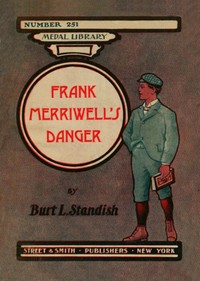
Frank Merriwell's danger — Context and Discussion
Edition facts
The source record for Frank Merriwell's danger — Context and Discussion measures this digital text at 71,053 words, 5 hr 9 min estimated reading time, and 41 detected text sections.
The text analysis averages about 12.0 words per sentence, while the detected sections provide another way to judge how the source is divided.
Project Gutenberg metadata also associates the work with “Adventure stories,” connecting these edition facts with the source record’s subject description.
Calculated from edition completeness, EPUB availability, text structure and catalogue metadata. Not a user rating.
How this score is calculated
- Description quality20 pts
- Title & short description10 pts
- Source metadata20 pts
- Text length15 pts
- Chapters / structure15 pts
- EPUB file integrity20 pts
Total of 100 points, scaled to a 2.5-5.0 range. Editions with an empty description or a missing EPUB file are not scored.
Read the Text
be seen on the Yale campus was the festive freshman, but now, on this mild, sunny April day, which was a promise of June soon to come, a few blades of grass were struggling to appear.
It was a day to bring everybody out. For the first time one could realize that winter was really a thing of the past.
At noon the campus swarmed and the fence was lined with roosters. The juniors came out and smoked their big English pipes, and did their best to imitate the graveness and dignity of the seniors. The sophomores loaded their line of fence, joking, laughing and guying the freshmen. And the freshmen gamboled like young colts just turned out to pasture, betraying their absolute “newness” by every word and act.
Big Bruce Browning smoked in lazy abandon, leaning against a post, feeling far too tired to climb to a seat upon the top rail. Bink Stubbs was whittling with a brand-new knife, while Danny Griswold whistled a rollicking tune. Dismal Jones actually wore an expression on his face that was as near perfect satisfaction and happiness as anyone had ever seen on his long countenance. “Lucy” Little, with a necktie “loud enough to jar the bricks out of South Middle,” was doing his best to see how many packages of cigarettes he could smoke in five minutes.
Everywhere the talk was baseball. Who would make the team? Would it be as strong as the year before? and would they win out from Harvard?
It was pretty certain Harvard would have an exceptionally strong team. The material to choose from was better than ever before, and Harvard was “making a brace” in all directions. Yale had won the last football game from Harvard more by the wonderful work of one man than by the superior strength of her eleven, and the Cambridge lads were thirsting for revenge.
The man who seemed to stand head and shoulders above all others in Yale sports and athletics was Frank Merriwell. But Merriwell had become a “greasy grind” during the winter, and there were those who prophesied that he was satisfied with his fame, and would retire on his laurels. It was even reported that he was ambitious to be valedictorian, and it was known that he could go to either Bones or Keys, as he might choose, which was a most remarkable state of affairs, as there were hundreds of good men and true, with hearts full of ambition, who could not reach either.
All along Merriwell had refused to say anything about his plans, and he would not talk baseball. He had been drawn into the football game with Harvard through force of circumstances, and against his inclination, so it was not strange that the general belief was that he might refuse to become the leading “twirler” for Yale that season.
It was generally conceded by Merriwell’s friends and foes alike that his refusal to play would be a great blow to Yale. Hugh Heffiner and Dad Hicks, the old timers, were gone, and Merriwell was the only man left who had been tried by Yale and not found wanting.
True, there was some new material. Walbert, an Andover man, was a promising candidate; and Haggerty, who had come to Yale after being dropped at straight-laced little Williams for some thoughtless prank, was said to be a great “southpaw” twirler.
But what Yale wanted was steady, reliable material in which confidence could be placed. The new men might show up all right when the time came, but what if they did not? The “if” was in the way.
So baseball was the theme on this bright April day, and the enthusiasm which the game always arouses among the “cranks” was beginning to make itself manifest.
While they were talking of him, Frank Merriwell appeared. He looked trim and well-groomed. It was one of his peculiarities that he always looked as if he had just emerged from a bath.
Barely was Frank upon the campus before Harry Rattleton, his old-time chum, rushed up and caught him by the arm.
“Looking for you, old man--looking for you!” he excitedly sputtered. “There’s tomething on sap--I mean something on tap.”
“You know I never drink beer,” smiled Frank.
“Never mind--t’ain’t beer,” Harry rattled on. “This is just the day, isn’t it?”
“Just the day for what?”
“What sort of a cruise?”
“On the sound. I’ve got a cat.”
“A cat? Well, what has a cat to do with a cruise on the sound?”
“I mean a batcoat--no, no, a catboat! Bought her yesterday.”
“Oh! I must say you are starting early.”
“None too early. And this is just the day for a sail. We can have a glorious afternoon on the sound. What do you say to it, old man?”
“Anybody you want. We’ll take along Browning and Diamond.”
“I don’t think I ought to spend the time.”
“Oh, come off! You have been cramming like a fiend all winter, and an afternoon’s outing is just what you need. You can’t say no. Think of the sport.”
Frank did think of it. He knew it was true he had become a “dig,” and he felt that a sail on the sound would do him good. It would serve as a relaxation for half a day, and he could return to his studies with fresh energy on the morrow.
All at once he turned on Harry, exclaiming:
“I am with you, old fellow!”
“Dead sure. I’ll be able to study all the better for it afterward.”
“That’s the talk, Merry! Who’ll we take?”
“Name your own crew.”
“Diamond and Browning.”
“They’re all right. What say if I get Hodge and take him along?”
“Get him. That will make just the right sort of a crew. I’ll get a lunch, and we’ll meet at the New Haven Yacht Clubhouse. The _Jolly Sport_ is moored off the clubhouse. We’ll all get down there as soon as possible. I know Browning and Diamond will go when they know you are coming along, Frank. You go for Hodge, and I’ll look after the others.”
In this way it was settled. Frank started to get Bart Hodge, another old chum, who roomed at a distance. Hodge had passed examinations successfully, and was a Yale student at last. Rattleton made for Browning, who still leaned in solemn stateliness against the fence.
Rattleton and Diamond were on the _Jolly Sport_, getting her in trim, when Frank and Bart appeared.
“Where’s Browning?” shouted Frank.
“Coming,” Harry called back.
“So’s Christmas, but it’ll be a long time getting here. If you really expect that fellow to sail with us this afternoon, you should have brought him along.”
“We can’t waste the afternoon waiting for him,” said Jack, impatiently.
Frank and Bart got on board the boat, and then Bruce appeared, perspiring and staggering under a heavy load, for he carried a huge basket in either hand.
“Dat the whickens--I mean, what the dickens has he there?” cried Harry. “Oh, I know, the lunch!”
“That’s it!” exclaimed Frank. “We were smart not to think of that. But he has brought enough to provision the _Jolly Sport_ for a week’s cruise.”
“Hurry up, Browning!” shouted Jack, testily. “We’ve waited long enough for you.”
“Oh, fall overboard and cool off!” flung back the big fellow, who seemed a bit out of sorts himself from the exertion. “You’re always in a hurry.”
“What have you there, anyway?” asked Frank, as Bruce came on board.
“Beer?” shouted all the lads.
“Then it’s not all beer?”
“That’s all right,” said Diamond, beginning to look satisfied. “We’ll take care of it.”
“Oh, I don’t know!” grunted Browning. “I brought it along for myself. Supposed you chaps would bring your own beer and provisions.”
“You don’t mean to say you brought all that stuff in those two great baskets for yourself and no one else?”
“How long do you think this cruise will last?”
“Can’t tell about that.”
“You’ll divvy, or we’ll put you in irons and cast you into the hold!” declared Rattleton. “I’m owner and captain of this vessel, and what I say goes. See?”
To this Bruce simply grunted.
The baskets were stowed as snugly as possible, and then Rattleton began to give orders.
“Haul away!” he cried. “Haul away on the throat halyards! Up with the peak! That’s right. Slack off the sheet a bit, Diamond. Lay her a bit more to port! Steady, so!”
The tide was running out, and the wind was light, but the _Jolly Sport_ seemed eager to get out into the sound, and was soon running down past an anchored fishing vessel at good speed.
“Well, this is great!” muttered Hodge, as he lay back comfortably, lighting a cigar.
Down past the fort in Indian Hill they slipped, steered across to the old lighthouse, and tacked into the sound.
“Hurrah!” cried Skipper Rattleton. “The breeze is with us, boys!”
Then he sang a snatch of “A Life on the Ocean Wave.”
“What do you think of my singing?” he asked. “It’s entirely by ear.”
“Great heavens!” cried Merry, tragically. “That explains it!”
“Why, I didn’t think it possibly could be by mouth.”
Browning grunted. It was as near as he could come to laughing without exerting himself.
The boys took off their coats and prepared to enjoy life. All fell to smoking, with the exception of Frank.
“Going to pitch on the nine this spring, Merry?” asked Bart.
“I may,” answered Frank. “I was practicing yesterday, and I threw the ball a mile.”
“What’s that? Threw a baseball a mile? Oh, come off!”
“You see, I threw it at a mark.”
“Isn’t a miss as good as a mile?” chuckled Frank.
Rattleton came near having a fit.
“If this keeps up,” said Diamond, “there will be a lot of maniacs on board before the _Jolly Sport_ sails back to New Haven.”
As they passed a puffing tug, an old salt hailed them:
“Better be careful, boys,” he called.
“There’ll be a reg’ler nor’wester to-night. This is a weather breeder.”
“All right, cap,” returned Frank. “We’ll be back before night.”
And they did not think of the warning afterward.
Away down the harbor ran the _Jolly Sport_. The boys smoked, laughed, sang and joked. It was like a midsummer day. They took the East Channel out toward Brandford Point, and then set their course toward the Thimble Islands.
After a time the wind freshened a little, and they put on their coats. The Thimbles were seen glistening in the bright sunshine. Harry had brought along a glass, and they took turns peering off toward the islands, of which there are said to be three hundred and sixty-five, one for each day in the year.
The wind rose steadily till they had a “spanking breeze,” and the catboat danced along right merrily.
“Perhaps we hadn’t better try to make the islands,” said Frank, but the others cried him down.
“What’s the matter with you?” they demanded. “This is a beautiful breeze. Of course, we’ll go to the Thimbles.”
They were enthusiastic, for the way the _Jolly Sport_ reeled along was exhilarating. Soon the glistening islands grew to bits of green and then took on definite shapes.
“Look at that schooner yonder,” said Jack. “Isn’t she a queer-looking craft?”
He pointed out a black two-master that was running up into the sound. There was something rakish about the slant of the masts, and the vessel seemed to creep over the water in a stealthy fashion. The boys watched her with increasing interest.
“Makes me think of some of the stories of pirate vessels,” said Bart.
“Jingoes!” exclaimed Diamond. “She does look like a pirate!”
“But the days of pirates are past,” said Harry. “Probably she is a fishing vessel.”
“Guess not,” said Frank. “She does not look like a fisherman. There is something mysterious in her appearance.”
“You know Capt. Kidd ran in here something over a hundred years ago and landed on the Thimbles,” Harry reminded. “He hid his vessel behind the rocky islands and buried his treasure where he and no one else has since been able to find it. His ‘punch bowl’ and initials remain to prove that he really did come in here.”
“Imagine we are living in the days of pirates,” said Diamond, his eyes sparkling. “Imagine that fellow coming yonder is one.”
“We’d be headed the other way, instead of bearing down to cross close under his stern,” declared Hodge.
“I don’t believe that schooner is much of a sailor, for all of her rakish appearance,” said Harry.
“She’s running under light sail,” observed Frank. “It would make a difference if she were to crack on every stitch.”
At the wheel a man seemed half asleep. Another man was at work forward, and those were all the boys could see.
“Don’t believe she carries a heavy crew,” said Browning, surveying the schooner with lazy interest.
Somehow or other as they drew nearer to the black vessel they lowered their voices and all seemed to feel an air of awe stealing over them.
“Do you make out her name, Merry?” asked Harry of Frank, who had the glass.
“Yes. There, you can all see it now.”
The schooner swung to port, and the white letters on her stern were distinctly seen.
“_P-i-r-a-t-e_,” spelled Diamond.
“_Pirate_?” gasped Harry, doubtfully.
“_Pirate_!” exclaimed Hodge, excitedly.
“_Pirate_,” came languidly from Browning, who showed no remarkable interest.
“That’s right,” nodded Frank. “An appropriate name for her, sure enough.”
“I should say so!” nodded Rattleton. “She looks like a pirate.”
“And I’m hanged if the man at the wheel don’t look like one!” half laughed Frank, passing the glass to Harry.
Rattleton took a look through the glass.
“Both men are tough-looking fellows,” he declared. “They have the appearance of men who would not hesitate to cut a throat for a sawbuck. I wouldn’t---- What’s up now?”
There was a commotion on board the black schooner.
THE MAN WITH THE GUN.
The boys heard a scream. It sounded like the voice of a woman.
Then there was a hoarse shout. The man at the wheel woke to a show of interest, and the man forward started aft.
Suddenly a girlish figure appeared on deck. She ran to the rail and tried to leap overboard, but two men, besides those already on deck, appeared in pursuit, grasped and held her.
The girl seemed to see the small sailboat.
“Help!” she wildly cried. “Save----”
One of the men clapped a hand over her mouth, and she was carried away, struggling.
Then there was excitement on board the _Jolly Sport_.
“The Old Nick is to pay on board the _Pirate_!” exclaimed Rattleton.
“It’s a girl, boys!” cried Diamond, all his natural gallantry awakened and aroused. “She is in distress. We must aid her!”
“Bring her round, Hodge--bring her round, and we’ll----”
“Lay her up, Hodge, lay her up, and we’ll make a run after the schooner!” came promptly from Frank. “I want to know something more about this.”
“That’s right,” nodded Rattleton, who did not resent the manner in which Frank took command. “What right have they to treat a girl like that! There’s something wrong going on!”
Even Browning was aroused.
“I believe Rattleton is right,” he said. “Maybe that girl has been kidnaped.”
The _Jolly Sport_ was headed in pursuit of the black schooner, without immediately attracting the attention of anyone on board the _Pirate_.
The girl had been overpowered with ease and carried below.
“What are we going to do when we overtake them?” asked Browning.
“We’ll do something if we get on board!” exclaimed Hodge.
“But it’s not likely we’ll be able to get on board.”
It was not long before the man at the wheel saw the boat in pursuit. He called to another man, who went below, after coming astern to take a look at the pursuing catboat.
In a short time two men came up from below and took a survey of the _Jolly Sport_. One of the men seemed to be captain of the schooner. He betrayed uneasiness.
Coming to the rail, the captain harshly shouted:
“What are you lubbers chasin’ us fer? Go about, and mind your own business!”
“We wish to talk with you, captain,” returned Frank.
“Don’t want to talk,” was the surly retort. “Keep off.”
“We want to talk, I tell you. What’s the use to be so unsociable. Make yourself agreeable.”
“We saw you were having a little trouble on board and so----”
“Ain’t havin’ no trouble. Tell yer to mind your own business! If you nose round us, you’ll get hurt.”
“Who was the young lady who tried to jump overboard?”
“That was my gal,” answered the man, after some hesitation.
“Why did she try to leap over the rail?”
“She’s been sick, an’ she’s a little daffy in her upper deck, that’s all.”
“He’s lying!” exclaimed Hodge, in a low voice. “You can tell that he is lying by the way he says it!”
“We’ve got a doctor here,” fibbed Rattleton. “We’ll come aboard and he’ll prescribe for her.”
“Keep off!” roared the man on the schooner. “We don’t want no doctors botherin’ round here.”
“But we are coming aboard!” flung back Diamond. “We want to see that girl.”
“You can’t see her! If you come round here, you’ll get yer heads broke!”
The black-bearded sailor was angry. He shook his fist at the boys, and used language that would not look well in print.
Still the _Jolly Sport_ kept after the _Pirate_, as if the youthful crew of the former had determined to overhaul the schooner and board her.
There was a consultation on board the schooner, and then one of the men hastily went below.
The _Jolly Sport_ was drawing close to the other vessel when the man reappeared, bringing a gun, which he handed to the black-bearded man who had done all the talking.
“Jee whiskers!” gurgled Rattleton. “That means trouble!”
“He won’t dare use it!” declared Diamond.
The man with the gun leaned over the rail of the schooner.
“Now, look here, you fresh young lubbers,” he roared, “if you don’t go round and git, I’ll fill you full of duck-shot, or my name’s not Cyrus Horn!”
The way he said it seemed to indicate that he meant business.
“Hanged if I don’t think he’ll do it!” grunted Browning. “He is a genuine old pirate, for sure.”
“Are you the captain of that schooner?” asked Frank Merriwell.
“I be,” was the answer.
“Well, what’s the use to be touchy, captain! We’ve got some beer on board, and you must be thirsty. You’ll find us a jolly crowd.”
“I don’t drink beer and I don’t want nothing to do with yer. Git!”
Capt. Horn leveled his big gun at the pursuing boat.
“Don’t be hasty, captain, for----”
The captain of the schooner was not to be beguiled by smooth words. They could see his greenish eyes glaring along the barrel of the gun he held, and he looked like a person who would not hesitate to shoot.
“I’ll give ye till I count three to go about,” he roared. “If ye don’t do it, I’ll begin shootin’.”
The boys looked at each other undecidedly.
“It’s no use,” said Frank, quietly. “If the man is in such a mood, it’s worse than folly to try to board his boat. He could claim that he took us for robbers, and----”
“Down with your helm!” cried Rattleton, and the _Jolly Sport_ was put about.
None too soon, for the captain of the schooner was seen taking aim with great deliberation.
“Now git!” he roared. “If I see anything of yer again, I’ll take a shot at yer jest for the fun of it.”
“Well, if that man isn’t a genuine pirate, it’s not his fault,” growled Browning. “It’s certain he was cut out for one.”
“He’d cut a throat with pleasure,” nodded Hodge.
Merriwell was silent, with his eyes fastened on the receding schooner. There was a troubled expression on his handsome face, and it was plain enough that he regretted their inability to solve the mystery of the girl who had tried to leap overboard.
Frank Merriwell's Danger opens with a rapid shift from a casual conversation among Yale students to a heated debate about the baseball team's captaincy. The dialogue is punctuated by physical reactions—Bruce Browning shakes Pooler "till his teeth rattled together"—that externalize internal conflicts. This technique, where a character's body betrays their emotions, recurs throughout the excerpt, as when Hardy falls "limp as a rag" after exertion. The setting, a college campus, serves as a stage for both athletic competition and social maneuvering, with the threat of heart trouble introducing a medical mystery that intertwines with the sports plot.
Dialogue as Action
The excerpt relies heavily on dialogue to advance the plot and reveal character. Rather than lengthy descriptions, Standish uses back-and-forth exchanges to convey information—such as Hardy's heart condition—and to establish alliances and enmities. For instance, Pooler's sullen remarks contrast with Sidney Gooch's hypocritical praise, while Browning's outburst provides a rare moment of physical action. The dialogue is often punctuated by interjections like "That's all right" or "How can you say that!" which mimic natural speech patterns and keep the pace brisk. This technique allows the narrative to move quickly between scenes without extensive exposition.
Recurring Physical Reactions
Throughout the excerpt, characters' physical states mirror their emotional or medical conditions. Hardy's collapse during a baseball game—"he fell limp as a rag"—is described with visceral detail, emphasizing the danger beneath the surface of athletic prowess. Similarly, Browning's shaking of Pooler and Pooler's grinding teeth convey aggression without lengthy internal monologue. These physical cues serve as shorthand for character dynamics, making the story accessible to a young audience. The repetition of such reactions, from fainting to trembling, creates a pattern that underscores the high stakes of both the game and the social tensions.
Movement Between Scenes
The narrative moves fluidly from a group discussion to a private confrontation, then back to the larger crowd. Standish uses transitional phrases like "They turned eagerly to the dark-faced, proud-looking lad" to shift focus without breaking momentum. The setting remains largely the same—a campus gathering spot—but the emotional temperature changes with each new speaker. This technique keeps the reader engaged by varying the intensity: from Pooler's sullen defiance to Browning's explosive anger, then to Hodge's authoritative confirmation. The lack of scene breaks suggests a continuous present, heightening the immediacy of the crisis.
The Role of the Crowd
The group of students functions as a collective character, reacting to news and shaping the social landscape. Their "doleful silence" after learning of Hardy's condition amplifies the gravity of the situation. Individual voices emerge from the crowd—Halliday, Parker, Gamp—each contributing a piece of information or opinion. This technique mimics real-life gossip and decision-making, where news spreads through conversation. The crowd also serves as a foil for Frank Merriwell, who is discussed but not present, building anticipation for his eventual appearance. Their loyalty or hostility toward him defines the factions within the story.
Readers attentive to the interplay of dialogue and physical detail will find that Standish builds suspense through small, observable moments—a stammer, a shake, a fall. The medical subplot adds a layer of vulnerability to the athletic setting, reminding us that even heroes face bodily limits. As the story unfolds, watch for how these recurring images of collapse and recovery shape the narrative's rhythm and the characters' fates.
Rereading my notes on Frank Merriwell’s Danger, I kept noticing how the stillness before each confrontation felt heavier than the action itself. That waiting, that breath held under pressure, reminded me of the long quiet corridors in Twenty Thousand Leagues under the Sea — Story, Setting & Ideas, where the ocean’s silence does the same patient work on the reader’s nerves.
Oliver Johnson
3 weeks agoGrace King
1 month agoDylan Adams
3 weeks ago-
Matthew Ramirez - 2 weeks ago
Frank Merriwell's Danger is a gripping page-turner that exemplifies the best of the dime novel genre. The plot is filled with suspense, clever twists, and a heroic protagonist who is both skilled and morally upright. The pacing is relentless, keeping you on the edge of your seat from start to finish. It's a classic adventure that shows why Frank Merriwell became such an iconic character in American pulp fiction. -
Claire Rodriguez - 2 weeks ago
An entertaining read that delivers on action and suspense, true to the Merriwell series. The story is quick and easy to follow, with a likeable hero. However, it's very formulaic, and the plot twists are predictable if you've read other Merriwell tales. It's a fine escapist read, but it won't challenge you or leave a lasting impression. Good for fans of the series, but not a standout. -
Christina John Clark - 1 week ago
This is a tired and predictable addition to the Merriwell series. The plot is stock, the dialogue is wooden, and the hero is too perfect to be interesting. The writing feels rushed, with little attention to detail or character depth. For modern readers, it's a poor example of the genre, lacking the charm or wit that might have made it appealing in its time. Only for completists of the series, and even they might be disappointed.
Your personal reading reflection
Build a private reading journal entry for this title.
Mila Garcia
1 week ago