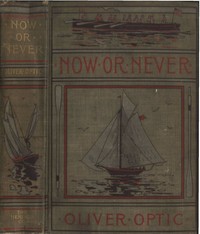
Now or Never; Or, The Adventures of Bobby Bright — Reading Notes

(7 User reviews)   957
Optic, Oliver, 1822-1897 Project Gutenberg 2006 Not confirmed
Children's stories; Fishing -- Juvenile fiction; Maine -- Juvenile fiction; Runaway children -- Juvenile fiction; Mothers and sons -- Juvenile fiction; Boston (Mass.) -- Juvenile fiction; Child labor -- Juvenile fiction; Theft -- Juvenile fiction; Money -- Juvenile fiction; Widows -- Juvenile fiction; Book industries and trade -- Juvenile fiction Readers of public-domain and historical texts
Project Gutenberg digital edition en

Edition facts

Words 50,944
Reading time 222 min
Text sections 7

The catalog record for Now or Never; Or, The Adventures of Bobby Bright — Reading Notes provides practical reading context through 50,944 words, 3 hr 42 min estimated reading time, and 7 detected text sections.

The text analysis averages about 15.8 words per sentence, while the detected sections provide another way to judge how the source is divided.

Project Gutenberg metadata also associates the work with “Children's stories,” connecting these edition facts with the source record’s subject description.

Oliver Optic's 1856 novel follows Bobby Bright, a boy who runs away to Boston, sells books, and navigates moral dilemmas involving theft, reputation, and family duty. The story contrasts youthful ambition with principles of honesty and hard work, using fishing trips, business dealings, and confrontations with a local bully to dramatize its lessons.
Share
Editorial Edition Score 4.7/5

Calculated from edition completeness, EPUB availability, text structure and catalogue metadata. Not a user rating.

How this score is calculated
  • Description quality20 pts
  • Title & short description10 pts
  • Source metadata20 pts
  • Text length15 pts
  • Chapters / structure15 pts
  • EPUB file integrity20 pts

Total of 100 points, scaled to a 2.5-5.0 range. Editions with an empty description or a missing EPUB file are not scored.

Edition quality

Read the Text

Bobby had saved from impending death, was too much agitated to say much, even to the bold youth who had rendered him such a signal service. He could scarcely believe the intelligence which the boy brought him; it seemed too good to be true. He had assured himself that Ellen--for that was the young lady's name--was killed or dreadfully injured.

Kate was driven at the top of her speed, and in a few moments reached the bridge, where Ellen was awaiting his arrival.

"Here I am, father, alive and unhurt!" cried Ellen, as Mr. Bayard stopped the horse.

"Thank Heaven, my child!" replied the glad father, embracing his daughter. "I was sure you were killed."

"No, father; thanks to this bold youth, I am uninjured."

"I am under very great obligations to you, young man," continued Mr. Bayard, grasping Bobby's hand.

"O, never mind, sir;" and Bobby blushed just as he had blushed when the young lady spoke to him.

"We shall never forget you--shall we, father?" added Ellen.

"No, my child; and I shall endeavor to repay, to some slight extent, our indebtedness to him. But you have not yet told me how you were saved."

"O, I merely stopped the horse; that's all," answered Bobby, modestly.

"Yes, father, but he placed himself right before Kate when she was almost flying over the ground. When I saw him, I was certain that he would lose his life, or be horribly mangled for his boldness," interposed Ellen.

"It was a daring deed, young man, to place yourself before an affrighted horse in that manner," said Mr. Bayard.

"I didn't mind it, sir."

"And then he flourished a big club, almost as big as he is himself, in the air, which made Kate pause in her mad career, when my deliverer here grasped her by the bit and held her."

"It was well and bravely done."

"That it was, father; not many men would have been bold enough to do what he did," added Ellen, with enthusiasm.

"Very true; and I feel that I am indebted to him for your safety. What is your name, young man?"

"Robert Bright, sir."

Mr. Bayard took from his pocket several pieces of gold, which he offered to Bobby.

"No, I thank you, sir," replied Bobby, blushing.

"What! as proud as you are bold?"

"I don't like to be paid for doing my duty."

"Bravo! You are a noble little fellow! But you must take this money, not as a reward for what you have done, but as a testimonial of my gratitude."

"I would rather not, sir."

"Do take it, Robert," added Ellen.

"I don't like to take it. It looks mean to take money for doing one's duty."

"Take it, Robert, to please me;" and the young lady smiled so sweetly that Bobby's resolution began to give way. "Only to please me, Robert."

"I will, to please you; but I don't feel right about it."

"You must not be too proud, Robert," said Mr. Bayard, as he put the gold pieces into his hand.

"I am not proud, sir; only I don't like to be paid for doing my duty."

"Not paid, my young friend. Consider that you have placed me under an obligation to you for life. This money is only an expression of my own and my daughter's feelings. It is but a small sum, but I hope you will permit me to do something more for you, when you need it. You will regard me as your friend as long as you live."

"When you want any assistance of any kind, come to me. I live in Boston; here is my business card."

Mr. Bayard handed him a card, on which Bobby read, "F. Bayard & Co., Booksellers and Publishers, No. --, Washington Street, Boston."

"You are very kind, sir."

"I want you should come to Boston and see us, too," interposed Ellen. "I should be delighted to show you the city, to take you to the Athenaeum and the Museum."

Mr. Bayard inquired of Bobby about his parents, where he lived, and about the circumstances of his family. He then took out his memorandum book, in which he wrote the boy's name and residence.

"I am sorry to leave you now, Robert, but I have over twenty miles to ride to-day. I should be glad to visit your mother, and next time I come to Riverdale, I shall certainly do so."

"Thank you, sir; my mother is a very poor woman, but she will be glad to see you."

"Now, good by, Robert."

"Good by," repeated Ellen.

Mr. Bayard drove off, leaving Bobby standing on the bridge with the gold pieces in his hand.

"Here's luck!" said Bobby, shaking the coin. "Won't mother's eyes stick out when she sees these shiners? There are no such shiners in the river as these."

Bobby was astonished, and the more he gazed at the gold pieces, the more bewildered he became. He had never held so much money in his hand before. There were three large coins and one smaller one. He turned them over and over, and finally ascertained that the large coins were ten dollar pieces, and the smaller one a five dollar piece. Bobby was not a great scholar, but he knew enough of arithmetic to calculate the value of his treasure. He was so excited, however, that he did not arrive at the conclusion half so quick as most of my young readers would have done.

"Thirty-five dollars!" exclaimed Bobby, when the problem was solved. "Gracious!"

"Hallo, Bob!" shouted Tom Spicer, who had got tired of fishing; besides, the village clock was just striking twelve, and it was time for him to go home.

Bobby made no answer, but hastily tying the gold pieces up in the corner of his handkerchief, he threw the broken rail he had used in stopping the horse where it belonged, and started for the place where he had left his fishing apparatus.

"Stopped him--didn't you?"

"You were a fool; he might have killed you."

"So he might; but I didn't stop to think of that. The lady's life was in danger."

"Everything, I should say."

"Did he give you anything?"

"Yes;" and Bobby continued his walk down to the river's side.

"I say, what did he give you, Bobby?" persisted Tom, following him.

"O, he gave me a good deal of money."

"I want to get my fish line now; I will tell you all about it some other time," replied Bobby, who rather suspected the intentions of his companion.

"Tell me now; how much was it?"

"Humph! Do you think I mean to rob you?"

"Ain't you going halveses?"

"Wasn't I fishing with you?"

"You did not do anything about stopping the horse."

"I would, if I hadn't been afraid to go up to the road."

"Somebody might have seen me, and they would have known that I was hooking jack."

"Then you ought not to share the money."

"Yes, I had. When a fellow is with you, he ought to have half. It is mean not to give him half."

"If you had done anything to help stop the horse, I would have shared with you. But you didn't."

Bobby was particularly sensitive in regard to the charge of meanness. His soul was a great deal bigger than his body, and he was always generous, even to his own injury, among his companions. It was evident to him that Tom had no claim to any part of the reward; but he could not endure the thought even of being accused of meanness.

"I'll tell you what I will do, if you think I ought to share with you. I will leave it out to Squire Lee; and if he thinks you ought to have half, or any part of the money, I will give it to you."

"No, you don't; you want to get me into a scrape for hooking jack. I see what you are up to."

"I will state the case to him without telling him who the boys are."

"No, you don't! You want to be mean about it. Come, hand over half the money."

"I will not," replied Bobby, who, when it became a matter of compulsion, could stand his ground at any peril.

"How much have you got?"

"Thirty-five dollars."

"By jolly! And you mean to keep it all yourself?"

"I mean to give it to my mother."

"No, you won't! If you are going to be mean about it, I'll smash your head!"

This was a favorite expression with Tom Spicer, who was a noted bully among the boys of Riverdale. The young ruffian now placed himself in front of Bobby, and shook his clenched fist in his face.

"No, I won't. You have no claim to any part of the money; at least, I think you have not. If you have a mind to leave it out to Squire Lee, I will do what is right about it."

"Not I; hand over, or I'll smash your head!"

"Smash away," replied Bobby, placing himself on the defensive.

"Do you think you can lick me?" asked Tom, not a little embarrassed by this exhibition of resolution on the part of his companion.

"I don't think anything about it; but you don't bully me in that kind of style."

But Tom did not immediately put his threat in execution, and Bobby would not be the aggressor; so he stepped one side to pass his assailant. Tom took this as an evidence of the other's desire to escape, and struck him a heavy blow on the side of the head. The next instant the bully was floundering in the soft mud of a ditch; Bobby's reply was more than Tom had bargained for, and while he was dragging himself out of the ditch, our hero ran down to the river, and got his fish pole and basket.

"You'll catch it for that!" growled Tom.

"I'm all ready, whenever it suits your convenience," replied Bobby.

"Just come out here and take it in fair fight," continued Tom, who could not help bullying, even in the midst of his misfortune.

"No, I thank you; I don't want to fight with any fellow. I will not fight if I can help it."

"What did you hit me for, then?"

"Just come out here, and try it fair!"

"No;" and Bobby hurried home, leaving the bully astonished and discomfited by the winding up of the morning's sport.

IN WHICH THE LITTLE BLACK HOUSE IS BOUGHT BUT NOT PAID FOR

Probably my young readers have by this time come to the conclusion that Bobby Bright was a very clever fellow--one whose acquaintance they would be happy to cultivate. Perhaps by this time they have become so far interested in him as to desire to know who his parents were, what they did, and in what kind of a house he lived.

I hope none of my young friends will think any less of him when I inform them that Bobby lived in an old black house which had never been painted, which had no flower garden in front of it, and which, in a word, was quite far from being a palace. A great many very nice city folks would not have considered it fit to live in, would have turned up their noses at it, and wondered that any human beings could be so degraded as to live in such a miserable house. But the widow Bright, Bobby's mother, thought it was a very comfortable house, and considered herself very fortunate in being able to get so good a dwelling. She had never lived in a fine house, knew nothing about velvet carpets, mirrors seven feet high, damask chairs and lounges, or any of the smart things which very rich and very proud city people consider absolutely necessary for their comfort. Her father had been a poor man, her husband had died a poor man, and her own life had been a struggle to keep the demons of poverty and want from invading her humble abode.

Mr. Bright, her deceased husband, had been a day laborer in Riverdale. He never got more than a dollar a day, which was then considered very good wages in the country. He was a very honest, industrious man, and while he lived, his family did very well. Mrs. Bright was a careful, prudent woman, and helped him support the family. They never knew what it was to want for anything.

Poor people, as well as rich, have an ambition to be something which they are not, or to have something which they have not. Every person, who has any energy of character, desires to get ahead in the world. Some merchants, who own big ships and big warehouses by the dozen, desire to be what they consider rich. But their idea of wealth is very grand. They wish to count it in millions of dollars, in whole blocks of warehouses; and they are even more discontented than the day laborer who has to earn his dinner before he can eat it.

Bobby's father and mother had just such an ambition, only it was so modest that the merchant would have laughed at it. They wanted to own the little black house in which they resided, so that they could not only be sure of a home while they lived, but have the satisfaction of living in their own house. This was a very reasonable ideal, compared with that of the rich merchants I have mentioned; but it was even more difficult for them to reach it, for the wages were small, and they had many mouths to feed.

Mr. Bright had saved up fifty dollars; and he thought a great deal more of this sum than many people do of a thousand dollars. He had had to work very hard and be very prudent in order to accumulate this sum, which made him value it all the more highly.

With this sum of fifty dollars at his command, John Bright felt rich; and then, more than ever before, he wanted to own the little black house. He felt as grand as a lord; and as soon as the forty-nine dollars had become fifty, he waited upon Mr. Hardhand, a little crusty old man, who owned the little black house, and proposed to purchase it.

The landlord was a hard man. Everybody in Riverdale said he was mean and stingy. Any generous-hearted man would have been willing to make an easy bargain with an honest, industrious, poor man, like John Bright, who wished to own the house in which he lived; but Mr. Hardhand, although he was rich, only thought how he could make more money. He asked the poor man four hundred dollars for the old house and the little lot of land on which it stood.

It was a matter of great concern to John Bright. Four hundred dollars was a "mint of money," and he could not see how he should ever be able to save so much from his daily earnings. So he talked with Squire Lee about it, who told him that three hundred was all it was worth. John offered this for it, and after a month's hesitation Mr. Hardhand accepted the offer, agreeing to take fifty dollars down, and the rest in semi-annual payments of twenty-five dollars each until the whole was paid.

I am thus particular in telling my readers about the bargain, because this debt which his father contracted was the means of making a man of Bobby, as will be seen in his subsequent history.

John Bright paid the first fifty dollars; but before the next instalment became due, the poor man was laid in his cold and silent grave. A malignant disease carried him off, and the hopes of the Bright family seemed to be blasted.

Four children were left to the widow. The youngest was only three years old, and Bobby, the oldest, was nine, when his father died. Squire Lee, who had always been a good friend of John Bright, told the widow that she had better go to the poorhouse, and not attempt to struggle along with such fearful odds against her. But the widow nobly refused to become a pauper, and to make paupers of her children, whom she loved quite as much as though she and they had been born in a ducal palace. She told the squire that she had two hands, and as long as she had her health, the town need not trouble itself about her support.

Squire Lee was filled with surprise and admiration at the noble resolution of the poor woman; and when he returned to his house, he immediately sent her a cord of wood, ten bushels of potatoes, two bags of meal, and a firkin of salt pork.

The widow was very grateful for these articles, and no false pride prevented her from accepting the gift of her rich and kind-hearted neighbor.

Riverdale Centre was largely engaged in the manufacturing of boots and shoes, and this business gave employment to a large number of men and women.

Mrs. Bright had for several years "closed" shoes--which, my readers who do not live in "shoe towns" may not know, means sewing or stitching them. To this business she applied herself with renewed energy. There was a large hotel in Riverdale Centre, where several families from Boston spent the summer. By the aid of Squire Lee, she obtained the washing of these families, which was more profitable than closing shoes.

By these means she not only supported her family very comfortably, but was able to save a little money towards paying for the house. Mr. Hardhand, by the persuasions of Squire Lee, had consented to let the widow keep the house, and pay for it as she could.

John Bright had been dead four years at the time we introduce Bobby to the reader. Mrs. Bright had paid another hundred dollars towards the house, with the interest; so there was now but one hundred due. Bobby had learned to "close," and helped his mother a great deal; but the confinement and the stooping posture did not agree with his health, and his mother was obliged to dispense with his assistance. But the devoted little fellow found a great many ways of helping her. He was now thirteen, and was as handy about the house as a girl. When he was not better occupied, he would often go to the river and catch a mess of fish, which was so much clear gain.

The winter which had just passed had brought a great deal of sickness to the little black house. The children all had the measles, and two of them the scarlet fever, so that Mrs. Bright could not work much. Her affairs were not in a very prosperous condition when the spring opened; but the future was bright, and the widow, trusting in Providence, believed that all would end well.

One thing troubled her. She had not been able to save anything for Mr. Hardhand. She could only pay her interest; but she hoped by the first of July to give him twenty-five dollars of the principal. But the first of July came, and she had only five dollars of the sum she had partly promised her creditor. She could not so easily recover from the disasters of the hard winter, and she had but just paid off the little debts she had contracted. She was nervous and uneasy as the day approached. Mr. Hardhand always abused her when she told him she could not pay him, and she dreaded his coming.

It was the first of July on which Bobby caught those pouts, caught the horse, and on which Tom Spicer had "caught a Tartar."

Bobby hastened home, as we said at the conclusion of the last chapter. He was as happy as a lord. He had fish enough in his basket for dinner, and for breakfast the next morning, and money enough in his pocket to make his mother as happy as a queen, if queens are always happy.

The widow Bright, though she had worried and fretted night and day about the money which was to be paid to Mr. Hardhand on the first of July, had not told her son anything about it. It would only make him unhappy, she reasoned, and it was needless to make the dear boy miserable for nothing; so Bobby ran home all unconscious of the pleasure which was in store for him.

The first chapter of Oliver Optic's Now or Never; Or, The Adventures of Bobby Bright opens with Bobby declaring, 'I'm big enough to protect my Mother, and I'll do it.' This line, set in the preface as a motto, immediately establishes the hero's protective instinct and moral resolve. The narrative quickly moves to a fishing scene where Bobby catches a horse—a literal and figurative hook that signals the blend of everyday realism and improbable adventure. Optic's preface frames the story as a 'record of youthful struggles, not only in the world without, but in the world within,' emphasizing internal moral battles over external success. The author explicitly aims to make Bobby's 'devotion to principles' more compelling than exciting incidents, a promise that shapes the episodic structure.

The Bully's Shadow and the Theft Accusation

A key tension emerges in the excerpt where Tom Spicer, the local bully, confronts Bobby by the river. Tom's father has accused him of stealing ten dollars, a charge that divides the community. Optic writes that 'people generally believed that Spicer had carried no money home,' suggesting the father's intemperance undermines his credibility. Yet Bobby's internal judgment is harsh: 'the boy that would do all these things certainly would steal if he got a good chance.' This moment reveals a pattern: the story tests characters' reputations against their actions. Bobby himself is cautious, refusing to share book-pricing secrets with Tom, calling it 'a publisher's secret.' The theft subplot remains unresolved in the excerpt, but it establishes a moral landscape where appearances and evidence are constantly weighed.

The Book Trade as Moral and Economic Education

Bobby's book-selling venture in Boston forms the economic backbone of the story. In the excerpt, he reports selling 'about fifty' books and making 'about fifteen dollars,' a modest success that surprises even his enemy Tom. Optic uses the trade to dramatize lessons in discretion, profit, and honesty. When Tom presses for cost details, Bobby deflects by hauling in a fish—a small evasion that preserves business ethics. The preface explicitly contrasts this legitimate commerce with the 'politics, cigars, 2:40 horses, and "one stew"' that characterize the 'smart boy' stereotype of the era. Bobby's work is presented as a corrective, substituting 'the duties of a rational and accountable being' for empty sophistication. The narrative thus turns a commercial transaction into a vehicle for character development.

Voice and Structure: Direct Address and Moral Interruption

Optic frequently breaks the narrative to address the reader directly, as when he comments on Tom's reputation: 'from which my readers can understand that it is an excellent thing to have a good reputation.' This technique, common in didactic fiction of the period, turns the story into an explicit moral lesson. The structure is episodic, with chapter titles like 'In which Bobby goes a fishing, and catches a Horse' promising both action and irony. The prose is brisk, with dialogue carrying much of the plot. Bobby's speech is polite and measured—'Very well,' 'First rate,' 'Easy enough'—contrasting with Tom's blunt 'By jolly!' and 'You are a smart one.' These vocal differences reinforce the moral hierarchy: Bobby's restraint signals his inner discipline, while Tom's enthusiasm hints at instability.

Readers approaching Now or Never should attend to how Optic balances incident with instruction. The fishing scenes, business negotiations, and confrontations with Tom are not merely plot devices but stages for ethical choice. The incomplete excerpts leave several threads—the stolen money, Bobby's full Boston adventures—unresolved, inviting curiosity about how the hero's principles will be tested further. Optic's preface warns that worldly prosperity is 'not the truest victory'; the novel's interest lies in watching Bobby navigate temptations that are both external and internal.

There’s something about Bobby Bright’s restless, river-adjacent ambitions that lingers, and when I closed that book, my thoughts drifted to the quieter shores of All Aboard; or, Life on the Lake A Sequel to "The Boat Club" — A Closer Reading. I suppose it’s that same feeling of water carrying a boy’s choices forward, gently, without ever quite letting him go.

Liam Miller
4 weeks ago

Henry Rodriguez
4 weeks ago

Luke Allen
2 weeks ago

Owen Jones
2 weeks ago

Owen Hall
1 month ago

4.5
4.5 out of 5 (7 User reviews )

Add a Review

Your Rating *
There are no comments for this eBook.

Reader reflection

How did this book work for you?

Your answers remain private and are stored only in this browser.

Your progress 0 / 10
1

Have you finished this book?

2

What was your overall reaction to the book?

3

Is this a title you would suggest to others?

4

How easy was the book to follow?

Related eBooks