1

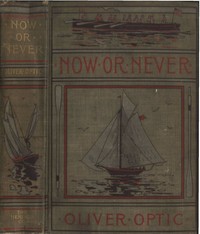
Now or Never; Or, The Adventures of Bobby Bright — Reading Notes
(0 User reviews)
977
Project Gutenberg
2006
Not confirmed
Children's stories; Fishing -- Juvenile fiction; Maine -- Juvenile fiction; Runaway children -- Juvenile fiction; Mothers and sons -- Juvenile fiction; Boston (Mass.) -- Juvenile fiction; Child labor -- Juvenile fiction; Theft -- Juvenile fiction; Money -- Juvenile fiction; Widows -- Juvenile fiction; Book industries and trade -- Juvenile fiction
Readers of public-domain and historical texts
Project Gutenberg digital edition
en
Edition facts
Words
50,944
Reading time
222 min
Text sections
7
The catalog record for Now or Never; Or, The Adventures of Bobby Bright — Reading Notes provides practical reading context through 50,944 words, 3 hr 42 min estimated reading time, and 7 detected text sections.
The text analysis averages about 15.8 words per sentence, while the detected sections provide another way to judge how the source is divided.
Project Gutenberg metadata also associates the work with “Children's stories,” connecting these edition facts with the source record’s subject description.
Source:
Project Gutenberg record #19473
Oliver Optic's 1856 novel follows Bobby Bright, a boy who runs away to Boston, sells books, and navigates moral dilemmas involving theft, reputation, and family duty. The story contrasts youthful ambition with principles of honesty and hard work, using fishing trips, business dealings, and confrontations with a local bully to dramatize its lessons.
Read the complete public-domain text at its original source.
Read on Project GutenbergThe first chapter of Oliver Optic's Now or Never; Or, The Adventures of Bobby Bright opens with Bobby declaring, 'I'm big enough to protect my Mother, and I'll do it.' This line, set in the preface as a motto, immediately establishes the hero's protective instinct and moral resolve. The narrative quickly moves to a fishing scene where Bobby catches a horse—a literal and figurative hook that signals the blend of everyday realism and improbable adventure. Optic's preface frames the story as a 'record of youthful struggles, not only in the world without, but in the world within,' emphasizing internal moral battles over external success. The author explicitly aims to make Bobby's 'devotion to principles' more compelling than exciting incidents, a promise that shapes the episodic structure.
The Bully's Shadow and the Theft Accusation
A key tension emerges in the excerpt where Tom Spicer, the local bully, confronts Bobby by the river. Tom's father has accused him of stealing ten dollars, a charge that divides the community. Optic writes that 'people generally believed that Spicer had carried no money home,' suggesting the father's intemperance undermines his credibility. Yet Bobby's internal judgment is harsh: 'the boy that would do all these things certainly would steal if he got a good chance.' This moment reveals a pattern: the story tests characters' reputations against their actions. Bobby himself is cautious, refusing to share book-pricing secrets with Tom, calling it 'a publisher's secret.' The theft subplot remains unresolved in the excerpt, but it establishes a moral landscape where appearances and evidence are constantly weighed.
The Book Trade as Moral and Economic Education
Bobby's book-selling venture in Boston forms the economic backbone of the story. In the excerpt, he reports selling 'about fifty' books and making 'about fifteen dollars,' a modest success that surprises even his enemy Tom. Optic uses the trade to dramatize lessons in discretion, profit, and honesty. When Tom presses for cost details, Bobby deflects by hauling in a fish—a small evasion that preserves business ethics. The preface explicitly contrasts this legitimate commerce with the 'politics, cigars, 2:40 horses, and "one stew"' that characterize the 'smart boy' stereotype of the era. Bobby's work is presented as a corrective, substituting 'the duties of a rational and accountable being' for empty sophistication. The narrative thus turns a commercial transaction into a vehicle for character development.
Voice and Structure: Direct Address and Moral Interruption
Optic frequently breaks the narrative to address the reader directly, as when he comments on Tom's reputation: 'from which my readers can understand that it is an excellent thing to have a good reputation.' This technique, common in didactic fiction of the period, turns the story into an explicit moral lesson. The structure is episodic, with chapter titles like 'In which Bobby goes a fishing, and catches a Horse' promising both action and irony. The prose is brisk, with dialogue carrying much of the plot. Bobby's speech is polite and measured—'Very well,' 'First rate,' 'Easy enough'—contrasting with Tom's blunt 'By jolly!' and 'You are a smart one.' These vocal differences reinforce the moral hierarchy: Bobby's restraint signals his inner discipline, while Tom's enthusiasm hints at instability.
Readers approaching Now or Never should attend to how Optic balances incident with instruction. The fishing scenes, business negotiations, and confrontations with Tom are not merely plot devices but stages for ethical choice. The incomplete excerpts leave several threads—the stolen money, Bobby's full Boston adventures—unresolved, inviting curiosity about how the hero's principles will be tested further. Optic's preface warns that worldly prosperity is 'not the truest victory'; the novel's interest lies in watching Bobby navigate temptations that are both external and internal.
There’s something about Bobby Bright’s restless, river-adjacent ambitions that lingers, and when I closed that book, my thoughts drifted to the quieter shores of All Aboard; or, Life on the Lake A Sequel to "The Boat Club" — A Closer Reading. I suppose it’s that same feeling of water carrying a boy’s choices forward, gently, without ever quite letting him go.
There are no reviews for this eBook.
There are no comments for this eBook.
Reader reflection
How did this book work for you?
Your answers remain private and are stored only in this browser.
Your progress
0
/
10
2
What was your overall reaction to the book?
3
Is this a title you would suggest to others?
4
How easy was the book to follow?
5
What was the strongest part of the book?
6
Did any part of the book feel personally relevant?
7
How would you describe its reading pace?
8
How much did the book move you?
9
What did this book teach you most?
10