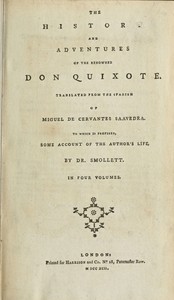
The history and adventures of the renowned Don Quixote — Text and Context

(5 User reviews)   1413
Cervantes Saavedra, Miguel de, 1547-1616, Stothard, Thomas, 1755-1834 [Illustrator], Smollett, T. (Tobias), 1721-1771 [Translator] Project Gutenberg 2025 Not confirmed
Spain -- Social life and customs -- 16th century -- Fiction; Knights and knighthood -- Spain -- Fiction; Picaresque literature; Romances Readers of public-domain and historical texts
Project Gutenberg digital edition en

Edition facts

Words 433,608
Reading time 1886 min
Text sections 45

This digital edition of The history and adventures of the renowned Don Quixote — Text and Context is described by source-level measurements including 433,608 words, 31 hr 26 min estimated reading time, and 45 detected text sections.

The text analysis averages about 44.7 words per sentence, while the detected sections provide another way to judge how the source is divided.

Project Gutenberg metadata also associates the work with “Spain -- Social life and customs -- 16th century -- Fiction,” connecting these edition facts with the source record’s subject description.

This 1782 translation by Tobias Smollett, illustrated by Thomas Stothard, presents Cervantes' novel with a distinctive British Augustan voice. The excerpts show Don Quixote and Sancho learning of a published book about their adventures, a metafictional twist that complicates the catalog subjects of picaresque and romance.
Share
Editorial Edition Score 4.9/5

Calculated from edition completeness, EPUB availability, text structure and catalogue metadata. Not a user rating.

How this score is calculated
  • Description quality20 pts
  • Title & short description10 pts
  • Source metadata20 pts
  • Text length15 pts
  • Chapters / structure15 pts
  • EPUB file integrity20 pts

Total of 100 points, scaled to a 2.5-5.0 range. Editions with an empty description or a missing EPUB file are not scored.

Edition quality

Read the Text

territories of Spain. The fame of Don Quixote diffused itself through all the civilized countries of Europe; and the work was so much admired in France, that some gentlemen who attended the French ambassador to Madrid, in a conversation with the licentiate Marques Torres, chaplain to the archbishop of Toledo, expressed their surprize that Cervantes was not maintained from the publick treasury, as the honour and pride of the Spanish nation. Nay, this work, which was first published at Madrid in the year 1605, had the good fortune to extort the approbation of royalty itself: Philip III. standing in a balcony of his palace, and surveying the adjacent country, perceived a student on the bank of the Manzanares, reading a book, and every now and then striking his forehead and bursting out into loud fits of laughter. His majesty having observed his emotions for some time, ‘That student,’ said he, ‘is either mad, or reading Don Quixote.’ Some of the courtiers in attendance, had the curiosity to go out and enquire, and actually found the scholar engaged in the adventures of our Manchegan.

As the book was dedicated to the Duke de Bejar, we may naturally suppose that nobleman, either by his purse or interest, obtained the author’s discharge from prison; for he congratulates himself upon the protection of such a patron, in certain verses prefixed to the book, and supposed to be written by Urganda the unknown. He afterwards attracted the notice of the Count De Lemos, who seems to have been his chief and favourite benefactor; and even enjoyed a small share of the countenance of the cardinal archbishop of Toledo: so that we cannot, with any probability, espouse the opinion of those who believe his Don Quixote was intended as a satire upon the administration of that nobleman. Nor is there the least plausible reason for thinking his aim was to ridicule the conduct of Charles V. whose name he never mentions without expressions of the utmost reverence and regard. Indeed, his own indigence was a more severe satire than any thing he could have invented against the ministry of Philip III. for, though their protection kept him from starving, it did not exempt him from the difficulties and mortifications of want; and no man of taste and humanity can reflect upon his character and circumstances, without being shocked at the barbarous indifference of his patrons. What he obtained was not the offering of liberality and taste, but the scanted alms of compassion: he was not respected as a genius, but relieved as a beggar.

One would hardly imagine that an author could languish in the shade of poverty and contempt, while his works afforded entertainment and delight to whole nations, and even sovereigns were found in the number of his admirers; but Cervantes had the misfortune to write in the reign of a prince whose disposition was sordid, and whose talents, naturally mean, had received no manner of cultivation; so that his head was altogether untinctured with science, and his heart an utter stranger to the virtues of beneficence. Nor did the liberal arts derive the least encouragement from his ministry, which was ever weak and wavering. The Duke De Lerma seems to have been a proud, irresolute, shallow-brained politician, whose whole attention was employed in preserving the good graces of his master; though, notwithstanding all his efforts, he still fluctuated between favour and disgrace, and at last was fain to shelter himself under the hat of a cardinal. As for the Count de Lemos, who had some share in the administration, he affected to patronize men of genius, though he had hardly penetration enough to distinguish merit; and the little taste he possessed was so much warped by vanity and self-conceit, that there was no other avenue to his friendship but the road of adulation and panegyrick: we need not, therefore, wonder that his bounty was so sparingly bestowed upon Cervantes, whose conscious worth and spirit would not suffer him to practise such servility of prostration.

Rather than stoop so far beneath the dignity of his own character, he resolved to endure the severest stings of fortune; and, for a series of years, wrestled with inconceivable vexation and distress. Even in this low situation, he was not exempted from the ill offices of those who envied his talents and his fame. The bad writers vilified his genius, and censured his morals; they construed Don Quixote into an impertinent libel, and endeavoured to depreciate his Exemplary Novels, which were published at Madrid, in the year 1613. This performance is such as might be expected from the invention and elegance of Cervantes, and was accordingly approved by the best judges of his time. Indeed, it must have been a great consolation to him, in the midst of his misfortunes, to see himself celebrated by the choicest wits of Spain; and, among the rest, by the renowned Lope De Vega, prince of the Spanish theatre, who, both during the life and after the death of our author, mentioned him in the most respectful terms of admiration[9].

But, of all the insults to which he was exposed from the malevolence of mankind, nothing provoked him so much, as the outrage he sustained, from the insolence and knavery of an author, who, while he was preparing the second part of Don Quixote for the press, in the year 1614, published a performance, intitled, The Second Volume of the sage Hidalgo Don Quixote De La Mancha, containing his third sally. Composed by the licentiate Alonzo Fernandez De Avellaneda, a native of Tordesillas; dedicated to the alcalde, regidors, and gentlemen, of the noble town of Argamasilla, the happy country of Don Quixote De La Mancha. This impostor, not contented with having robbed Cervantes of his plan, and, as some people believe, of a good part of his copy, attacked him personally, in his preface, in the most virulent manner; accusing him of envy, malice, peevishness, and rancour; reproaching him with his poverty, and taxing him with having abused his cotemporary writers, particularly Lope De Vega, under the shadow of whose reputation this spurious writer takes shelter, pretending to have been lashed, together with that great genius, in some of our author’s critical reflections.

In spite of the disguise he assumed, Cervantes discovered him to be an Arragonian; and in all probability knew his real name, which, however, he did not think proper to transmit to posterity; and his silence in this particular was the result either of discretion, or contempt. If he was a person of consequence, as some people suppose, it was undoubtedly prudent in Cervantes to pretend ignorance of his true name and quality; because, under the shadow of that pretence, he could the more securely chastise him for his dullness, scurrility, and presumption: but if he knew him to be a man of no character or estimation in life, he ought to have deemed him altogether unworthy of his resentment; for his production was such as could not possibly prejudice our author’s interest or reputation. It is altogether void of invention and propriety; the characters of Don Quixote and Sancho are flattened into the most insipid absurdity; the adventures are unentertaining and improbable; and the stile barbarous, swoln, and pedantick.

Howsoever Saavedra’s fortune might have been affected by this fraudulent anticipation, I am persuaded, from the consideration of his magnanimity, that he would have looked upon the attempt with silent disdain, had the fictitious Avellaneda abstained from personal abuse; but finding himself so injuriously upbraided with crimes which his soul abhorred, he gave a loose to his indignation and ridicule, which appear through the preface and second part of Don Quixote, in a variety of animadversions equally witty and severe. Indeed, the genuine continuation, which was published in the year 1615, convinced the world that no other person could compleat the plan of the original projector. It was received with universal joy and approbation; and in a very little time translated into the languages of Italy, France, England, and other countries, where, though the knight appeared to disadvantage, he was treated as a noble stranger of superlative merit and distinction.

In the year after the publication of his novels, Cervantes ushered into the world a poem called, A Voyage to Parnassus, dedicated to Don Rodrigo De Tapia, knight of St. Jago. This performance is an ironical satire on the Spanish poets of his time, written in imitation of Cæsar Caporali, who lashed his cotemporaries of Italy under the same title; though Saavedra seems to have had also another scope, namely, to complain of the little regard that was paid to his own age and talents. Those who will not allow this piece to be an excellent poem, cannot help owning that it abounds with wit and manly satire; and that nothing could be a more keen reproach upon the taste and patronage of the times, than the dialogue that passes between him and Apollo; to whom, after having made a bold, yet just recapitulation of his own success in writing, he pathetically complains, that he was denied a seat among his brethren; and takes occasion to observe, that rewards were not bestowed according to merit, but in consequence of interest and favour.

He has, upon other occasions, made severe remarks upon the scarcity of patrons among the nobility of Spain, and even aimed the shafts of his satire at the throne itself. In his dedication of the second part of Don Quixote, to the Count De Lemos, he proceeds in this ironical strain: ‘But no person expresses a greater desire of seeing my Don Quixote, than the mighty Emperor of China, who, about a month ago, sent me a letter by an express, desiring, or rather beseeching, me to supply him with a copy of that performance, as he intended to build and endow a college for teaching the Spanish language from my book, and was resolved to make me rector or principal teacher. I asked if his majesty had sent me any thing towards defraying the charges; and, when he answered in the negative, “Why, then, friend,” said I, “you may return to China as soon as you please; for my own part, I am not in a state of health to undertake such a long journey: besides, I am not only weak in body, but still weaker in purse, and so I am the emperor’s most humble servant.” In short, emperor for emperor, and monarch for monarch, to take one with the other, and set the hare’s head against the goose giblets, there is the noble Count De Lemos, at Naples, who, without any rectorships, supports, protects, and favours me, to my heart’s content.’

This facetious paragraph certainly alludes to some unsubstantial promise he had received from the court. At the same time I cannot help observing, that his gratitude and acknowledgment to the Count De Lemos, seem to have greatly exceeded the obligation; for, at this very time, while he is extolling his generosity, he gives us to understand that his circumstances were extremely indigent.

At the very time of this dedication, the poverty of Cervantes had increased to such a degree of distress, that he was fain to sell eight plays, and as many interludes, to Juan Villaroel, because he had neither means nor credit for printing them at his own expence. These theatrical pieces, which were published at Madrid in the year 1615, though counted inferior to many productions of Lope De Vega, have nevertheless merit enough to persuade the discerning reader that they would have succeeded in the representation; but he was no favourite with the players, who have always arrogated to themselves the prerogative of judging and rejecting the productions of the drama; and, as they forbore to offer, he disdained to solicit their acceptance. The truth is, he considered actors as the servants of the publick, who, though entitled to a certain degree of favour and encouragement for the entertainment they afforded, ought ever to demean themselves with modesty and respect for their benefactors; and he had often professed himself an enemy to the self-sufficiency, insolence, and outrageous behaviour of the king’s company; some of whom had been guilty of the most flagrant crimes, and even committed murder with impunity.

It is sometimes in the power of the most inconsiderable wretch to mortify a character of the highest dignity. Cervantes, notwithstanding his contempt of such petty criticks, could not help feeling the petulance of a puny player, who presumed to depreciate the talents of this venerable father of the stage. ‘Some years ago[10],’ says he, ‘I had recourse again to my old amusement; and, on the supposition that the times were not altered since my name was in some estimation, I composed a few pieces for the stage; but found no birds in last year’s nests: my meaning is, I could find no player who would ask for my performances, though the whole company knew they were finished; so that I threw them aside, and condemned them to perpetual silence. About this time, a certain bookseller told me he would have purchased my plays, had he not been prevented by an actor, who said, that from my prose much might be expected, but nothing from my verse. I confess, I was not a little chagrined at hearing this declaration; and said to myself, “Either I am quite altered, or the times are greatly improved, contrary to common observation, by which the past is always preferred to the present.” I revised my comedies, together with some interludes which had lain some time in a corner, and I did not think them so wretched, but that they might appeal from the muddy brain of this player, to the clearer perception of other actors less scrupulous and more judicious. Being quite out of humour, I parted with the copy to a bookseller, who offered me a tolerable price: I took his money, without giving myself any farther trouble about the actors, and he printed them as you see. I could wish they were the best in the world; or, at least, possessed of some merit. Gentle reader, thou wilt soon see how they are, and if thou canst find any thing to thy liking, and afterwards should happen to meet with my back-biting actor, desire him, from me, to take care and mend himself; for I offend no man: as for the plays, thou mayest tell him, they contain no glaring nonsense, no palpable absurdities.’

The source of this indifference towards Cervantes, we can easily explain, by observing that Lope De Vega had, by this time, engrossed the theatre, and the favour of the publick, to such a degree, as ensured success to all his performances; so that the players would not run any risk of miscarriage, in exhibiting the productions of an old neglected veteran, who had neither inclination nor ability to support his theatrical pieces by dint of interest and cabal. Far from being able to raise factions in his favour, he could hardly subsist in the most parsimonious manner, and in all probability would have actually starved, had not the charity of the Count De Lemos enabled him barely to breathe.

The last work he finished was a novel, intitled, The Troubles of Persiles and Sigismunda; which, however, he did not live to see in print. This child of his old age he mentions in the warmest terms of paternal affection[11], preferring it to all the rest of his productions; a compliment which every author pays to the youngest offspring of his genius; for, whatever sentence the world may pronounce, every man thinks he daily improves in experience and understanding; and that in refusing the pre-eminence to his last effort, he would fairly own the decay and degeneracy of his own talents.

We must not, however, impute the encomiums which Cervantes bestows upon his last performance to this fond partiality alone; because the book has indubitable merit; and, as he himself says, may presume to vie with the celebrated romance of Heliodorus[12], in elegance of diction, entertaining incidents, and fecundity of invention. Before this novel saw the light, our author was seized with a dropsy, which gradually conveyed him to his grave; and nothing could give a more advantageous idea of his character, than the fortitude and good-humour which he appears to have maintained to the last moment of his life, overwhelmed as he was with misery, old age, and an incurable distemper. The preface and dedication of his Persiles and Sigismunda contain a journal of his last stage, by which we are enabled to guess at the precise time of his decease. ‘Loving reader,’ said he, ‘as two of my friends and myself were coming from the famous town of Esquivias—famous, I say, on a thousand accounts; first, for its illustrious families, and secondly, for its more illustrious wines, &c.—I heard somebody galloping after us, with intent, as I imagined, to join our company; and, indeed, he soon justified my conjecture, by calling out to us to ride more softly. We accordingly waited for this stranger; who riding up to us upon a she ass, appeared to be a grey student; for he was cloathed in grey, with country buskins, such as peasants wear to defend their legs in harvest-time, round-toed shoes, a sword provided, as it happened, with a tolerable chape, a starched band, and an even number of three-thread bredes; for the truth is, he had but two; and as his band would every now and then shift to one side, he took incredible pains to adjust it again. “Gentlemen,” said he, “you are going, belike, to solicit some post or pension at court: his eminence of Toledo must be there, to be sure, or the king at least, by your making such haste. In good faith I could hardly overtake you, though my ass hath been more than once applauded for a tolerable ambler.” To this address one of my companions replied, “We are obliged to set on at a good rate, to keep up with that there mettlesome nag, belonging to Signior Miguel De Cervantes.” Scarce had the student heard my name, when springing from the back of his ass, whilst his pannel fell one way, and his wallet another, he ran towards me, and taking hold of my stirrup, “Aye, aye,” cried he, “this is the sound cripple! the renowned, the merry writer; in a word, the darling of the muses!” In order to make some return to these high compliments, I threw my arms about his neck, so as that he lost his band by the eagerness of my embraces; and told him that he was mistaken, like many of my well-wishers. “I am, indeed, Cervantes,” said I; “but not the darling of the muses, or in any shape deserving of those encomiums you have bestowed: be pleased, therefore, good Signior, to remount your beast and let us travel together like friends the rest of the way.” The courteous student took my advice; and, as we jogged on softly together, the conversation happening to turn on the subject of my illness, the stranger soon pronounced my doom, by assuring me that my distemper was a dropsy, which all the water of the ocean, although it were not salt, would never be able to quench. “Therefore, Signior Cervantes,” added the student, “you must totally abstain from drink; but do not forget to eat heartily: and this regimen will effect your recovery without physick.”—“I have received the same advice from other people,” answered I, “but I cannot help drinking, as if I had been born to do nothing else but drink. My life is drawing to a period; and, by the daily journal of my pulse, which I find will have finished its course by next Sunday at farthest, I shall also have finished my career; so that you come in the very nick of time to be acquainted with me, though I shall have no opportunity of shewing how much I am obliged to you for your good will.” By this time we had reached the Toledo Bridge; where, finding we must part, I embraced my student once more, and he having returned the compliment with great cordiality, spurred up his beast, and left me as ill-disposed on my horse as he was ill-mounted on his ass; although my pen itched to be writing some humourous description of his equipage: but, adieu my merry friends all; for I am going to die, and I hope to meet you again in the other world, as happy as heart can wish.’

The excerpts from this 1782 translation by Tobias Smollett, illustrated by Thomas Stothard, reveal a Don Quixote already aware of his own fame. In a striking metafictional turn, Sancho reports that a printed history of their adventures exists, written by one "Cid Hamet Bean-and-jelly"—a mangling of the Arabic "Cid Hamet Benengeli." Don Quixote, rather than dismissing this, muses that the author must be "some sage inchanter." This self-referential moment, where characters discuss their own published story, sets the novel apart from the picaresque and romance traditions listed in its catalog subjects.

Smollett's Translation and Its Augustan Flavor

Tobias Smollett, known for his own picaresque novels, brings a distinctively British Augustan sensibility to Cervantes' text. The excerpts show a formal, balanced prose style: "whenever virtue shines in an eminent degree, she always meets with persecution." This elevated diction contrasts with Sancho's earthy humor, as when he jokes that Moors are "very fond of beans and jellies." Smollett's translation, first published in 1755 and reprinted here in 1782, was part of a wave of eighteenth-century English Quixotes. The translator's note and preface (listed in the contents) likely explain his approach, but the excerpts themselves demonstrate a careful calibration between Cervantes' irony and Smollett's own comic voice.

Metafiction Before Modernism

The conversation with Bachelor Sampson Carrasco is a landmark of metafictional play. Sancho reports that the book mentions him by name, as well as Dulcinea del Toboso, and includes events that passed "between you and me only." Don Quixote's response—that the historian must be a sage enchanter—shows him incorporating the book into his chivalric worldview. This self-awareness, where characters grapple with their own textual existence, predates modernist experiments by centuries. The catalog subjects list "picaresque literature" and "romances," but this episode undercuts those genres by exposing the artifice of storytelling itself.

The Role of the Reader in the Excerpts

The excerpts invite the reader into a layered experience. When Sancho says the book includes "other things that passed between you and me only," he implies a private world now made public. Don Quixote's anxiety—"I cannot eat a morsel with any satisfaction, until I am informed of the whole affair"—mirrors a reader's curiosity. The text thus becomes a hall of mirrors: we read about characters reading about themselves. This recursive structure is hinted at in the excerpts, though the full extent of its development requires the complete novel. The catalog subject "Spain -- Social life and customs" recedes as the metafictional game takes center stage.

Readers approaching this edition should attend to the interplay between Smollett's translation choices and Cervantes' original ironies. The excerpts offer a glimpse of a novel that constantly questions its own status as fiction. Rather than a straightforward adventure, this Don Quixote rewards attention to its self-referential puzzles and the way its characters become readers of their own story.

Smollett’s Don Quixote, stumbling upon printed tales of his own madness, felt less like fiction and more like an old friend’s confession. That quiet ache of seeing oneself through another’s eyes lingered. I found it again, softer, in the margins of Martin Rattler — Reading Notes, where the boy’s wanderings read like a gentle echo of Sancho’s patient honesty. Odd, how two distant journeys hold the same warm, unassuming truth.

Sophia Jones
3 weeks ago

Jack Taylor
1 week ago

Madison Jackson
1 month ago

Mia Walker
4 weeks ago

Olivia Lee
4 weeks ago

5
5 out of 5 (5 User reviews )

Add a Review

Your Rating *
There are no comments for this eBook.

Reader reflection

How will you remember this book?

Save your reaction, strongest insight, and memorable passage.

Your progress 0 / 10
1

Which reading stage best describes you?

2

What was your overall reaction to the book?

3

Would you pass this book on to a friend?

4

What was the reading difficulty like?

Related eBooks