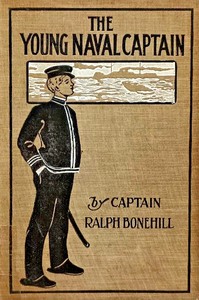
The young naval captain — Text and Context

(1 User reviews)   205
Stratemeyer, Edward, 1862-1930 Project Gutenberg 2025 Not confirmed
Science fiction; War stories; Conduct of life -- Juvenile fiction; Adventure stories; Friendship -- Juvenile fiction; Bombs -- Juvenile fiction; Voyages and travels -- Juvenile fiction; Seafaring life -- Juvenile fiction; Ship captains -- Juvenile fiction; Sailors -- Juvenile fiction; Submarines (Ships) -- Juvenile fiction; Youth -- Conduct of life -- Juvenile fiction; Courtship -- Juvenile fiction; Prisoners -- Juvenile fiction; Youth and death -- Juvenile fiction; Imaginary wars and battles -- Juvenile fiction Readers of public-domain and historical texts
Project Gutenberg digital edition en

Edition facts

Words 45,574
Reading time 199 min
Text sections 32

The catalog record for The young naval captain — Text and Context provides practical reading context through 45,574 words, 3 hr 19 min estimated reading time, and 32 detected text sections.

The text analysis averages about 14.2 words per sentence, while the detected sections provide another way to judge how the source is divided.

Project Gutenberg metadata also associates the work with “Science fiction,” connecting these edition facts with the source record’s subject description.

An early 20th-century boys' adventure imagining a global war, centered on Captain Oscar and the submarine Holland XI. The narrative moves rapidly between naval battles, spy missions, and bizarre encounters like a whale jamming the sub's hatch, using episodic structure and recurring motifs of explosive devices and underwater hazards.
Share
Editorial Edition Score 4.8/5

Calculated from edition completeness, EPUB availability, text structure and catalogue metadata. Not a user rating.

How this score is calculated
  • Description quality20 pts
  • Title & short description10 pts
  • Source metadata20 pts
  • Text length15 pts
  • Chapters / structure15 pts
  • EPUB file integrity20 pts

Total of 100 points, scaled to a 2.5-5.0 range. Editions with an empty description or a missing EPUB file are not scored.

Edition quality

Read the Text

CHAPTER I. The United States Against the World

CHAPTER II. First Battle on the Ocean

CHAPTER III. An Interview with the Secretary of the Navy

CHAPTER IV. Blowing Up of the Tien-Tsin

CHAPTER V. Prisoners of the Sea

CHAPTER VI. Out of a Living Tomb

CHAPTER VII. An Attack on the Japanese Troops

CHAPTER VIII. The Act of a Madman

CHAPTER IX. Another Blowing Up

CHAPTER X. The Fraudulent Message

CHAPTER XI. An Urgent Call for the Holland XI

CHAPTER XII. Defeat Turned Into Victory

CHAPTER XIII. The Central American Canal

CHAPTER XIV. Cast Upon the Shore

CHAPTER XV. Tidal Waves and Whales

CHAPTER XVI. Saving the Merchantman

CHAPTER XVII. Playing the Spy

CHAPTER XVIII. The Capture of Hang Chang

CHAPTER XIX. News of the President's Daughter

CHAPTER XX. The Cave Under the Ocean

CHAPTER XXI. Out of One Danger Into Another

CHAPTER XXII. A Run Not Wanted

CHAPTER XXIII. The Fight off Cape Nome

CHAPTER XXIV. Sinking of the Ivan II

CHAPTER XXV. In Which the Holland XI is Captured

CHAPTER XXVI. Prisoners on the Holland XI

CHAPTER XXVII. The Defeat of the Enemy

CHAPTER XXVIII. An Underwater Earthquake

CHAPTER XXIX. The Rescue of Jean Fevre

CHAPTER XXX. The Last Battle--Conclusion

My object in writing this imaginary tale of a war of all nations in years to come has been two-fold.

In the first place, I wished to draw the attention of my young readers to the fact that naval science, as well as science in all other branches, is making wonderful strides, and that for the future hardly anything seems impossible. In years gone by electric lights, the telephone and telegraph, not to mention wireless telegraphy, navigable balloons, and even our railroad trains would have been laughed at as impossibilities. Yet to-day we have all these things, and many others equally wonderful, and each day we look forward to something even more startling.

In the second place, I wished to draw attention to the fact that our country is growing with marvelous rapidity. From thirteen States we have multiplied to several times that number, and our flag waves from the coast of Maine in the East to the coast of Luzon in the West, and from Alaska in the North to Texas and Porto Rico in the South. What a truly great country it is, and what glorious freedom it grants to millions upon millions of people! In these days it is truly worth while to be an American, and in the days to come the honor will probably be even greater.

There is an important lesson to be learned from all this, and I would that every lad who reads these lines would take that lesson to heart. The opportunities for boys and young men were never greater than they are to-day. The future lies with you, and you can make of it, and of our grand country, what you will. The path to success is open to rich and to poor alike, and even the humble rail-splitter or the canal-boat boy can become President. Will you take hold of that opportunity or will you let it slip by?

CAPTAIN RALPH BONEHILL.

THE YOUNG NAVAL CAPTAIN.

THE UNITED STATES AGAINST THE WORLD.

"It is true. The news has just come by telephone from the cabinet chamber at Washington."

"Are you joking, Andy?"

"Oscar, I was never more serious in my life. The War Department has just sent the news to the office. The three new warships we are building must be completed without delay. The firm is offered a bonus of fifty thousand dollars if we can float them complete by the first of July."

"That is just six weeks off."

"Exactly, and it means that four months' work must be accomplished in that time. We can't do it," and Andy Greggs shook his head doubtfully.

He was a tall, well-built fellow of eighteen, with blue eyes and curly brown hair. He was a machinist, employed in the great Standard Shipyard of Bridgeport.

"We can do it and we will," answered Oscar Pelham decidedly. "We can work nights."

"It won't be enough."

"Then the firm will have to double the force."

"Where are you going to get the men?"

"Advertise for them--hunt for them--take them from other shipyards if necessary. If Uncle Sam wants those ships he is going to have them. But a war against the world! It's enough to stagger a fellow, Andy."

"So it is, Oscar, but it was bound to come, sooner or later. Foreign nations have been watching the United States with great envy since we whipped the Spaniards and gathered in Porto Rico and the Philippines, and when Cuba became a new state and Canada broke loose from England, I reckon they thought we were getting too big for our boots."

"No, the real trouble started in China," was the answer from Oscar Pelham. "England, France, Germany, Russia and Japan wanted to carve up poor China to suit themselves during the Yellow War of 1925 and Uncle Sam wouldn't allow it. Then South Africa tried for liberty again, and that put England's nose out of joint worse than ever when we helped the Boers to freedom. Then came the old quarrel about that money Turkey is owing us, and when we turned the Turkish kingdom inside out in 1928 that set all the rest of Europe in a rage."

"Well, we were justified in going for the Turks. They are the worst heathens on the face of the globe, outside of the Chinese."

"The Chinese ought to be our friends in this war, for we did so much for them when the other nations were after them. But England, Russia and the Japanese have bought her, body and soul, and now she is against us with all the rest."

"But we'll win out--we must win out!"

"Right you are! The Stars and Stripes forever!"

The conversation recorded above took place one spring morning of the year 1936.

For two years the United States--that vast territory which now embraces all of North America, from the Isthmus of Panama to Hudson Bay, and takes in all of the West Indies, Hawaii, the Philippines, and half a dozen other islands of the sea, as well as a corner of China and another corner of Japan--had been at peace with the world. We say peace. What we mean is, there was no war, but war talk was on every tongue.

In the past twenty-five years the country had prospered immensely. We now numbered over a hundred million of inhabitants, and nearly all of these were well-to-do and had money in the bank.

Jefferson McKinley Adams was President, and had been for six years, and under him were a standing army of five hundred thousand men, and a navy of five hundred of the best warships which human ingenuity could devise.

Many of the best of the warships had been turned out at the Standard Ship Yard at Bridgeport, which, up to a year before, had been under the personal supervision of Commodore David Pelham, the father of Oscar Pelham, just introduced. David Pelham had been a retired veteran of the Civil and the Spanish-American wars, and had followed his beloved wife to her grave, leaving Oscar alone in the world.

Oscar Pelham was a young man of nearly twenty, well-built and strong, with piercing black eyes and curly black hair.

At first he thought to follow his father into the navy, but he had a strong taste for electricity and mechanics generally, and he ended by entering the services of the ship building company, after spending three years at Edison's Electrical University at Llewellyn Park.

Oscar was a smart young man, and already many of his electric and other devices were beginning to attract attention. When the improved submarine torpedo-boat destroyer, Holland X., was building at Elizabethport he had gone to see her, and had come away much impressed by the novel construction of the craft.

"I'll build such a boat myself some day," he said to his boy friends, "only I'll make her better than anything afloat."

Some of his friends laughed at this, but others only smiled faintly. "Perhaps the boy is right," said one old machinist. "He had a smart father and a smart grandfather. Blood ought to tell."

And blood did tell, for, although only twenty years old, Oscar now had the whole run of the extensive shipyard and hardly any plan went through but what somebody came to him for his opinion on it.

Once Oscar disapproved of the plan of a new submarine boat, invented by an old war captain from Vermont.

"That boat will sink fast enough," he said. "But she won't come up."

The experts laughed at him and said he was mistaken. Then the boat was built. She sank on her first trial and blew up in her effort to raise herself.

After that Oscar Pelham's opinion counted for a good deal in all matters under consideration, so far as ship structure and the use of electricity went.

"Can't git around him," said George Dross, the oldest engineer in the yard. "He's got it all down on his finger tips. Him as tries ter corner him will git bit sure!"

The visit to the Holland X. had never left Oscar's mind. He remembered exactly how the submarine destroyer had been built and just how she was worked.

Once, when some of the naval vessels were at Newport, the Holland X. took a midnight trip among them, and Oscar was allowed on board.

The destroyer sank almost out of sight, and unknown to those on the big warships, passed completely around and under, first one vessel and then another.

"We could have blown every warship sky high!" said the inventor, but of this Oscar was doubtful. Yet he realized that the Holland X. was a grand boat and one calculated to do some terrific damage in a naval contest.

"But I'll build a better--wait and see," he said, over and over again, and when he was nineteen years of age he began to perfect the plans which had rested so long in his brain.

His boat was to be built of aluminum and steel--aluminum on account of its lightness and steel because of its strength. The craft was to be one hundred and fifteen feet long, sixteen feet wide, and eight to eleven feet six inches high. She was to be shaped like a stubby cigar and have three windows of glass on each side and one in front, and another in the stern. She was to have two small but exceedingly powerful screws, operated by an electric engine. She was to carry both natural and manufactured air, and had ample space for provisions and water, as well as ammunition, the latter to consist principally of torpedo tubes and dynamite bombs. She was to attain, under favorable circumstances, a speed of twenty-three knots an hour, and must work absolutely without noise, both while under water and while sailing over the surface.

Luckily for Oscar Pelham, his father had been rich, and upon the commodore's death, all the wealth went to the young inventor, to do with exactly as the young man saw fit. Several thousands of dollars were immediately spent upon a model of the Holland XI., as Oscar christened his craft, and this model was, one dark night, taken out on Long Island Sound for a trial.

No one was in the secret but Oscar and his particular friend, Andy Greggs, and it must be confessed that Andy was almost as anxious for success as the young inventor himself.

"If she runs all right, she'll be the biggest thing on the water," he declared.

"You ought to say, under the water," said Oscar.

The trial took the best part of the night and when it proved a perfect success Oscar Pelham could hardly contain himself.

"She'll be the submarine terror," he observed. "No warship, no matter how big she is, will be able to stand up against her secret attacks."

FIRST BATTLE ON THE OCEAN.

The news that war had been declared against practically the whole civilized world was correct.

In a thousand ways Uncle Sam tried to settle the many existing troubles without an appeal to arms, and had failed in each and every instance.

Other nations looked with keen envy upon our growth and development.

"We must cut that nation down," they said. "If we do not it will, sooner or later, rule us all, commercially and otherwise."

Yet the United States had no intention of ruling any nation without the people's consent.

Freedom had been given to Cuba and the Philippines, and some years later these islands had begged to be admitted, first as territories and then as states.

They saw how much it would be to their advantage to form part of our glorious Union. They saw that the United States was destined to become the one great world power.

Even when this great war broke out--the like of which the world had never before witnessed--several large countries of South America, as well as several smaller countries of Central America, were knocking for admission into the Union. Brazil, Chili, Peru and Honduras were among those who wished to enter.

Mexico had come in through the solicitation of the people of Texas, and after her admission the bitter Mexican war of 1848 was forgotten.

And nothing was now heard of the contest against the Filipinos. Aguinaldo was dead, yet in the main square of Manila an imposing monument had been erected to this remarkable military personage who had done so much and yet so little for his countrymen.

The appeal to arms created a tremendous excitement, both in the cities and in the country places.

In New York the whole population went wild, and a grand "war march," as it was termed, took place. The city at that time was built up solid as far as Yonkers, and the marchers proceeded as far as that, while some of the columns went over the four bridges uniting New York and Brooklyn and the two bridges reaching from Manhattan Island to the New Jersey shore.

The decorations were magnificent, and Oscar Pelham and Andy Greggs came down from Bridgeport to see them. Banners were flung from the tops of all the big buildings, including the Empire, which was fifty-six stories high, and balloons were anchored a mile in the air, each ablaze with electric lights, turning night into day.

It was felt that the war would be carried on principally on the ocean, or rather, on the oceans, and for that purpose every available warship was put into service with all possible speed.

Enlistments in the navy were followed by enlistments in the army, until our soldiers and sailors numbered over a million men.

The soldiers were armed with the Miles-Gilford electric repeating rifles, which were known to shoot with great accuracy up to two thousand yards.

The rifles of the sharpshooters were fitted with telescopes, and many of the sharpshooters could pick off an enemy at a mile distance with ease.

It was felt that the combined navies of the world would come first to our Eastern seacoast, and the coast defenses were put in the best possible condition without delay.

The forts at Sandy Hook and on Long Island were armed with the latest improved Hotchkiss bomb guns, which could carry projectiles weighing a thousand pounds a distance of sixteen to eighteen miles.

But it was felt that these fortifications were not sufficient, and others were speedily projected, taking in the whole coast from Nova Scotia to Florida, as well as Cuba, Porto Rico and other islands in that vicinity.

Our naval vessels, as said before, were as good as any on the face of the globe, and included the submarine boat, Holland, the one first accepted by the government in 1900, and also the Hollands III., V., VI., IX. and X., the II., IV., VII. and VIII. having been destroyed or condemned.

Much was expected of the Holland boats, especially in night work, when they might run out to any foreign warship and wreck her with one or more powerful torpedoes attached to her hull.

Those who managed the submarine vessels were enthusiastic about them, and had good reason to be.

One day Andy Greggs came into the shipyard wild with excitement.

"Something awful has happened!" he cried, as soon as he met Oscar.

"What is it?" demanded the young inventor.

"The Holland I. has been blown up into a million pieces!"

"Andy, you can't mean it."

"Who did it, some of the foreign warships?"

"No, one mean, miserable skunk of a man did it all."

"An Italian named Gabretti. He was employed on the boat as an engineer. The foreign governments bought him up, it's said, for a hundred thousand dollars, and he blew her up by connecting an electric battery with the torpedoes she was carrying."

"And were the crew killed?"

"To a man. Gabretti had just time enough to get into a steam launch when the Holland sailed skyward. The steam launch was followed by the cruiser Massachusetts, but escaped in the darkness, and it is surmised that the Italian went on board one of the foreign warships cruising around the Atlantic Ocean."

This news, startling as it was, was true.

Bitter was the denunciation of the Italian engineer, who was a naturalized citizen, and who had thus proved a traitor to his country, and the government immediately offered a reward of fifty thousand dollars for his capture, dead or alive.

"I'd like to earn that reward," said Andy Greggs.

"I would like to capture him," returned Oscar Pelham. "The traitor! He ought to be tortured to death!" Oscar came from a long line of true-blue patriots, and to his mind a traitor was the worst thing to be imagined.

The loss of the Holland I was a sore one for the United States, for during the past year England, Germany and France had constructed submarine boats of more or less efficacy, and it was now felt that we were at a disadvantage so far as this class of vessel was concerned.

But worse news followed. In two days came word that all the other submarine craft were either blown up or seriously damaged.

Soon came the news that a great fleet of foreign warships had been sighted off the coast of Nova Scotia. The guns at the forts in this vicinity had tried to reach the flotilla, but failed, for the foreign vessels had kept well out to sea.

The foreigners were headed southward, and it was felt that they would probably attack Boston or New York.

The foreign vessels numbered at least fifteen and to combat them the United States sent out twelve of their best warships, including the new Columbia, an armored cruiser of eighteen thousand tons displacement and carrying a battery of twelve twenty-pounders and sixteen twenty-inch guns.

The foreign fleet was sighted off Montauk Point and it was seen to head directly for New York Harbor.

It was on a rainy Saturday that the two fleets met, twenty miles off Sandy Hook.

The foreign ships had tried to enter New York Harbor under cover of the darkness the night before, but the powerful searchlights at Sandy Hook had exposed them, and one ship had been sunk by the guns from the forts and another had struck a submerged mine and been literally split in twain.

It was thirteen vessels to twelve, and the fight opened with a terrific bombardment from both sides which lasted for nearly an hour. The din could be plainly heard in New York, where it sounded like rolling thunder, and the top of every tall building was covered with spectators, with first-class telescopes, watching the magnificent contest.

At the end of an hour it looked as if the Americans had the better of the fight and those on shore were jubilant in consequence.

"We'll lick 'em out of their boots!" shouted more than one old veteran. "It's America against the world, and we are bound to come out on top!"

At this time but one American vessel, the Chicago, had sunk. Of the foreigners, a German and a French vessel were blown up, while a large Russian man-of-war and an Italian cruiser were in flames from stem to stern.

But now the fortunes of war turned swiftly.

For some unknown reason, the French and the German submarine boats which had accompanied the expedition had been delayed in getting to the battle ground, having run foul of some wreckage off the coast of Long Island.

Now they came up, and after some minute directions from the admiral in command of the Allies, as the foreigners were termed, both boats sank promptly out of sight.

The story opens with the United States at war with the entire world, and within the first chapter a naval battle is underway. Captain Oscar commands the submarine Holland XI, a vessel that becomes the focal point for a series of loosely connected episodes. The narrative moves quickly from one crisis to the next: a whale forces its head through the open hatch, a thunderstorm kills a crewman, and a merchantman is chased by Japanese warships. These events are linked less by a single plot than by the recurring need for Oscar to improvise solutions using the submarine's limited resources.

The structure is episodic, with each chapter presenting a self-contained problem—a bomb to disarm, a spy to capture, a tidal wave to survive. The author, writing under the pseudonym Captain Ralph Bonehill, emphasizes practical ingenuity over character development. The excerpts show a preference for action over reflection, with dialogue often reduced to exclamations and orders.

Episodic Structure and Rapid Scene Shifts

The book is divided into thirty chapters, each titled like a log entry: “First Battle on the Ocean,” “Blowing Up of the Tien-Tsin,” “Tidal Waves and Whales.” The narrative does not linger. A whale-crushing incident is resolved within a few pages, and the next chapter introduces a thunderstorm that kills a crewman. This rapid succession of events creates a rhythm of tension and release, but it also means that consequences are rarely explored. The dead sailor is consigned to the ocean with a brief prayer, and the story moves on.

The episodic structure is typical of boys’ adventure serials of the period. Each chapter could almost stand alone, and the submarine serves as a mobile stage for a variety of threats. The lack of a central antagonist or overarching goal means that the reader’s interest is sustained by the novelty of each new predicament rather than by character arcs or thematic depth.

Recurring Images: Explosives and Mechanical Solutions

Explosives appear repeatedly as a problem-solving tool. When a whale jams the submarine’s hatch, Oscar does not attempt to push it out; he rams a signaling shell into its mouth and detonates it. The explosion tears the whale’s head apart, freeing the vessel. This moment is emblematic of the book’s attitude toward violence: it is immediate, effective, and described with clinical detail (“fat and blood spattering all sides”).

Other instances include the blowing up of the Tien-Tsin and the use of bombs against enemy ships. The submarine itself is a mechanical marvel, and the narrative often pauses to describe its features—the trap-door, the screw, the ammunition room. These descriptions ground the fantastical premise in a veneer of technical plausibility, even if the science is vague. The recurring image of the shell or bomb as a key to escape reinforces the idea that force, not diplomacy, resolves conflicts.

Movement Between Underwater and Surface Worlds

The Holland XI moves constantly between depths and surface, and this vertical movement structures many scenes. The submarine sinks to escape storms, rises to engage enemies, and surfaces to take on fresh air or observe the horizon. The whale incident occurs because the trap-door is open at the surface; the thunderstorm death happens when a crewman goes on deck. These transitions are often abrupt, and the narrative uses them to shift the tone from claustrophobic danger to open-sea spectacle.

The contrast between the silent, safe underwater world and the chaotic surface is a recurring motif. Below, the crew is insulated from storms and enemy fire; above, they are vulnerable. Yet the submarine is also a prison when trapped, as in the chapter “Out of a Living Tomb.” The movement between these states creates a rhythm of confinement and release that drives the episodic plot.

Voice and Dialogue: Direct and Functional

The dialogue in the excerpts is terse and utilitarian. Characters speak in short exclamations or commands: “We must get rid of that whale!” “Shut the trap!” “Run away!” There is little banter or introspection. The speech patterns are consistent across characters—Oscar, Andy, and old George Dross all use similar clipped phrases. This uniformity suggests that the author prioritized plot momentum over individual voice.

The narrator’s voice is equally direct, often summarizing action in a single sentence: “The whale had struck the trap-door opening head first.” The prose avoids metaphor or elaborate description, focusing instead on physical details that advance the scene. This style suits the fast-paced adventure but can feel repetitive. The lack of emotional depth in the dialogue means that even dramatic moments, like the death of a crewman, are handled with matter-of-fact brevity.

Readers approaching The Young Naval Captain should expect a series of self-contained adventures rather than a unified novel. The submarine Holland XI is the true protagonist, and the human characters are interchangeable. The book’s value lies in its period flavor—an early vision of submarine warfare mixed with the improbable hazards of whales and tidal waves. For those interested in the evolution of boys’ adventure fiction or early 20th-century attitudes toward technology and conflict, this title offers a concise example of the genre’s conventions.

That old submarine yarn, with its whale jamming the hatch and bombs ticking everywhere, left a peculiar warmth—not for the battles, but for how calmly Oscar faced each absurd snag. It reminded me of another clever soul navigating chaos with a wink. The Extraordinary Adventures of Arsène Lupin, Gentleman-Burglar — A Closer Reading carries that same unhurried mischief, a quiet smile against the world’s noise.

Elijah Moore
1 week ago

4
4 out of 5 (1 User reviews )

Add a Review

Your Rating *
There are no comments for this eBook.

Reader reflection

How will you remember this book?

Save your reaction, strongest insight, and memorable passage.

Your progress 0 / 10
1

What is your current status with this title?

2

How much did you enjoy the reading experience?

3

Would you encourage someone else to read it?

4

How much effort did this book require?

Related eBooks