
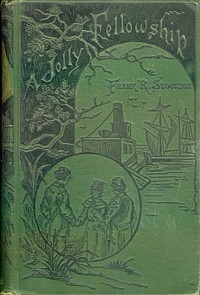
A Jolly Fellowship — Background and Themes

(1 User reviews)   166
Stockton, Frank R., 1834-1902 Project Gutenberg 2007 Not confirmed
Conduct of life -- Juvenile fiction; Young men -- Conduct of life -- Juvenile fiction; Adventure and adventurers -- Juvenile fiction; Voyages and travels -- Juvenile fiction; Seafaring life -- Juvenile fiction; Ship captains -- Juvenile fiction; Uncles -- Juvenile fiction; Enslaved persons -- Juvenile fiction; Queens -- Juvenile fiction Readers of public-domain and historical texts
Project Gutenberg digital edition en

Edition facts

Words 80,699
Reading time 351 min
Text sections 9

The source record for A Jolly Fellowship — Background and Themes measures this digital text at 80,699 words, 5 hr 51 min estimated reading time, and 9 detected text sections.

The text analysis averages about 16.2 words per sentence, while the detected sections provide another way to judge how the source is divided.

Project Gutenberg metadata also associates the work with “Conduct of life -- Juvenile fiction,” connecting these edition facts with the source record’s subject description.

Frank R. Stockton's 1880 novel follows sixteen-year-old Will Gordon and his companions on a sea voyage and Caribbean adventures. The first-person narration blends colloquial energy with formal interludes, as the group attempts to crown an elderly African woman as queen. The story's pace shifts between brisk dialogue and descriptive set pieces.
Share
Editorial Edition Score 4.8/5

Calculated from edition completeness, EPUB availability, text structure and catalogue metadata. Not a user rating.

How this score is calculated
  • Description quality20 pts
  • Title & short description10 pts
  • Source metadata20 pts
  • Text length15 pts
  • Chapters / structure15 pts
  • EPUB file integrity20 pts

Total of 100 points, scaled to a 2.5-5.0 range. Editions with an empty description or a missing EPUB file are not scored.

Edition quality

Read the Text

I was sitting on the deck of a Savannah steam-ship, which was lying at a dock in the East River, New York. I was waiting for young Rectus, and had already waited some time; which surprised me, because Rectus was, as a general thing, a very prompt fellow, who seldom kept people waiting. But it was probably impossible for him to regulate his own movements this time, for his father and mother were coming with him, to see him off.

I had no one there to see me off, but I did not care for that. I was sixteen years old, and felt quite like a man; whereas Rectus was only fourteen, and couldn't possibly feel like a man--unless his looks very much belied his feelings. My father and mother and sister lived in a small town some thirty miles from New York, and that was a very good reason for their not coming to the city just to see me sail away in a steam-ship. They took a good leave of me, though, before I left home.

I shall never forget how I first became acquainted with Rectus. About a couple of years before, he was a new boy in the academy at Willisville. One Saturday, a lot of us went down to the river to swim. Our favorite place was near an old wharf, which ran out into deep water, and a fellow could take a good dive there, when the tide was high. There were some of the smaller boys along that day, but they didn't dive any, and if they even swam, it was in shallow water near the shore, by the side of the wharf. But I think most of them spent their time wading about.

I was a good swimmer, and could dive very well. I was learning to swim under water, but had not done very much in that line at the time I speak of. We were nearly ready to come out, when I took a dive from a post on the end of the wharf, and then turned, under water, to swim in shore. I intended to try to keep under until I got into water shallow enough for me to touch bottom, and walk ashore. After half a dozen strokes, I felt for the bottom and my feet touched it. Then I raised my head, but I didn't raise it out of the water. It struck something hard.

In an instant I knew what had happened. There was a big mud-scow lying by the side of the wharf, and I had got under that! It was a great flat thing, ever so long and very wide. I knew I must get from under it as quickly as I could. Indeed, I could hardly hold my breath now. I waded along with my head bent down, but I didn't reach the side of it. Then I turned the other way, but my hands, which I held up, still touched nothing but the hard, slimy bottom of the scow. I must have been wading up and down the length of the thing. I was bewildered. I couldn't think which way to turn. I could only think of one thing. I would be drowned in less than a minute. Scott would be head of the class. My mother, and little Helen--but I can't tell what my thoughts were then. They were dreadful. But just as I was thinking of Helen and mother, I saw through the water some white things, not far from me. I knew by their looks that they were a boy's legs.

I staggered toward them, and in a moment my hands went out of water, just at the side of the scow. I stood up, and my head with half my body came up into the air.

What a breath I drew! But I felt so weak and shaky that I had to take hold of the side of the scow, and stand there for a while before I waded ashore. The boy who was standing by me was Rectus. He did not have that name then, and I didn't know him.

"It must be pretty hard to stay under water so long," he said.

"Hard!" I answered, as soon as I could get my breath; "I should think so. Why, I came near being drowned!"

"Is that so?" said he; "I didn't know that. I saw you go down, and have been watching for you to come up. But I didn't expect you to come from under the scow."

How glad I was that he had been standing there watching for me to come up! If he had not been there, or if his legs had been green or the color of water, I believe I should have drowned.

I always liked the boy after that, though, of course, there was no particular reason for it. He was a boarder. His parents lived in New York. Samuel Colbert was his real name, and the title of Rectus he obtained at school by being so good. He scarcely ever did anything wrong, which was rather surprising to the rest of us, because he was not sickly or anything of that kind. After a while, we got into the way of calling him Rectus, and as he didn't seem to mind it, the name stuck to him. The boys generally liked him, and he got on quite well in the school,--in every way except in his studies. He was not a smart boy, and did not pretend to be.

I went right through the academy, from the lowest to the highest class, and when I left, the professor, as we called our principal, said that I was ready to go to college, and urged me very much to do so. But I was not in any hurry, and my parents agreed with me that, after four years of school-life, I had better wait a while before beginning a new course. All this disturbed the professor very much, but he insisted on my keeping up my studies, so as not to get rusty, and he came up to our house very often, for the purpose of seeing what I was doing in the study line, and how I was doing it.

I thought over things a good deal for myself, and a few months after I left the academy I made up my mind to travel a little. I talked about it at home, and it was generally thought to be a good idea, although my sister was in favor of it only in case I took her with me. Otherwise she opposed it. But there were a great many reasons why I could not take her. She was only eleven.

I had some money of my own, which I thought I would rather spend in travel than in any other way, and, as it was not a large sum, and as my father could not afford to add anything to it, my journey could not be very extensive. Indeed, I only contemplated going to Florida and perhaps a few other Southern States, and then--if it could be done--a visit to some of the West India islands, and, as it was winter-time, that would be a very good trip. My father did not seem to be afraid to trust me to go alone. He and the professor talked it over, and they thought that I would take good enough care of myself. The professor would have much preferred to see me go to college, but, as I was not to do that, he thought travelling much better for me than staying at home, although I made no promise about taking my books along. But it was pretty well settled that I was to go to college in the fall, and this consoled him a little.

The person who first suggested this travelling plan was our old physician, Dr. Mathews. I don't know exactly what he said about it, but I knew he thought I had been studying too hard, and needed to "let up" for a while. And I'm sure, too, that he was quite positive that I would have no let up as long as I staid in the same town with the professor.

Nearly a year before this time, Rectus had left the academy. He had never reached the higher classes,--in fact, he didn't seem to get on well at all. He studied well enough, but he didn't take hold of things properly, and I believe he really did not care to go through the school. But he was such a quiet fellow that we could not make much out of him. His father was very rich, and we all thought that Rectus was taken away to be brought up as a partner in the firm. But we really knew nothing about it: for, as I found out afterward, Rectus spent all his time, after he left school, in studying music.

Soon after my trip was all agreed upon and settled, father had to go to New York, and there he saw Mr. Colbert, and of course told him of my plans. That afternoon, old Colbert came to my father's hotel, and proposed to him that I should take his son with me. He had always heard, he said, that I was a sensible fellow, and fit to be trusted, and he would be very glad to have his boy travel with me. And he furthermore said that if I had the care of Samuel--for of course he didn't call his son Rectus--he would pay me a salary. He had evidently read about young English fellows travelling on the continent with their tutors, and I suppose he wanted me to be his son's tutor, or something like it.

When father told me what Mr. Colbert had proposed, I agreed instantly. I liked Rectus, and the salary would help immensely. I wrote to New York that very night, accepting the proposition.

When my friends in the town, and those at the school, heard that Rectus and I were going off together, they thought it an uncommonly good joke, and they crowded up to our house to see me about it.

"Two such good young men as you and Rectus travelling together ought to have a beneficial influence upon whole communities," said Harry Alden; and Scott remarked that if there should be a bad storm at sea, he would advise us two to throw everybody else overboard to the whales, for the other people would be sure to be the wicked ones. I am happy to say that I got a twist on Scott's ear that made him howl, and then mother came in and invited them all to come and take supper with me, the Tuesday before I started. We invited Rectus to come up from the city, but he did not make his appearance. However, we got on first-rate without him, and had a splendid time. There was never a woman who knew just how to make boys have a good time, like my mother.

I had been a long while on the steamer waiting for Rectus. She was to sail at three o'clock, and it was then after two. The day was clear and fine, but so much sitting and standing about had made me cold, so that I was very glad to see a carriage drive up with Rectus and his father and mother. I went down to them. I was anxious to see Rectus, for it had been nearly a year since we had met. He seemed about the same as he used to be, and had certainly not grown much. He just shook hands with me and said, "How d' ye do, Gordon?" Mr. and Mrs. Colbert seemed ever so much more pleased to see me, and when we went on the upper deck, the old gentleman took me into the captain's room, the door of which stood open. The captain was not there, but I don't believe Mr. Colbert would have cared if he had been. All he seemed to want was to find a place where we could get away from the people on deck. When he had partly closed the door, he said:

"Have you got your ticket?"

"Oh, yes!" I answered; "I bought that ten days ago. I wrote for it."

"That's right," said he, "and here is Sammy's ticket. I was glad to see that you had spoken about the other berth in your state-room being reserved for Sammy."

I thought he needn't have asked me if I had my ticket when he knew that I had bought it. But perhaps he thought I had lost it by this time. He was a very particular little man.

"Where do you keep your money?" he asked me, and I told him that the greater part of it--all but some pocket-money--was stowed away in an inside pocket of my vest.

"Very good," said he; "that's better than a pocket-book or belt: but you must pin it in. Now, here is Sammy's money--for his travelling expenses and his other necessities; I have calculated that that will be enough for a four months' trip, and you wont want to stay longer than that. But if this runs out, you can write to me. If you were going to Europe, now, I'd get you a letter of credit, but for your sort of travelling, you'd better have the money with you. I did think of giving you a draft on Savannah, but you'd have to draw the money there--and you might as well have it here. You're big enough to know how to take care of it." And with this he handed me a lot of banknotes.

"And now, what about your salary? Would you like to have it now, or wait until you come back?"

This question made my heart jump, for I had thought a great deal about how I was to draw that salary. So, quick enough, I said that I'd like to have it now.

"I expected so," said he, "and here's the amount for four months. I brought a receipt. You can sign it with a lead-pencil. That will do. Now put all this money in your inside pockets. Some in your vest, and some in your under-coat. Don't bundle it up too much, and be sure and pin it in. Pin it from the inside, right through the money, if you can. Put your clothes under your pillow at night. Good-bye! I expect they'll be sounding the gong directly, for us to get ashore."

And so he hurried out. I followed him, very much surprised. He had spoken only of money, and had said nothing about his son,--what he wished me to do for him, what plans of travel or instruction he had decided upon, or anything, indeed, about the duties for which I was to be paid. I had expected that he would come down early to the steamer and have a long talk about these matters. There was no time to ask him any questions now, for he was with his wife, trying to get her to hurry ashore. He was dreadfully afraid that they would stay on board too long, and be carried to sea.

Mrs. Colbert, however, did not leave me in any doubt as to what she wanted me to do. She rushed up to me, and seized me by both hands.

"Now you will take the greatest and the best care of my boy, wont you? You'll cherish him as the apple of your eye? You'll keep him out of every kind of danger? Now _do_ take good care of him,--especially in storms."

I tried to assure Rectus's mother--she was a wide, good-humored lady--that I would do as much of all this as I could, and what I said seemed to satisfy her, for she wiped her eyes in a very comfortable sort of a way.

Mr. Colbert got his wife ashore as soon as he could, and Rectus and I stood on the upper deck and watched them get into the carriage and drive away. Rectus did not look as happy as I thought a fellow ought to look, when starting out on such a jolly trip as we expected this to be.

I proposed that we should go and look at our state-room, which was number twenty-two, and so we went below. The state-room hadn't much state about it. It was very small, with two shelves for us to sleep on. I let Rectus choose his shelf, and he took the lower one. This suited me very well, for I'd much rather climb over a boy than have one climb over me.

There wasn't anything else in the room to divide, and we were just about to come out and call the thing settled, when I heard a shout at the door. I turned around, and there stood Harry Alden, and Scott, and Tom Myers and his brother George!

I tell you, I was glad to see them. In spite of all my reasoning that it made no difference about anybody coming to see me off, it did make a good deal of difference. It was a lonely sort of business starting off in that way--especially after seeing Rectus's father and mother come down to the boat with him.

"We didn't think of this until this morning," cried Scott. "And then we voted it was too mean to let you go off without anybody to see you safely on board----"

"And so our class appointed a committee," Scott went on, "to come down and attend to you, and we're the committee. It ought to have been fellows that had gone through the school, but there were none of them there."

"So we came," said Scott. "We raised all the spare cash there was in the class, and there was only enough to send four of us. We drew lots. If it hadn't been you, I don't believe the professor would have let us off. Any way, we missed the noon train, and were afraid, all the way here, that we'd be too late. Do you two fellows have to sleep in those 'cubby-holes'?"

"Certainly," said I; "they're big enough."

"Don't believe it," said Harry Alden; "they're too short."

"That's so," said Scott, who was rather tall for his age. "Let's try 'em."

This was agreed to on the spot, and all four of the boys took off their boots and got into the berths, while Rectus and I sat down on the little bench at the side of the room and laughed at them. Tom Myers and his brother George both climbed into the top berth at once, and as they found it was a pretty tight squeeze, they both tried to get out at once, and down they came on Scott, who was just turning out of the lower berth,--which was too long for him, in spite of all his talk,--and then there was a much bigger tussle, all around, than any six boys could make with comfort in a little room like that.

I hustled Tom Myers and his brother George out into the dining-room, and the other fellows followed.

"Is this where you eat?" asked Scott, looking up and down at the long tables, with the swinging shelves above them.

"No, this isn't where they eat," said Harry; "this is where they come to look at victuals, and get sick at the sight of them."

"Sick!" said I; "not much of it."

But the committee laughed, and didn't seem to agree with me.

"You'll be sick ten minutes after the boat starts," said Scott.

"We wont get into sea-sick water until we're out of the lower bay," I said. "And this isn't a boat--it's a ship. You fellows know lots!"

Tom Myers and his brother George were trying to find out why the tumblers and glasses were all stuck into holes in the shelves over the tables, when Harry Alden sung out:

"What's that swishing?"

"There it goes again!" Harry cried. "Splashing!"

"It's the wheels!" exclaimed Rectus.

"That's so!" cried Scott. "The old thing's off! Rush up! Here! The hind-stairs! Quick!"

And upstairs to the deck we all went, one on top of another. The wheels were going around, and the steamer was off!

Already she was quite a distance from the wharf. I suppose the tide carried her out, as soon as the lines were cast off, for I'm sure the wheels had not been in motion half a minute before we heard them. But all that made no difference. We were off.

I never saw four such blank faces as the committee wore, when they saw the wide space of water between them and the wharf.

Frank R. Stockton’s A Jolly Fellowship (1880) is narrated by sixteen-year-old Will Gordon, who announces in the preface that he “saw for himself everything worth seeing” and therefore knows more than any hearsay-dependent reporter. This claim of authority sets the tone for a first-person account that is both self-assured and occasionally self-deprecating. Will’s voice is colloquial and direct, peppered with phrases like “I think the probability was” and “we didn’t seem anxious to tell him,” which give the narration a conversational, almost offhand quality. Yet the story also contains moments of formal address—such as the governor’s office scene, where the boys and a girl named Corny petition for an African queen—that slow the pace and introduce a more deliberate, almost theatrical rhythm. The tension between Will’s breezy storytelling and the formal situations he describes is a key feature of the narrative’s shifting pace.

Will Gordon’s Narrative Voice

Will Gordon speaks directly to the reader, using a casual, observant style that often undercuts his own seriousness. He describes himself as “rather large for his age, and very fond of being a leader among his young companions,” but his narration reveals a boy who is more reactive than commanding. When the group visits the governor, Will whispers to Rectus, “if you’re captain, you’ve got to step up and do the talking. It isn’t my place,” showing a willingness to cede authority when the situation demands formality. His descriptions are vivid but restrained: the governor’s office is “a large room, with plenty of book-cases and shelves against the walls,” and the governor himself is “dressed all in white linen, which gave him an air of coolness and cleanness.” Will’s eye for detail—such as noting that the secretary “arranged the chairs before we came in”—adds a layer of wry observation that keeps the narrative grounded.

Pace Shifts: From Brisk Dialogue to Formal Scenes

The novel’s pace varies markedly between rapid-fire dialogue and extended, almost stage-like encounters. In the governor’s office, the exchange is quick and playful: when Rectus says “a poor queen, a very good and honest woman,” the governor interrupts with “A poor but honest queen!” and Corny jumps in to clarify, “Oh, he don’t mean a common queen … He means a black queen,—an African.” The dialogue here is snappy, with characters finishing each other’s thoughts. But the scene itself is drawn out, with careful descriptions of the room’s furnishings and the governor’s demeanor. Earlier, the narrative moves briskly through action: “We then went up to the red-coat, and asked to see the governor. The soldier looked at us a little queerly, and went back into the house.” The contrast between these quick, almost cinematic cuts and the slower, more descriptive passages creates a rhythm that keeps the reader engaged while allowing for moments of reflection.

Recurring Details: The Queen and the Beans

Two recurring details anchor the narrative: the elderly African queen and the “three gray beans.” The queen is introduced as a woman who “sells peppers” but retains her royal status, and the boys’ project to crown her becomes a central plot thread. Corny insists that “selling things on a door-step can’t take the royal blood out of a person,” a line that echoes the novel’s interest in dignity versus circumstance. The “three gray beans” appear in a chapter title and are mentioned in the table of contents, suggesting a motif that may recur throughout the story. These concrete objects—the queen’s peppers, the beans—serve as touchstones that ground the fantastical elements of the plot in everyday reality. The narrative’s attention to such details, from the governor’s white linen suit to the “packages of manuscript tied up with tape,” creates a world that feels both specific and whimsical.

Readers should pay attention to how Stockton uses Will’s first-person perspective to control the story’s pace. The narrator’s tendency to summarize or skip over certain events—such as the journey itself—while lingering on others, like the audience with the governor, creates an uneven but deliberate rhythm. The novel rewards those who notice the small, recurring objects and the way characters’ voices shift between informal and formal registers. Approach A Jolly Fellowship as a travelogue filtered through a young narrator’s selective memory, where the jolliness of the title is tempered by moments of genuine negotiation and surprise.

Reading A Jolly Fellowship again, I found myself thinking of how Will’s restless energy never quite quiets the odd, formal pauses in his tale. That same tug-of-war—between breezy adventure and something more serious underneath—reminded me of Frank Merriwell's danger — Context and Discussion, where the excitement feels similarly weighted by quieter concerns. It’s a strange, fond echo, one book softly calling another to mind.

Aria Rivera
4 weeks ago

5
5 out of 5 (1 User reviews )

Add a Review

Your Rating *
There are no comments for this eBook.

Reader reflection

What did you think of this book?

Answer a few questions and save a private reflection on this device.

Your progress 0 / 10
1

Have you finished this book?

2

What was your overall reaction to the book?

3

Would you encourage someone else to read it?

4

How demanding did the text feel?

Related eBooks