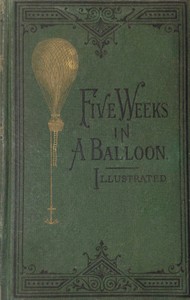
Five Weeks in a Balloon Or, Journeys and Discoveries in Africa by Three Englishmen — Inside the Classic
Edition facts
The source record for Five Weeks in a Balloon Or, Journeys and Discoveries in Africa by Three Englishmen — Inside the Classic measures this digital text at 97,550 words, 7 hr 5 min estimated reading time, and 47 detected text sections.
The text analysis averages about 16.5 words per sentence, while the detected sections provide another way to judge how the source is divided.
Project Gutenberg metadata also associates the work with “Science fiction,” connecting these edition facts with the source record’s subject description.
Calculated from edition completeness, EPUB availability, text structure and catalogue metadata. Not a user rating.
How this score is calculated
- Description quality20 pts
- Title & short description10 pts
- Source metadata20 pts
- Text length15 pts
- Chapters / structure15 pts
- EPUB file integrity20 pts
Total of 100 points, scaled to a 2.5-5.0 range. Editions with an empty description or a missing EPUB file are not scored.
Read the Text
ill complete and link together the notions, as yet disjointed, which the world entertains of African cartology” (vehement applause); “and, should it fail, it will, at least, remain on record as one of the most daring conceptions of human genius!” (Tremendous cheering.)
“Huzza! huzza!” shouted the immense audience, completely electrified by these inspiring words.
“Huzza for the intrepid Ferguson!” cried one of the most excitable of the enthusiastic crowd.
The wildest cheering resounded on all sides; the name of Ferguson was in every mouth, and we may safely believe that it lost nothing in passing through English throats. Indeed, the hall fairly shook with it.
And there were present, also, those fearless travellers and explorers whose energetic temperaments had borne them through every quarter of the globe, many of them grown old and worn out in the service of science. All had, in some degree, physically or morally, undergone the sorest trials. They had escaped shipwreck; conflagration; Indian tomahawks and war-clubs; the fagot and the stake; nay, even the cannibal maws of the South Sea Islanders. But still their hearts beat high during Sir Francis M——’s address, which certainly was the finest oratorical success that the Royal Geographical Society of London had yet achieved.
But, in England, enthusiasm does not stop short with mere words. It strikes off money faster than the dies of the Royal Mint itself. So a subscription to encourage Dr. Ferguson was voted there and then, and it at once attained the handsome amount of two thousand five hundred pounds. The sum was made commensurate with the importance of the enterprise.
A member of the Society then inquired of the president whether Dr. Ferguson was not to be officially introduced.
“The doctor is at the disposition of the meeting,” replied Sir Francis.
“Let him come in, then! Bring him in!” shouted the audience. “We’d like to see a man of such extraordinary daring, face to face!”
“Perhaps this incredible proposition of his is only intended to mystify us,” growled an apoplectic old admiral.
“Suppose that there should turn out to be no such person as Dr. Ferguson?” exclaimed another voice, with a malicious twang.
“Why, then, we’d have to invent one!” replied a facetious member of this grave Society.
“Ask Dr. Ferguson to come in,” was the quiet remark of Sir Francis M——.
And come in the doctor did, and stood there, quite unmoved by the thunders of applause that greeted his appearance.
He was a man of about forty years of age, of medium height and physique. His sanguine temperament was disclosed in the deep color of his cheeks. His countenance was coldly expressive, with regular features, and a large nose—one of those noses that resemble the prow of a ship, and stamp the faces of men predestined to accomplish great discoveries. His eyes, which were gentle and intelligent, rather than bold, lent a peculiar charm to his physiognomy. His arms were long, and his feet were planted with that solidity which indicates a great pedestrian.
A calm gravity seemed to surround the doctor’s entire person, and no one would dream that he could become the agent of any mystification, however harmless.
Hence, the applause that greeted him at the outset continued until he, with a friendly gesture, claimed silence on his own behalf. He stepped toward the seat that had been prepared for him on his presentation, and then, standing erect and motionless, he, with a determined glance, pointed his right forefinger upward, and pronounced aloud the single word—
Never had one of Bright’s or Cobden’s sudden onslaughts, never had one of Palmerston’s abrupt demands for funds to plate the rocks of the English coast with iron, made such a sensation. Sir Francis M——‘s address was completely overshadowed. The doctor had shown himself moderate, sublime, and self-contained, in one; he had uttered the word of the situation—
The gouty old admiral who had been finding fault, was completely won over by the singular man before him, and immediately moved the insertion of Dr. Ferguson’s speech in “The Proceedings of the Royal Geographical Society of London.”
Who, then, was this person, and what was the enterprise that he proposed?
Ferguson’s father, a brave and worthy captain in the English Navy, had associated his son with him, from the young man’s earliest years, in the perils and adventures of his profession. The fine little fellow, who seemed to have never known the meaning of fear, early revealed a keen and active mind, an investigating intelligence, and a remarkable turn for scientific study; moreover, he disclosed uncommon address in extricating himself from difficulty; he was never perplexed, not even in handling his fork for the first time—an exercise in which children generally have so little success.
His fancy kindled early at the recitals he read of daring enterprise and maritime adventure, and he followed with enthusiasm the discoveries that signalized the first part of the nineteenth century. He mused over the glory of the Mungo Parks, the Bruces, the Caillies, the Levaillants, and to some extent, I verily believe, of Selkirk (Robinson Crusoe), whom he considered in no wise inferior to the rest. How many a well-employed hour he passed with that hero on his isle of Juan Fernandez! Often he criticised the ideas of the shipwrecked sailor, and sometimes discussed his plans and projects. He would have done differently, in such and such a case, or quite as well at least—of that he felt assured. But of one thing he was satisfied, that he never should have left that pleasant island, where he was as happy as a king without subjects—no, not if the inducement held out had been promotion to the first lordship in the admiralty!
It may readily be conjectured whether these tendencies were developed during a youth of adventure, spent in every nook and corner of the Globe. Moreover, his father, who was a man of thorough instruction, omitted no opportunity to consolidate this keen intelligence by serious studies in hydrography, physics, and mechanics, along with a slight tincture of botany, medicine, and astronomy.
Upon the death of the estimable captain, Samuel Ferguson, then twenty-two years of age, had already made his voyage around the world. He had enlisted in the Bengalese Corps of Engineers, and distinguished himself in several affairs; but this soldier’s life had not exactly suited him; caring but little for command, he had not been fond of obeying. He, therefore, sent in his resignation, and half botanizing, half playing the hunter, he made his way toward the north of the Indian Peninsula, and crossed it from Calcutta to Surat—a mere amateur trip for him.
From Surat we see him going over to Australia, and in 1845 participating in Captain Sturt’s expedition, which had been sent out to explore the new Caspian Sea, supposed to exist in the centre of New Holland.
Samuel Ferguson returned to England about 1850, and, more than ever possessed by the demon of discovery, he spent the intervening time, until 1853, in accompanying Captain McClure on the expedition that went around the American Continent from Behring’s Straits to Cape Farewell.
Notwithstanding fatigues of every description, and in all climates, Ferguson’s constitution continued marvellously sound. He felt at ease in the midst of the most complete privations; in fine, he was the very type of the thoroughly accomplished explorer whose stomach expands or contracts at will; whose limbs grow longer or shorter according to the resting-place that each stage of a journey may bring; who can fall asleep at any hour of the day or awake at any hour of the night.
Nothing, then, was less surprising, after that, than to find our traveller, in the period from 1855 to 1857, visiting the whole region west of the Thibet, in company with the brothers Schlagintweit, and bringing back some curious ethnographic observations from that expedition.
During these different journeys, Ferguson had been the most active and interesting correspondent of the _Daily Telegraph_, the penny newspaper whose circulation amounts to 140,000 copies, and yet scarcely suffices for its many legions of readers. Thus, the doctor had become well known to the public, although he could not claim membership in either of the Royal Geographical Societies of London, Paris, Berlin, Vienna, or St. Petersburg, or yet with the Travellers’ Club, or even the Royal Polytechnic Institute, where his friend the statistician Cockburn ruled in state.
The latter _savant_ had, one day, gone so far as to propose to him the following problem: Given the number of miles travelled by the doctor in making the circuit of the Globe, how many more had his head described than his feet, by reason of the different lengths of the radii?—or, the number of miles traversed by the doctor’s head and feet respectively being given, required the exact height of that gentleman?
This was done with the idea of complimenting him, but the doctor had held himself aloof from all the learned bodies—belonging, as he did, to the church militant and not to the church polemical. He found his time better employed in seeking than in discussing, in discovering rather than discoursing.
There is a story told of an Englishman who came one day to Geneva, intending to visit the lake. He was placed in one of those odd vehicles in which the passengers sit side by side, as they do in an omnibus. Well, it so happened that the Englishman got a seat that left him with his back turned toward the lake. The vehicle completed its circular trip without his thinking to turn around once, and he went back to London delighted with the Lake of Geneva.
Doctor Ferguson, however, had turned around to look about him on his journeyings, and turned to such good purpose that he had seen a great deal. In doing so, he had simply obeyed the laws of his nature, and we have good reason to believe that he was, to some extent, a fatalist, but of an orthodox school of fatalism withal, that led him to rely upon himself and even upon Providence. He claimed that he was impelled, rather than drawn by his own volition, to journey as he did, and that he traversed the world like the locomotive, which does not direct itself, but is guided and directed by the track it runs on.
“I do not follow my route;” he often said, “it is my route that follows me.”
The reader will not be surprised, then, at the calmness with which the doctor received the applause that welcomed him in the Royal Society. He was above all such trifles, having no pride, and less vanity. He looked upon the proposition addressed to him by Sir Francis M——as the simplest thing in the world, and scarcely noticed the immense effect that it produced.
When the session closed, the doctor was escorted to the rooms of the Travellers’ Club, in Pall Mall. A superb entertainment had been prepared there in his honor. The dimensions of the dishes served were made to correspond with the importance of the personage entertained, and the boiled sturgeon that figured at this magnificent repast was not an inch shorter than Dr. Ferguson himself.
Numerous toasts were offered and quaffed, in the wines of France, to the celebrated travellers who had made their names illustrious by their explorations of African territory. The guests drank to their health or to their memory, in alphabetical order, a good old English way of doing the thing. Among those remembered thus, were: Abbadie, Adams, Adamson, Anderson, Arnaud, Baikie, Baldwin, Barth, Batouda, Beke, Beltram, Du Berba, Bimbachi, Bolognesi, Bolwik, Belzoni, Bonnemain, Brisson, Browne, Bruce, Brun-Rollet, Burchell, Burckhardt, Burton, Cailland, Caillie, Campbell, Chapman, Clapperton, Clot-Bey, Colomieu, Courval, Cumming, Cuny, Debono, Decken, Denham, Desavanchers, Dicksen, Dickson, Dochard, Du Chaillu, Duncan, Durand, Duroule, Duveyrier, D’Escayrac, De Lauture, Erhardt, Ferret, Fresnel, Galinier, Galton, Geoffroy, Golberry, Hahn, Halm, Harnier, Hecquart, Heuglin, Hornemann, Houghton, Imbert, Kauffmann, Knoblecher, Krapf, Kummer, Lafargue, Laing, Lafaille, Lambert, Lamiral, Lampriere, John Lander, Richard Lander, Lefebvre, Lejean, Levaillant, Livingstone, MacCarthy, Maggiar, Maizan, Malzac, Moffat, Mollien, Monteiro, Morrison, Mungo Park, Neimans, Overweg, Panet, Partarrieau, Pascal, Pearse, Peddie, Penney, Petherick, Poncet, Prax, Raffenel, Rabh, Rebmann, Richardson, Riley, Ritchey, Rochet d’Hericourt, Rongawi, Roscher, Ruppel, Saugnier, Speke, Steidner, Thibaud, Thompson, Thornton, Toole, Tousny, Trotter, Tuckey, Tyrwhitt, Vaudey, Veyssière, Vincent, Vinco, Vogel, Wahlberg, Warrington, Washington, Werne, Wild, and last, but not least, Dr. Ferguson, who, by his incredible attempt, was to link together the achievements of all these explorers, and complete the series of African discovery.
The Article in the Daily Telegraph.—War between the Scientific Journals.—Mr. Petermann backs his Friend Dr. Ferguson.—Reply of the Savant Koner.—Bets made.—Sundry Propositions offered to the Doctor.
On the next day, in its number of January 15th, the _Daily Telegraph_ published an article couched in the following terms:
“Africa is, at length, about to surrender the secret of her vast solitudes; a modern Œdipus is to give us the key to that enigma which the learned men of sixty centuries have not been able to decipher. In other days, to seek the sources of the Nile—_fontes Nili quærere_—was regarded as a mad endeavor, a chimera that could not be realized.
“Dr. Barth, in following out to Soudan the track traced by Denham and Clapperton; Dr. Livingstone, in multiplying his fearless explorations from the Cape of Good Hope to the basin of the Zambesi; Captains Burton and Speke, in the discovery of the great interior lakes, have opened three highways to modern civilization. _Their point of intersection_, which no traveller has yet been able to reach, is the very heart of Africa, and it is thither that all efforts should now be directed.
“The labors of these hardy pioneers of science are now about to be knit together by the daring project of Dr. Samuel Ferguson, whose fine explorations our readers have frequently had the opportunity of appreciating.
“This intrepid discoverer proposes to traverse all Africa from east to west _in a balloon_. If we are well informed, the point of departure for this surprising journey is to be the island of Zanzibar, upon the eastern coast. As for the point of arrival, it is reserved for Providence alone to designate.
“The proposal for this scientific undertaking was officially made, yesterday, at the rooms of the Royal Geographical Society, and the sum of twenty-five hundred pounds was voted to defray the expenses of the enterprise.
“We shall keep our readers informed as to the progress of this enterprise, which has no precedent in the annals of exploration.”
As may be supposed, the foregoing article had an enormous echo among scientific people. At first, it stirred up a storm of incredulity; Dr. Ferguson passed for a purely chimerical personage of the Barnum stamp, who, after having gone through the United States, proposed to “do” the British Isles.
A humorous reply appeared in the February number of the _Bulletins de la Société Géographique_ of Geneva, which very wittily showed up the Royal Society of London and their phenomenal sturgeon.
But Herr Petermann, in his _Mittheilungen_, published at Gotha, reduced the Geneva journal to the most absolute silence. Herr Petermann knew Dr. Ferguson personally, and guaranteed the intrepidity of his dauntless friend.
Besides, all manner of doubt was quickly put out of the question: preparations for the trip were set on foot at London; the factories of Lyons received a heavy order for the silk required for the body of the balloon; and, finally, the British Government placed the transport-ship _Resolute_, Captain Bennett, at the disposal of the expedition.
At once, upon word of all this, a thousand encouragements were offered, and felicitations came pouring in from all quarters. The details of the undertaking were published in full in the bulletins of the Geographical Society of Paris; a remarkable article appeared in the _Nouvelles Annales des Voyages, de la Géographie, de l’Histoire, et de l’Archaeologie de M. V. A. Malte-Brun_ (“New Annals of Travels, Geography, History, and Archaeology, by M. V. A. Malte-Brun”); and a searching essay in the _Zeitschrift für Allgemeine Erdkunde_, by Dr. W. Koner, triumphantly demonstrated the feasibility of the journey, its chances of success, the nature of the obstacles existing, the immense advantages of the aërial mode of locomotion, and found fault with nothing but the selected point of departure, which it contended should be Massowah, a small port in Abyssinia, whence James Bruce, in 1768, started upon his explorations in search of the sources of the Nile. Apart from that, it mentioned, in terms of unreserved admiration, the energetic character of Dr. Ferguson, and the heart, thrice panoplied in bronze, that could conceive and undertake such an enterprise.
The _North American Review_ could not, without some displeasure, contemplate so much glory monopolized by England. It therefore rather ridiculed the doctor’s scheme, and urged him, by all means, to push his explorations as far as America, while he was about it.
In a word, without going over all the journals in the world, there was not a scientific publication, from the _Journal of Evangelical Missions_ to the _Revue Algérienne et Coloniale_, from the _Annales de la Propagation de la Foi_ to the _Church Missionary Intelligencer_, that had not something to say about the affair in all its phases.
Many large bets were made at London and throughout England generally, first, as to the real or supposititious existence of Dr. Ferguson; secondly, as to the trip itself, which, some contended, would not be undertaken at all, and which was really contemplated, according to others; thirdly, upon the success or failure of the enterprise; and fourthly, upon the probabilities of Dr. Ferguson’s return. The betting-books were covered with entries of immense sums, as though the Epsom races were at stake.
Thus, believers and unbelievers, the learned and the ignorant, alike had their eyes fixed on the doctor, and he became the lion of the day, without knowing that he carried such a mane. On his part, he willingly gave the most accurate information touching his project. He was very easily approached, being naturally the most affable man in the world. More than one bold adventurer presented himself, offering to share the dangers as well as the glory of the undertaking; but he refused them all, without giving his reasons for rejecting them.
Numerous inventors of mechanism applicable to the guidance of balloons came to propose their systems, but he would accept none; and, when he was asked whether he had discovered something of his own for that purpose, he constantly refused to give any explanation, and merely busied himself more actively than ever with the preparations for his journey.
The Doctor’s Friend.—The Origin of their Friendship.—Dick Kennedy at London.—An unexpected but not very consoling Proposal.—A Proverb by no means cheering.—A few Names from the African Martyrology.—The Advantages of a Balloon.—Dr. Ferguson’s Secret.
Dr. Ferguson had a friend—not another self, indeed, an _alter ego_, for friendship could not exist between two beings exactly alike.
But, if they possessed different qualities, aptitudes, and temperaments, Dick Kennedy and Samuel Ferguson lived with one and the same heart, and that gave them no great trouble. In fact, quite the reverse.
Dick Kennedy was a Scotchman, in the full acceptation of the word—open, resolute, and headstrong. He lived in the town of Leith, which is near Edinburgh, and, in truth, is a mere suburb of _Auld Reekie_. Sometimes he was a fisherman, but he was always and everywhere a determined hunter, and that was nothing remarkable for a son of Caledonia, who had known some little climbing among the Highland mountains. He was cited as a wonderful shot with the rifle, since not only could he split a bullet on a knife-blade, but he could divide it into two such equal parts that, upon weighing them, scarcely any difference would be perceptible.
Kennedy’s countenance strikingly recalled that of Herbert Glendinning, as Sir Walter Scott has depicted it in “The Monastery”; his stature was above six feet; full of grace and easy movement, he yet seemed gifted with herculean strength; a face embrowned by the sun; eyes keen and black; a natural air of daring courage; in fine, something sound, solid, and reliable in his entire person, spoke, at first glance, in favor of the bonny Scot.
From its opening pages, Five Weeks in a Balloon establishes a distinctive narrative voice that oscillates between the clinical precision of a scientific report and the breathless cadence of adventure fiction. The novel presents itself as a compilation of Dr. Ferguson's notes, yet the prose frequently slips into dramatic dialogue and vivid scene-painting, revealing the author's hand beneath the editor's mask. This tension between documentary and romance shapes every aspect of the text, from the meticulous cataloging of African geography to the theatrical rescue of a missionary in the heart of the continent.
The Voice of the Compiler
The novel's framing device—presenting itself as a translation of Dr. Ferguson's notes—creates a layered narrative voice. The opening chapters adopt a detached, almost bureaucratic tone when describing the balloon's construction and the doctor's credentials: "The balloon was of a capacity of 40,000 cubic feet." Yet this objectivity is frequently undercut by melodramatic exclamations and rhetorical questions, as when the narrator asks, "What would be the feelings of the travellers when they found themselves suspended in the air?" This inconsistency suggests Verne's deliberate blending of genres, using the pretense of scientific accuracy to license more extravagant storytelling.
Dialogue as Character Revelation
The exchanges between Dr. Ferguson, Kennedy, and Joe reveal their personalities through contrasting speech patterns. Ferguson speaks in measured, declarative sentences, often citing facts and probabilities: "We have a current of air that will carry us to the north-west." Kennedy, the practical Scot, responds with blunt skepticism and emotional outbursts: "Confound it!" and "I don't like this!" Joe, the servant, uses colloquial, sometimes humorous language, as when he remarks, "We are not going to be eaten up by the niggers, I hope." These linguistic distinctions create a dynamic trio, with each character's diction reinforcing his role—the scientist, the doubter, and the loyal everyman.
Descriptive Economy and the Sublime
Verne's descriptive passages often employ a restrained, almost technical vocabulary to evoke the African landscape, yet they occasionally shift into a more lyrical register. For instance, the narrator notes "the immense plain, covered with a carpet of verdure, dotted with clumps of trees"—a phrase that balances specificity with a sense of wonder. More striking are the moments when the text dwells on the balloon's perspective, describing "the vast panorama unrolled beneath them" or "the shadows of the clouds chasing each other over the earth." These passages, though brief, inject a sublime quality into the otherwise pragmatic narrative, hinting at the awe that scientific exploration could inspire.
The Missionary Episode: A Study in Sentiment
The encounter with the dying missionary offers a concentrated example of Verne's authorial choices. The dialogue is laden with pathos: the missionary speaks of "souls to redeem" and "ignorant and barbarous brethren," while Kennedy responds with the line, "Science has its heroes, but religion its martyrs!" The scene relies on stark contrasts—the pure sky versus the missionary's wounds, the doctor's tea versus the fever—to heighten emotional impact. Verne also uses the missionary's backstory, delivered in "broken murmurs," to inject a note of tragic biography. This episode, though brief, demonstrates how the novel uses sentimental set-pieces to humanize its scientific framework.
Readers attentive to Verne's prose will find a work that constantly negotiates between fact and fiction, using diction, dialogue, and description to create a hybrid genre. The novel rewards those who notice how its narrative voice shifts, how its characters speak, and how its landscapes are rendered. Rather than a straightforward adventure, it is a carefully constructed artifact of its era's fascination with exploration and its literary conventions.
Reading Five Weeks in a Balloon, I found myself thinking of the old atlas in my grandfather’s study, its faded margins penciled with routes nobody ever took. That same hushed wonder—maps turning into imagined horizons—came back to me last winter with Voyages to the Moon and the Sun — Reading Notes, like two quiet friends recalling the same impossible sky.
John Smith
3 weeks ago-
Elizabeth Powell - 3 weeks ago
A delightful Victorian adventure that combines science and imagination. The journey across Africa in a balloon is both thrilling and whimsical, filled with encounters that spark wonder. Jules Verne's storytelling is as engaging today as it was then, making this a timeless classic. -
Tina David Gilbert - 2 weeks ago
An enjoyable tale with inventive plot points and a sense of exploration. The descriptions are vivid, though the pacing sometimes drags due to lengthy geographical details. Still, it's a good read for fans of classic adventure literature. -
Bradley Joseph Brown - 2 weeks ago
The book suffers from outdated colonial attitudes and stereotypes about Africa. The narrative is also bogged down by excessive technical details that hinder the story's flow. For modern readers, the charm is overshadowed by these flaws.
Your personal reading reflection
Build a private reading journal entry for this title.
Mia Taylor
1 month ago