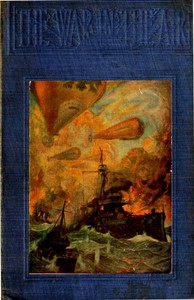
The War in the Air — Edition Insights

(0 User reviews)   683
Wells, H. G. (Herbert George), 1866-1946 Project Gutenberg 1997 Not confirmed
Science fiction; War stories; Air warfare -- Fiction Readers of public-domain and historical texts
Project Gutenberg digital edition en

Edition facts

Words 101,799
Reading time 443 min
Text sections 12

The War in the Air — Edition Insights can be approached with a clearer sense of reading commitment from its source measurements: 101,799 words, 7 hr 23 min estimated reading time, and 12 detected text sections.

The text analysis averages about 17.2 words per sentence, while the detected sections provide another way to judge how the source is divided.

Project Gutenberg metadata also associates the work with “Science fiction,” connecting these edition facts with the source record’s subject description.

An editorial note examining H.G. Wells's 1908 novel through its authorial choices in diction, dialogue, and description, focusing on the contrast between Bert Smallways's colloquial voice and the formal narration of global aerial warfare.
Share

Read the complete public-domain text at its original source.

Read on Project Gutenberg

H.G. Wells's The War in the Air opens not with a declaration of war but with a man on a fence: Tom Smallways, musing that “this here Progress … it keeps on.” The colloquial diction—the dropped “h,” the vague “here”—immediately signals a world of ordinary speech, far from the technical jargon one might expect in a novel about airships and global conflict. Wells juxtaposes this homely voice with the unfamiliar shapes of balloons inflating overhead, a contrast that defines the book’s narrative strategy. The story follows Bert Smallways, a bicycle-repair man, whose limited perspective becomes the lens through which we witness the collapse of civilization. By grounding the fantastic in the mundane, Wells makes the extraordinary feel immediate and unsettling.

Diction and the Voice of the Common Man

Wells’s choice to begin with Tom Smallways’s dialect is deliberate. Phrases like “You’d hardly think it could keep on” and the repeated “said Mr. Tom Smallways” establish a rhythm of oral storytelling. The narrator later adopts a more formal tone, but the Smallways family’s speech remains a touchstone. Bert’s thoughts are rendered in plain, unadorned language: he “got into Difficulties” (as chapter titles baldly state) not through grand ambition but through circumstance. This diction undercuts any heroic pretension. When Bert encounters the German air-fleet, his reactions are those of a man overwhelmed by scale—he does not analyze strategy but registers confusion and fear. Wells uses this linguistic gap to critique the gap between ordinary experience and the machinery of war.

Dialogue as a Marker of Social Distance

The dialogue in the excerpts reveals sharp social hierarchies. The German officers speak in clipped, authoritative commands; the American civilians respond with “unfriendly curiosity” that escalates to aggression. Wells renders the Germans’ confidence as a kind of bureaucratic arrogance: they behave “with a confidence that verged upon indiscretion.” In contrast, the Smallways’s conversations are full of hesitations and repetitions—Tom’s remark about progress is immediately qualified by his neighbor Stringer, who adds a rambling anecdote about balloons. This stylistic split mirrors the novel’s central tension: the impersonal logic of aerial warfare versus the messy, local concerns of individuals. Even the sniping around the stranded Bingen is described as a “fierce, disorderly struggle,” the adjective “disorderly” emphasizing the breakdown of formal combat into chaotic skirmishes.

Description of Technology and Its Limits

Wells describes airships with a mix of technical precision and deflating practicality. The balloons are “thin, wallowing bladders” that “flapped and rolled about”; later, a disabled airship’s “empty central gas-bags spread in canopies and festoons” over trees. These descriptions emphasize vulnerability rather than power. The author repeatedly notes what the airships cannot do: they are “quite unequal to the transport of any adequate landing parties,” and their crews are “just sufficient to manoeuvre and fight them in the air.” This limitation becomes a structural weakness—the Germans can bomb but not occupy. Wells’s choice to dwell on the material constraints of his imagined technology (the need for gas mains, the fragility of membranes) grounds the speculative in the practical, and his prose often shifts from sweeping vistas to close-up details of patching and repair.

Structure and the Pace of Collapse

The novel’s structure, as glimpsed in the table of contents, moves from the domestic (“Of Progress and the Smallways Family”) to the global (“A World at War”) and finally to aftermath (“The Great Collapse”). This arc is mirrored in the prose: early chapters linger on conversational exchanges, while later sections accelerate into fragmented, reportorial accounts of battles. The excerpt describing the attack on New York uses short, declarative sentences: “About eight the Bingen was rushed by an armed mob, and all its defenders killed.” The passive construction (“was rushed”) and the flat time marker (“About eight”) create a sense of inevitability. Wells also uses lists of destroyed infrastructure—“the City Hall—and Post-Office and other central ganglia”—to suggest systemic failure. The pacing reflects the theme: progress, once a slow “keeping on,” becomes a cascade of disasters.

Readers attentive to Wells’s authorial choices will notice how the novel’s voice shifts between the intimate and the panoramic. Bert Smallways’s limited viewpoint is not a flaw but a deliberate filter: through his eyes, the war in the air becomes a series of incomprehensible events, not a tidy narrative. The book rewards attention to its linguistic textures—the dialect, the technical asides, the sudden lurches into bureaucratic language. These are not mere decoration but the means by which Wells makes a warning about technological hubris feel personal and urgent.

There’s something touching about how Wells lets Bert’s plain speech stumble through his grand, terrible machinery—the small voice against the roar. It puts me in mind of quieter afternoons, and of A Maid in Arcady — Reading Notes, where similar softness holds its own against a wider world. I keep returning to both, oddly, for that same reason.

There are no reviews for this eBook.

0
0 out of 5 (0 User reviews )

Add a Review

Your Rating *
There are no comments for this eBook.

Reader reflection

How will you remember this book?

Save your reaction, strongest insight, and memorable passage.

Your progress 0 / 10
1

How far have you progressed with this book?

2

Did this book hold your interest?

3

How likely are you to recommend this book?

4

How easy was the book to follow?

Related eBooks