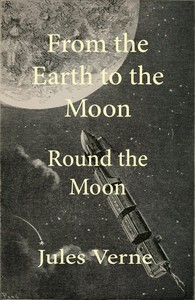
From the Earth to the moon; and, round the moon — Themes and Context

(2 User reviews)   694
Verne, Jules, 1828-1905 Project Gutenberg 1993 Not confirmed
Science fiction; Space flight to the moon -- Fiction; Moon -- Fiction; Space ships -- Fiction; Manned space flight -- Fiction Readers of public-domain and historical texts
Project Gutenberg digital edition en

Edition facts

Words 95,820
Reading time 417 min
Text sections 54

This digital edition of From the Earth to the moon; and, round the moon — Themes and Context is described by source-level measurements including 95,820 words, 6 hr 57 min estimated reading time, and 54 detected text sections.

The text analysis averages about 17.7 words per sentence, while the detected sections provide another way to judge how the source is divided.

Project Gutenberg metadata also associates the work with “Science fiction,” connecting these edition facts with the source record’s subject description.

Jules Verne's dual novel combines meticulous technical exposition with shifting narrative pace, from the Gun Club's boisterous planning to the projectile's silent, introspective voyage. The text balances scientific debate, comic relief, and stark cosmic isolation, using voice and structure to mirror the transition from Earth-bound action to weightless contemplation.
Share
Editorial Edition Score 4.9/5

Calculated from edition completeness, EPUB availability, text structure and catalogue metadata. Not a user rating.

How this score is calculated
  • Description quality20 pts
  • Title & short description10 pts
  • Source metadata20 pts
  • Text length15 pts
  • Chapters / structure15 pts
  • EPUB file integrity20 pts

Total of 100 points, scaled to a 2.5-5.0 range. Editions with an empty description or a missing EPUB file are not scored.

Edition quality

Read the Text

CHAPTER I. The Gun Club CHAPTER II. President Barbicane’s Communication CHAPTER III. Effect of the President’s Communication CHAPTER IV. Reply From the Observatory of Cambridge CHAPTER V. The Romance of the Moon CHAPTER VI. The Permissive Limits of Ignorance and Belief in the United States CHAPTER VII. The Hymn of the Cannon-Ball CHAPTER VIII. History of the Cannon CHAPTER IX. The Question of the Powders CHAPTER X. One Enemy _v._ Twenty-Five Millions of Friends CHAPTER XI. Florida and Texas CHAPTER XII. Urbi et Orbi CHAPTER XIII. Stones Hill CHAPTER XIV. Pickaxe and Trowel CHAPTER XV. The Fete of the Casting CHAPTER XVI. The Columbiad CHAPTER XVII. A Telegraphic Dispatch CHAPTER XVIII. The Passenger of the Atlanta CHAPTER XIX. A Monster Meeting CHAPTER XX. Attack and Riposte CHAPTER XXI. How A Frenchman Manages An Affair CHAPTER XXII. The New Citizen of the United States CHAPTER XXIII. The Projectile-Vehicle CHAPTER XXIV. The Telescope of the Rocky Mountains CHAPTER XXV. Final Details CHAPTER XXVI. Fire! CHAPTER XXVII. Foul Weather CHAPTER XXVIII. A New Star

Contents: Round the Moon

PRELIMINARY CHAPTER—Recapitulating the First Part of

This Work, and Serving as a Preface to the Second CHAPTER I. From Twenty Minutes Past Ten to Forty-Seven Minutes Past Ten P. M. CHAPTER II. The First Half Hour CHAPTER III. Their Place of Shelter CHAPTER IV. A Little Algebra CHAPTER V. The Cold of Space CHAPTER VI. Question and Answer CHAPTER VII. A Moment of Intoxication CHAPTER VIII.At Seventy-Eight Thousand Five Hundred and Fourteen Leagues CHAPTER IX. The Consequences of A Deviation CHAPTER X. The Observers of the Moon CHAPTER XI. Fancy and Reality CHAPTER XII. Orographic Details CHAPTER XIII. Lunar Landscapes CHAPTER XIV. The Night of Three Hundred and Fifty-Four Hours and A Half CHAPTER XV. Hyperbola or Parabola CHAPTER XVI. The Southern Hemisphere CHAPTER XVII. Tycho CHAPTER XVIII. Grave Questions CHAPTER XIX. A Struggle Against the Impossible CHAPTER XX. The Soundings of the Susquehanna CHAPTER XXI. J. T. Maston Recalled CHAPTER XXII. Recovered From the Sea CHAPTER XXIII. The End

FROM THE EARTH TO THE MOON

CHAPTER I. THE GUN CLUB

During the War of the Rebellion, a new and influential club was established in the city of Baltimore in the State of Maryland. It is well known with what energy the taste for military matters became developed among that nation of ship-owners, shopkeepers, and mechanics. Simple tradesmen jumped their counters to become extemporized captains, colonels, and generals, without having ever passed the School of Instruction at West Point; nevertheless; they quickly rivaled their compeers of the old continent, and, like them, carried off victories by dint of lavish expenditure in ammunition, money, and men.

But the point in which the Americans singularly distanced the Europeans was in the science of _gunnery_. Not, indeed, that their weapons retained a higher degree of perfection than theirs, but that they exhibited unheard-of dimensions, and consequently attained hitherto unheard-of ranges. In point of grazing, plunging, oblique, or enfilading, or point-blank firing, the English, French, and Prussians have nothing to learn; but their cannon, howitzers, and mortars are mere pocket-pistols compared with the formidable engines of the American artillery.

This fact need surprise no one. The Yankees, the first mechanicians in the world, are engineers—just as the Italians are musicians and the Germans metaphysicians—by right of birth. Nothing is more natural, therefore, than to perceive them applying their audacious ingenuity to the science of gunnery. Witness the marvels of Parrott, Dahlgren, and Rodman. The Armstrong, Palliser, and Beaulieu guns were compelled to bow before their transatlantic rivals.

Now when an American has an idea, he directly seeks a second American to share it. If there be three, they elect a president and two secretaries. Given _four_, they name a keeper of records, and the office is ready for work; _five_, they convene a general meeting, and the club is fully constituted. So things were managed in Baltimore. The inventor of a new cannon associated himself with the caster and the borer. Thus was formed the nucleus of the “Gun Club.” In a single month after its formation it numbered 1,833 effective members and 30,565 corresponding members.

One condition was imposed as a _sine quâ non_ upon every candidate for admission into the association, and that was the condition of having designed, or (more or less) perfected a cannon; or, in default of a cannon, at least a firearm of some description. It may, however, be mentioned that mere inventors of revolvers, fire-shooting carbines, and similar small arms, met with little consideration. Artillerists always commanded the chief place of favor.

The estimation in which these gentlemen were held, according to one of the most scientific exponents of the Gun Club, was “proportional to the masses of their guns, and in the direct ratio of the square of the distances attained by their projectiles.”

The Gun Club once founded, it is easy to conceive the result of the inventive genius of the Americans. Their military weapons attained colossal proportions, and their projectiles, exceeding the prescribed limits, unfortunately occasionally cut in two some unoffending pedestrians. These inventions, in fact, left far in the rear the timid instruments of European artillery.

It is but fair to add that these Yankees, brave as they have ever proved themselves to be, did not confine themselves to theories and formulae, but that they paid heavily, _in propriâ personâ_, for their inventions. Among them were to be counted officers of all ranks, from lieutenants to generals; military men of every age, from those who were just making their _début_ in the profession of arms up to those who had grown old in the gun-carriage. Many had found their rest on the field of battle whose names figured in the “Book of Honor” of the Gun Club; and of those who made good their return the greater proportion bore the marks of their indisputable valor. Crutches, wooden legs, artificial arms, steel hooks, caoutchouc jaws, silver craniums, platinum noses, were all to be found in the collection; and it was calculated by the great statistician Pitcairn that throughout the Gun Club there was not quite one arm between four persons and two legs between six.

Nevertheless, these valiant artillerists took no particular account of these little facts, and felt justly proud when the despatches of a battle returned the number of victims at ten-fold the quantity of projectiles expended.

One day, however—sad and melancholy day!—peace was signed between the survivors of the war; the thunder of the guns gradually ceased, the mortars were silent, the howitzers were muzzled for an indefinite period, the cannon, with muzzles depressed, were returned into the arsenal, the shot were repiled, all bloody reminiscences were effaced; the cotton-plants grew luxuriantly in the well-manured fields, all mourning garments were laid aside, together with grief; and the Gun Club was relegated to profound inactivity.

Some few of the more advanced and inveterate theorists set themselves again to work upon calculations regarding the laws of projectiles. They reverted invariably to gigantic shells and howitzers of unparalleled caliber. Still in default of practical experience what was the value of mere theories? Consequently, the clubrooms became deserted, the servants dozed in the antechambers, the newspapers grew mouldy on the tables, sounds of snoring came from dark corners, and the members of the Gun Club, erstwhile so noisy in their seances, were reduced to silence by this disastrous peace and gave themselves up wholly to dreams of a Platonic kind of artillery.

“This is horrible!” said Tom Hunter one evening, while rapidly carbonizing his wooden legs in the fireplace of the smoking-room; “nothing to do! nothing to look forward to! what a loathsome existence! When again shall the guns arouse us in the morning with their delightful reports?”

“Those days are gone by,” said jolly Bilsby, trying to extend his missing arms. “It was delightful once upon a time! One invented a gun, and hardly was it cast, when one hastened to try it in the face of the enemy! Then one returned to camp with a word of encouragement from Sherman or a friendly shake of the hand from McClellan. But now the generals are gone back to their counters; and in place of projectiles, they despatch bales of cotton. By Jove, the future of gunnery in America is lost!”

“Ay! and no war in prospect!” continued the famous James T. Maston, scratching with his steel hook his gutta-percha cranium. “Not a cloud on the horizon! and that too at such a critical period in the progress of the science of artillery! Yes, gentlemen! I who address you have myself this very morning perfected a model (plan, section, elevation, etc.) of a mortar destined to change all the conditions of warfare!”

“No! is it possible?” replied Tom Hunter, his thoughts reverting involuntarily to a former invention of the Hon. J. T. Maston, by which, at its first trial, he had succeeded in killing three hundred and thirty-seven people.

“Fact!” replied he. “Still, what is the use of so many studies worked out, so many difficulties vanquished? It’s mere waste of time! The New World seems to have made up its mind to live in peace; and our bellicose _Tribune_ predicts some approaching catastrophes arising out of this scandalous increase of population.”

“Nevertheless,” replied Colonel Blomsberry, “they are always struggling in Europe to maintain the principle of nationalities.”

“Well, there might be some field for enterprise down there; and if they would accept our services—”

“What are you dreaming of?” screamed Bilsby; “work at gunnery for the benefit of foreigners?”

“That would be better than doing nothing here,” returned the colonel.

“Quite so,” said J. T. Matson; “but still we need not dream of that expedient.”

“And why not?” demanded the colonel.

“Because their ideas of progress in the Old World are contrary to our American habits of thought. Those fellows believe that one can’t become a general without having served first as an ensign; which is as much as to say that one can’t point a gun without having first cast it oneself!”

“Ridiculous!” replied Tom Hunter, whittling with his bowie-knife the arms of his easy chair; “but if that be the case there, all that is left for us is to plant tobacco and distill whale-oil.”

“What!” roared J. T. Maston, “shall we not employ these remaining years of our life in perfecting firearms? Shall there never be a fresh opportunity of trying the ranges of projectiles? Shall the air never again be lighted with the glare of our guns? No international difficulty ever arise to enable us to declare war against some transatlantic power? Shall not the French sink one of our steamers, or the English, in defiance of the rights of nations, hang a few of our countrymen?”

“No such luck,” replied Colonel Blomsberry; “nothing of the kind is likely to happen; and even if it did, we should not profit by it. American susceptibility is fast declining, and we are all going to the dogs.”

“It is too true,” replied J. T. Maston, with fresh violence; “there are a thousand grounds for fighting, and yet we don’t fight. We save up our arms and legs for the benefit of nations who don’t know what to do with them! But stop—without going out of one’s way to find a cause for war—did not North America once belong to the English?”

“Undoubtedly,” replied Tom Hunter, stamping his crutch with fury.

“Well, then,” replied J. T. Maston, “why should not England in her turn belong to the Americans?”

“It would be but just and fair,” returned Colonel Blomsberry.

“Go and propose it to the President of the United States,” cried J. T. Maston, “and see how he will receive you.”

“Bah!” growled Bilsby between the four teeth which the war had left him; “that will never do!”

“By Jove!” cried J. T. Maston, “he mustn’t count on my vote at the next election!”

“Nor on ours,” replied unanimously all the bellicose invalids.

“Meanwhile,” replied J. T. Maston, “allow me to say that, if I cannot get an opportunity to try my new mortars on a real field of battle, I shall say good-by to the members of the Gun Club, and go and bury myself in the prairies of Arkansas!”

“In that case we will accompany you,” cried the others.

Matters were in this unfortunate condition, and the club was threatened with approaching dissolution, when an unexpected circumstance occurred to prevent so deplorable a catastrophe.

On the morrow after this conversation every member of the association received a sealed circular couched in the following terms:

BALTIMORE, October 3. The president of the Gun Club has the honor to inform his colleagues that, at the meeting of the 5th instant, he will bring before them a communication of an extremely interesting nature. He requests, therefore, that they will make it convenient to attend in accordance with the present invitation. Very cordially, IMPEY BARBICANE, P.G.C.

CHAPTER II. PRESIDENT BARBICANE’S COMMUNICATION

On the 5th of October, at eight p.m., a dense crowd pressed toward the saloons of the Gun Club at No. 21 Union Square. All the members of the association resident in Baltimore attended the invitation of their president. As regards the corresponding members, notices were delivered by hundreds throughout the streets of the city, and, large as was the great hall, it was quite inadequate to accommodate the crowd of _savants_. They overflowed into the adjoining rooms, down the narrow passages, into the outer courtyards. There they ran against the vulgar herd who pressed up to the doors, each struggling to reach the front ranks, all eager to learn the nature of the important communication of President Barbicane; all pushing, squeezing, crushing with that perfect freedom of action which is so peculiar to the masses when educated in ideas of “self-government.”

On that evening a stranger who might have chanced to be in Baltimore could not have gained admission for love or money into the great hall. That was reserved exclusively for resident or corresponding members; no one else could possibly have obtained a place; and the city magnates, municipal councilors, and “select men” were compelled to mingle with the mere townspeople in order to catch stray bits of news from the interior.

Nevertheless the vast hall presented a curious spectacle. Its immense area was singularly adapted to the purpose. Lofty pillars formed of cannon, superposed upon huge mortars as a base, supported the fine ironwork of the arches, a perfect piece of cast-iron lacework. Trophies of blunderbuses, matchlocks, arquebuses, carbines, all kinds of firearms, ancient and modern, were picturesquely interlaced against the walls. The gas lit up in full glare myriads of revolvers grouped in the form of lustres, while groups of pistols, and candelabra formed of muskets bound together, completed this magnificent display of brilliance. Models of cannon, bronze castings, sights covered with dents, plates battered by the shots of the Gun Club, assortments of rammers and sponges, chaplets of shells, wreaths of projectiles, garlands of howitzers—in short, all the apparatus of the artillerist, enchanted the eye by this wonderful arrangement and induced a kind of belief that their real purpose was ornamental rather than deadly.

At the further end of the saloon the president, assisted by four secretaries, occupied a large platform. His chair, supported by a carved gun-carriage, was modeled upon the ponderous proportions of a 32-inch mortar. It was pointed at an angle of ninety degrees, and suspended upon truncheons, so that the president could balance himself upon it as upon a rocking-chair, a very agreeable fact in the very hot weather. Upon the table (a huge iron plate supported upon six carronades) stood an inkstand of exquisite elegance, made of a beautifully chased Spanish piece, and a sonnette, which, when required, could give forth a report equal to that of a revolver. During violent debates this novel kind of bell scarcely sufficed to drown the clamor of these excitable artillerists.

In front of the table benches arranged in zigzag form, like the circumvallations of a retrenchment, formed a succession of bastions and curtains set apart for the use of the members of the club; and on this especial evening one might say, “All the world was on the ramparts.” The president was sufficiently well known, however, for all to be assured that he would not put his colleagues to discomfort without some very strong motive.

Impey Barbicane was a man of forty years of age, calm, cold, austere; of a singularly serious and self-contained demeanor, punctual as a chronometer, of imperturbable temper and immovable character; by no means chivalrous, yet adventurous withal, and always bringing practical ideas to bear upon the very rashest enterprises; an essentially New Englander, a Northern colonist, a descendant of the old anti-Stuart Roundheads, and the implacable enemy of the gentlemen of the South, those ancient cavaliers of the mother country. In a word, he was a Yankee to the backbone.

Barbicane had made a large fortune as a timber merchant. Being nominated director of artillery during the war, he proved himself fertile in invention. Bold in his conceptions, he contributed powerfully to the progress of that arm and gave an immense impetus to experimental researches.

He was personage of the middle height, having, by a rare exception in the Gun Club, all his limbs complete. His strongly marked features seemed drawn by square and rule; and if it be true that, in order to judge a man’s character one must look at his profile, Barbicane, so examined, exhibited the most certain indications of energy, audacity, and _sang-froid_.

At this moment he was sitting in his armchair, silent, absorbed, lost in reflection, sheltered under his high-crowned hat—a kind of black cylinder which always seems firmly screwed upon the head of an American.

Just when the deep-toned clock in the great hall struck eight, Barbicane, as if he had been set in motion by a spring, raised himself up. A profound silence ensued, and the speaker, in a somewhat emphatic tone of voice, commenced as follows:

“My brave, colleagues, too long already a paralyzing peace has plunged the members of the Gun Club in deplorable inactivity. After a period of years full of incidents we have been compelled to abandon our labors, and to stop short on the road of progress. I do not hesitate to state, baldly, that any war which would recall us to arms would be welcome!” (_Tremendous applause!_) “But war, gentlemen, is impossible under existing circumstances; and, however we may desire it, many years may elapse before our cannon shall again thunder in the field of battle. We must make up our minds, then, to seek in another train of ideas some field for the activity which we all pine for.”

The meeting felt that the president was now approaching the critical point, and redoubled their attention accordingly.

“For some months past, my brave colleagues,” continued Barbicane, “I have been asking myself whether, while confining ourselves to our own particular objects, we could not enter upon some grand experiment worthy of the nineteenth century; and whether the progress of artillery science would not enable us to carry it out to a successful issue. I have been considering, working, calculating; and the result of my studies is the conviction that we are safe to succeed in an enterprise which to any other country would appear wholly impracticable. This project, the result of long elaboration, is the object of my present communication. It is worthy of yourselves, worthy of the antecedents of the Gun Club; and it cannot fail to make some noise in the world.”

A thrill of excitement ran through the meeting.

Barbicane, having by a rapid movement firmly fixed his hat upon his head, calmly continued his harangue:

“There is no one among you, my brave colleagues, who has not seen the Moon, or, at least, heard speak of it. Don’t be surprised if I am about to discourse to you regarding the Queen of the Night. It is perhaps reserved for us to become the Columbuses of this unknown world. Only enter into my plans, and second me with all your power, and I will lead you to its conquest, and its name shall be added to those of the thirty-six states which compose this Great Union.”

“Three cheers for the Moon!” roared the Gun Club, with one voice.

From its opening chapter, From the Earth to the Moon establishes a distinctive narrative voice that oscillates between dry technical reportage and wry social commentary. The Gun Club members are introduced as men who have turned war into a science, their passion for gunnery described with a straight-faced precision that borders on satire. Verne's prose moves briskly through committee meetings, budget debates, and engineering challenges, yet the tone shifts markedly when the projectile leaves the atmosphere. The second part, Round the Moon, slows to a meditative crawl, trading public spectacle for private observation. The three travelers gaze at a shrinking Earth described as a 'slender crescent' and a 'fugitive morning star,' their dialogue replaced by long, silent contemplation. This structural pivot—from crowded Baltimore halls to the void of space—is the novel's most striking formal feature.

From Boisterous Debates to Silent Vigils

The novel's first half is dominated by argument and oratory. President Barbicane's proposal sparks a frenzy of letters, meetings, and rivalries, with chapters titled 'Effect of the President's Communication' and 'One Enemy v. Twenty-Five Millions of Friends.' Verne renders these scenes through rapid-fire dialogue and hyperbolic numbers, as when the Gun Club calculates cannon dimensions with obsessive exactitude. The pace is breathless, the mood triumphant. But once the projectile is fired, the narrative contracts. Chapter headings shift from public events to precise timestamps: 'From Twenty Minutes Past Ten to Forty-Seven Minutes Past Ten P. M.' The travelers' conversations become sparse; they sleep, wake, and peer through a glass porthole. The most dramatic moment—Barbicane's sudden cry 'I have found it!'—concerns a purely acoustic puzzle: why they heard no detonation. The answer, that they outran sound, is delivered with the same clinical logic that earlier governed cannon design, yet now it feels like a quiet epiphany rather than a public triumph.

The Weight of Scientific Detail

Verne loads his narrative with technical passages that would be at home in a nineteenth-century engineering manual. The reader is walked through the chemistry of gunpowder, the metallurgy of the Columbiad, and the algebra of trajectories. In one excerpt, Nicholl proposes a 'little algebra' to calculate their position; in another, Barbicane explains why the Earth appears as a crescent. These passages are not mere decoration—they shape the novel's identity as a work of speculative science. Yet Verne leavens the exposition with characterful asides. Michel Ardan, the French adventurer, dismisses 'scientific reasonings' in favor of poetic fancy, suggesting the Earth's shooting stars are a 'salute' to the departing crew. This tension between hard data and romantic interpretation runs through both volumes, giving the technical passages a dramatic function: they are the language of authority that Ardan's whimsy constantly challenges.

Shifts in Sensory Focus

As the projectile leaves Earth, the novel's sensory palette narrows. Early chapters are filled with noise: the roar of crowds, the crack of gunfire, the clamor of construction. But in space, the dominant sense becomes sight. The travelers 'try to pierce the profound darkness' and study the Earth's 'crescent finely traced on the dark background of the sky.' Sound vanishes—the detonation is inaudible, and the characters speak in hushed tones. Verne emphasizes this silence by having the men fall into 'profound slumber' after only a quarter hour of wakefulness. The only sensory event is visual: a 'brilliant cluster of shooting stars' that irradiates the darkness. This shift from cacophony to quiet observation mirrors the narrative's broader movement from collective action to individual reflection. The reader, like the characters, must adjust to a world where the familiar cues of atmosphere and gravity no longer apply.

Readers will find that the novel rewards attention to its pacing as much as its science. The transition from the Gun Club's bustling committees to the projectile's silent drift is not a flaw but a deliberate formal choice. Verne uses the contrast to explore how human perception changes when removed from Earth's sensory environment. Pay particular attention to the chapter headings: they function as a timeline of shifting priorities, from public spectacle to private wonder. The book is best approached as two distinct but complementary works—one a comedy of scientific enthusiasm, the other a meditation on cosmic solitude.

I was rereading Verne's lunar voyage, and it struck me how the silence aboard the projectile eventually feels almost like a character itself. That same quiet dread of an alien emptiness crept back when I thought of the relentless, creeping threat in The abysmal invaders — Themes and Context. Both share that strange sensation of being watched by something that doesn't care, a solitude that isn't quite alone.

Camila Allen
2 weeks ago

Isaac Jackson
1 month ago

4.5
4.5 out of 5 (2 User reviews )

Add a Review

Your Rating *
There are no comments for this eBook.

Reader reflection

What was your reading experience?

Capture what you thought, learned, and would like to remember.

Your progress 0 / 10
1

Where are you in your reading?

2

Was reading this book enjoyable?

3

How likely are you to recommend this book?

4

Did the language feel accessible?

Related eBooks