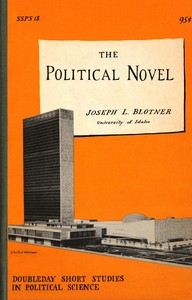
The political novel — Text and Context

(12 User reviews)   3075
Blotner, Joseph, 1923-2012 Project Gutenberg 2022 Not confirmed
Fiction -- History and criticism; Politics in literature; Political fiction -- History and criticism Readers of public-domain and historical texts
Project Gutenberg digital edition en

Edition facts

Words 56,718
Reading time 247 min
Text sections 16

The political novel — Text and Context can be approached with a clearer sense of reading commitment from its source measurements: 56,718 words, 4 hr 7 min estimated reading time, and 16 detected text sections.

The text analysis averages about 20.6 words per sentence, while the detected sections provide another way to judge how the source is divided.

Project Gutenberg metadata also associates the work with “Fiction -- History and criticism,” connecting these edition facts with the source record’s subject description.

Joseph Blotner's 1955 study examines how English novelists from Disraeli to Orwell use language, voice, and narrative pace to portray political life. Drawing on works such as 'Beauchamp's Career,' 'A Passage to India,' and 'Nineteen Eighty-Four,' Blotner traces shifts between emotional and restrained rhetoric, the mixing of religion with politics, and the contrasting depictions of imperial guilt versus working-class resilience.
Share
Editorial Edition Score 4.8/5

Calculated from edition completeness, EPUB availability, text structure and catalogue metadata. Not a user rating.

How this score is calculated
  • Description quality20 pts
  • Title & short description10 pts
  • Source metadata20 pts
  • Text length15 pts
  • Chapters / structure15 pts
  • EPUB file integrity20 pts

Total of 100 points, scaled to a 2.5-5.0 range. Editions with an empty description or a missing EPUB file are not scored.

Edition quality

Read the Text

orm of government. It is not unnatural then that American political novels range over a relatively narrower area, with their main emphasis on local or national subjects, while those of European authors delineate changing, conflicting, and radically different ideologies and resultant events. It is only since the 1930s, with the increase in centralized government, the impact of international Communism, and the recent appearance on both the Right and the Left of what seem to be threats to traditional American freedoms, that the American political novel has begun to approach the European in breadth of theme, concern with political theory, and interpretation of varying political behavior patterns.

The larger number of bad novels in the American group is also due to the fact that more American novels are treated. Because of their greater availability both for research and teaching, it is possible to show the evolution of this genre in the United States. In doing this one is able to examine the good ones, old and new, such as Henry Adams’ _Democracy_, John Dos Passos’ _District of Columbia_ trilogy, and Irwin Shaw’s _The Troubled Air_. One pays, however, by suffering through period pieces such as F. Marion Crawford’s _An American Politician_. Less obtuse politically but nearly as abysmal artistically, is Paul Leicester Ford’s _The Honorable Peter Stirling_. One is compensated, however, not only by the view of a developing genre, but also by the recording of significant periods in American national life and of the people who helped shape it, as in the Dos Passos work, and by the sensitive and penetrating analysis of central problems in contemporary life, as in Shaw’s novel.

The English political novel is also uneven. That its depths are not so low as those in the American novel is due in part to the political heritage which its authors share with their colleagues on the continent. Its authors work from a long and rich political history in which the evolution has been less violent but no less steady.

=The Novelist and the Political Scientist=

The differences between the methods of the political novelist and the political scientist are worth studying. Their intentions are often at variance. Whereas the scientist is dedicated to objectivity and statistical accuracy, the novelist is often consciously subjective; if his work is intended as a political instrument, as were _Uncle Tom’s Cabin_ and _The Possessed_, scrupulous attention to the claims of the other side will invariably lessen the emotional impact and political worth of the novel. If a scholar sets out to examine the rise of Nazism, he will have to treat not only the Beer Hall Putsch and the Reichstag fire, but German history and the German national character as well. He will chronicle the effects of Versailles, the staggering of the Weimar Republic, and the growing strength of the Brown Shirts. He will be concerned with national attitudes, with the relative strength of the parties that vied with the National Socialists. His study will gauge the effects of the aging Hindenburg and the demoniac Hitler on a people smarting from defeat, searching for a scapegoat, and longing for a resurgence. And all this will be backed with statistics where possible. It will be a cogently reasoned analysis with documented references to available sources. Also, the study will be aimed at a fairly homogeneous and well-defined audience. The appeal will be intellectual. If emotion creeps in, the work is probably bad.

The novelist who is to examine these same events will present them quite differently, even apart from the techniques of fiction. If he is a rather dispassionate chronicler of human foibles and frailties such as, say, Somerset Maugham, he will probably portray a group of people through whose actions the rise and significance of Nazism will become meaningful. The reader will probably observe the drifting war veteran, the hard-pressed workman, the anxious demagogue. Out of these lives and their interactions will emerge an objective study of the sources of a political movement and of the shape it took. If the novelist is an enthusiastic Nazi, the book will reflect his particular bias. The storm troopers will become heroic Horst Wessels, the young women stalwart Valkyries, the Führer an inspired prophet and leader. Out of the novel will come a plea for understanding or a justification of violence and a perverted view of German national destiny. The book will be emotionally charged, a calculated effort to produce a specific desired response. If this series of historical events is used by a Frenchman, they will undergo another change. There will probably be an evocation of the Junker mentality, of Prussian militarism, of hordes of gray-green figures under coal-scuttle helmets. If this novel is not a call to arms, it will be a warning cry to signal a growing danger. These three fictional books will use the same staples of the novelist’s art, yet each will differ from the others in motivation and attitude. They will portray aspects of the same complex of events treated by the political scientist, but this will be virtually their only similarity.

A disadvantage for the novelist is his need to make his book appealing enough to sell and to make his reader want to buy his next novel. Although the scientist too must make his work as polished and interesting as he can, the novelist does not, like him, find his readers among subscribers to the learned journals. He cannot rely upon sales prompted by the need to keep abreast of research in a specialized field. If a novelist is to stay in print, political savoir-faire and intellectual capacity are not enough. He has to sell copies. Perhaps this is one reason why all but a few of these novels have a love story accompanying the political theme. Sometimes the love story inundates it, as in _An American Politician_; in other novels, such as Sinclair’s _Presidential Agent_, it is peripheral and pieced out with flirtations. It may be that these novelists include this element because love is as much a part of life as politics. Its nearly universal presence is a reminder, however, of one aspect of the novelist’s task and one way in which his work differs considerably from that of the political scientist.

The advantages of the novelist’s method over the political scientist’s compensate for the drawbacks. These advantages do not necessarily produce a better work, one which gives more insight into a problem or explains it better. They do, however, offer more latitude and fewer restrictions. The novelist may use all the techniques of the political scientist. Sinclair’s Boston is studded with as many references to actual events, people, and documents as most scientific studies, although it is permeated by a violent partisanship which would make a scholarly study highly suspect. But this points up one of the novelist’s advantages: he can use the methods of scholarship to document his case and then supplement them with heroes and villains who add an emotional appeal to the intellectual one. This string to the novelist’s bow is a strong one. He can create a character like Shaw’s Clement Archer in _The Troubled Air_, while the scientist is forced to use opinion research, carefully documented sources, and well-verified trends in treating the problem of deprivation of livelihood as a penalty for suspected political unreliability. Sometimes the scientist uses case histories, but the subjects are often identified by initials and treated with such antiseptic objectivity that almost no emotional impact comes through. The loss of Clement Archer’s job, because he has employed actors blacklisted for suspected Communist activity by a newsletter acting as a self-appointed judge, presents this general problem with more frightening immediacy and reader-involvement than an excellent scholarly study could ever do. Archer becomes one embodiment of the problem--a rather naïve but courageous liberal made into a sacrificial goat because of his fight for what he believes to be traditional and critical American rights. If he wants to, the novelist can use historical personages to flesh out his story. Although the reader does not see him in its pages, Dos Passos’ _The Grand Design_ uses the figure of Franklin D. Roosevelt in the background as one of the mainsprings of the action. An individual may appear in transparent fictional guise. The _roman à clef_ has many representatives in the political novel. Pyotr Verhovensky in Dostoyevsky’s _The Possessed_ has been identified as the revolutionary Sergei Nechaev. Hamer Shawcross in Howard Spring’s _Fame Is the Spur_ is thought to be Ramsay MacDonald. The governor-dictators who rampage through Dos Passos’ _Number One_, Adria Langley’s _A Lion Is in the Streets_, and Robert Penn Warren’s _All the King’s Men_ look and act much like Huey Long. The novelist ranges backward into time as does the scientist. Maugham’s _Then and Now_ brings to life the wily Niccolo Machiavelli, and Samuel Shellabarger’s _Prince of Foxes_ reexamines the sinister Cesare Borgia. When the novelist goes forward into time he need not be confined to a mathematical extrapolation of birth rates, trade balances, or electoral trends. Instead, he can create, whole and entire, the world which he thinks will grow out of the one in which he lives or which he sees emerging. The scientist may attempt to define the group mind or examine pressures toward enforced conformity in political thought. But George Orwell in _1984_ creates his own terrifying vision of the world thirty years from now. And this story is frighteningly believable. It does not even require Coleridge’s “willing suspension of disbelief which constitutes poetic faith.” With its three super states perpetually at war, its Newspeak vocabulary including “thoughtcrime” and “doublethink,” its omnipresent Big Brother, 1984 reflects aspects of our world out of which the novelist’s vision grew. Besides the political apparatus which Orwell builds, he creates a protagonist, Winston Smith, one man out of all the masses of Party members and Proles who revolts against the system, providing the reader with a focus for personal association. The reader follows him through his round of duties in the Ministry of Truth, into his state-forbidden love affair, and finally down into the depths of the Ministry of Love where he is tortured into conformity before he will be “vaporized” and poured into the stratosphere as gas. If he likes, the author can move at will seven centuries into the future, where Aldous Huxley erected his _Brave New World_. From a world of mechanization, deteriorating family ties, and ascendant pragmatic science, he can artistically extrapolate a planet ruled cooperatively by ten World Controllers. Embryos are conditioned within their glass flasks and then decanted into a rigidly stratified society where stability has outlawed change and Ford has replaced God. And there are memorable people--sensuous Lenina Crowne, and the Savage, a “natural man” who commits suicide rather than choose between prehistoric primitivism and soulless modernism.

Not only does the novelist have complete freedom in time and space, he has the right to use any of the devices found attractive in communication since the first articulate primate squatting in the firelight gave his interpretation of experience to his hairy brothers. The point of the story can be driven home or made more palatable with laughter, suspense, or a cops-and-robbers chase that will make it memorable. Ernest Hemingway’s Spanish guerrillas and Ignazio Silone’s Italian peasants are often amusing. The reader may remember the inspired profanity or the droll proverbs; he will also remember the fight against Fascism and oppression. From _Darkness at Noon_ the reader will take with him Rubashov’s midnight arrest, the wait for the NKVD bullet in the back of the neck; he will retain, too, the irony of the disillusioned Bolshevik destroyed by the monster he helped create.

This attempt to differentiate the novelist’s approach from the scientist’s is not meant to prove that the novelist’s is better. It is simply different, representing another aspect of the difference between science and art. Each discipline tries to describe and interpret experience. Where one does it by means of well-defined, rigidly controlled techniques within generally accepted boundaries, the other is highly flexible, embodying a view of life shaped by an individual set of preferences and dislikes, talents and blind spots. Each of these divergent methods offers advantages and disadvantages. One should not go to political novels expecting to find, except in rare cases, complete objectivity, solidly documented references, and exhaustive expositions of political theory. He should not always anticipate credibility. When problems are presented, the reader may not find answers or even indications of the directions in which they may be found. But one cannot go to a scientific monograph with the hope of meeting in its pages someone whose life is an embodiment of a problem, or whose survival represents the gaining of a goal, his death the losing of it.

These two approaches to the study of politics complement each other, just as the physician and clergyman both mean to keep their identical patient and parishioner well and whole. The novelist can, however, enter well into the scientist’s field. When he deals with actual events, he tries to record them as they happened. If the names and places are changed, he is usually faithful to the manner or meaning of the events. In _Bricks Without Straw_ Albion W. Tourgée assures the reader that these events or others exactly like them took place during the Reconstruction era in the South, and there is no reason to doubt him. Sinclair’s _Oil!_ exhaustively treats the Sacco-Vanzetti case; it is completely opinionated, but it is a historical account, nonetheless, of one of the most memorable political cases in American history. More than a historian, the political novelist is also an analyst. He sees cause-effect relationships at work, he looks into stimulus and response, motivation and satisfaction. Stendhal is not content merely to describe military and political events during the Napoleonic era; he goes beneath the surface to explain what some of them meant.

=The Purposes of This Study=

This examination of the political novel will go beyond simply charting its development. In order to examine it as a distinct literary form, it will be necessary to discuss its practitioners, the literary techniques they use, the purposes they aim at, and their success in achieving them. More than this, there will be attention to the function of these political novels, at the time they were written and now in our time. In the forefront will be an attempt to show what the reader can learn, whether he approaches this body of work from a particular discipline such as political science or literature, or whether he goes to it as a general reader wanting either enlightenment or entertainment.

The purposes and scope of each chapter indicate the purposes of the study as a whole. Chapter Two, “The Novel as Political Instrument,” examines the effect of the political novel on politics. Some novels contain heroes presented against a political background which might just as well have been mercantile or medical; other novels are intended to have politics as their subject; still other novels are meant to have definite political consequences. This chapter is chiefly concerned with novels of this last type. But it is necessary to look at others, too, for in creating life in his novel the artist will often reflect his own preferences, and they may affect those of his reader. Chapter Three, “The Novelist as Political Historian,” describes the way in which the writer may weave into his story the threads of history, recording not only the lives of his creations, but actual events in the lives of nations. By virtue of his special skills, he can recreate these events with a vividness found in few scholarly histories. Chapter Four, “The Novel as Mirror of National Character,” is devoted to an examination of the cultural and national differences discernible in these novels. There appear to be some denominators of political behavior which remain common no matter what the scene of action. This chapter deals with the numerators, the quantities which vary from culture to culture. Chapter Five, “The Novelist as Analyst of Group Political Behavior,” demonstrates the insight the novel can give into political actions which derive from group attitudes, pressures, and responses rather than individual ones. The novelist may use several indices to determine how a society is structured, which of its groups is most homogeneous, which most apparent in the effect it has upon the body politic. Chapter Six, “The Novelist as Analyst of Individual Political Behavior,” shows how the basic unit in all political equations is treated. The novelist portrays the person who moves in the main stream of politics and the one who stands on its edges. In most cases the acts of these people are examined--their motives, their effects. As in any other kind of fiction, characters are created who are complete individuals, believable and unique. But sometimes they are also typical of a number of people. Chapter Seven, “Some Conclusions,” emphasizes the major points made in the study. It also discusses what may be expected of the political novel in the future. The annotated bibliography gives the author, title, and date for each novel.

In terms of organization, this study proceeds from the most direct relationship between the novel and politics to the least direct relationship. Chapter Two shows how this art form can actually influence the political process. Chapter Six, on the other hand, indicates the way in which the novel treats the individual, who, with the exception of the outstanding leader, has far less direct influence upon politics than groups or nations. Chapter Three deals with the way in which the novel has recorded some major events in the political scientist’s field from the early nineteenth century to the present. Chapters Four through Six proceed from larger to smaller political units.

In short, the aims of this study are to indicate the gradual development of the political novel in England and the United States, to show what it has produced in several other countries, and to demonstrate the insights it can give in this area of human behavior to students of literature, politics, and related disciplines, and to the general reader.

chapter two The Novel as Political Instrument

A political novel written from a point of view favoring a particular faction is a political instrument in effect even if not in intent. A writer may sternly tell himself at the outset that he will be completely impartial, only to have the reviewers note all sorts of bias, real or imagined, of which he may not have been conscious. This happened to Turgenev when he published _Fathers and Sons_, and it continues to happen every year. The intensity of the authors’ feelings varies from obsessive preoccupation to passing interest. The novels in this chapter were included because they contain definite opinions, sometimes appeals, on political subjects. Some of them never exhort the reader or seem to lead him by the hand to the author’s point of view. But each of them contains material capable of influencing the reader’s opinions about some phase of political activity. If a novelist gains a reader’s support for a cause, arouses his distaste for a course of action, or simply produces a reevaluation of previously accepted beliefs, his work has served as a political instrument just as surely as a pamphlet mailed by a national committee or a handbill stuffed into the mailboxes of a sleeping city.

=Harriet Beecher Stowe and the Civil War=

_Uncle Tom’s Cabin_ is a prime example of the novel as political instrument both in intent and effect. Harriet Beecher Stowe declared in her preface that

The object of these sketches is to awaken sympathy and feeling for the African race, as they exist among us; to show their wrongs and sorrows, under a system so necessarily cruel and unjust as to defeat and do away with the good effects of all that can be attempted for them....

Joseph Blotner's The Political Novel opens not with a grand theory but with a specific observation about how politicians in fiction speak. He notes that characters who flout maxims—not flaunt them, as a transcriber's correction points out—tend to fail, a lexical distinction that signals the book's close attention to verbal precision. Blotner's method is comparative: he moves from novel to novel, weighing how each author constructs political speech, from the revivalist fervor of a Chester Nimmo to the restrained irony of a Nevil Beauchamp.

The Rhetoric of the Platform and the Parlor

The contrast extends to the novelists' own narrative voices. In Beauchamp's Career, the dialogue between Colonel Halkett and Nevil Beauchamp is terse, ironic, and understated—'Well, sir, we must sell our opium'—while the prose around it carries a measured, almost judicial tone. Blotner implies that the novelist's choice of tempo is itself a political statement: rapid, emotional speech belongs to the demagogue; cool, ironic exchange to the aristocrat or intellectual. This observation is grounded in specific textual evidence, not in abstract claims about 'style.'

Imperial Guilt and the Weight of Sentences

By contrast, the South African novels Blotner cites, such as Too Late the Phalarope, accelerate toward tragedy. He notes the figure of Jakob Van Vlaanderen, the stern patriarch who recalls the trek into the interior, and how the narrative moves with a gathering momentum toward inevitable conflict. Blotner's insight is that pace is not merely a technical feature but a moral index: the faster the narrative moves, the less room for reflection; the slower, the more oppressive the atmosphere of guilt.

The Proles and the Persistence of Voice

This observation connects back to his earlier contrast between emotional and restrained speech. The Proles' singing is not oratory; it is pre-political, almost biological. But it is also, in Orwell's hands, the only sound that survives the Party's erasure of language. Blotner does not claim that Orwell endorses the Proles as a political force; he simply notes that the novel's structure gives them the last word, or rather the last song. The pacing of the final pages, with their shift from Winston's tortured interiority to the external, indifferent singing, is a formal choice that Blotner treats as evidence of Orwell's political ambivalence.

Blotner's study is best read as a series of linked close readings rather than a single argument. He moves quickly between novels, trusting the reader to follow the thread. Pay attention to the quotations he selects: they are often the moments when a character's voice breaks through the narrative, or when the prose itself changes speed. The book rewards those who read with the text in hand, checking each reference against the original.

Reading about Blotner’s quiet tracing of imperial guilt in A Passage to India, I keep drifting back to that odd little autobiography I once stumbled upon—the séance room politics of it, the way faith and electorate blur together. There’s something familiar in that restless voice. The spirit-rapper; an autobiography — Text and Context stayed with me for that very reason: it doesn’t argue, it simply remembers.

Grace Carter
2 weeks ago

Evelyn Hill
3 weeks ago

Emma Hernandez
1 week ago

Sofia Sanchez
1 week ago

Isaac Young
2 weeks ago

5
5 out of 5 (12 User reviews )

Add a Review

Your Rating *
There are no comments for this eBook.

Reader reflection

What did you think of this book?

Answer a few questions and save a private reflection on this device.

Your progress 0 / 10
1

How far have you progressed with this book?

2

How much did you enjoy the reading experience?

3

Is this a title you would suggest to others?

4

How demanding did the text feel?

Related eBooks