She who sleeps — A Reader’s Guide
Edition facts
For She who sleeps — A Reader’s Guide, the stored edition analysis reports 71,736 words, 5 hr 12 min estimated reading time, and 7 detected text sections.
The text analysis averages about 12.6 words per sentence, while the detected sections provide another way to judge how the source is divided.
Project Gutenberg metadata also associates the work with “New York (N.Y.) -- Fiction,” connecting these edition facts with the source record’s subject description.
Calculated from edition completeness, EPUB availability, text structure and catalogue metadata. Not a user rating.
How this score is calculated
- Description quality20 pts
- Title & short description10 pts
- Source metadata20 pts
- Text length15 pts
- Chapters / structure15 pts
- EPUB file integrity20 pts
Total of 100 points, scaled to a 2.5-5.0 range. Editions with an empty description or a missing EPUB file are not scored.
Read the Text
CHAPTER I. A FLASH OF LIGHTNING
Barry Cumberland pushed on through a growing darkness. There seemed to be an unfamiliar quality in this darkness which he first noticed when, quite mechanically, he stooped to switch on his headlights, and in doing so saw the time by the clock in the car. He slowed down for a moment, on a crossways, and stared into the west.
A great cloud, black as the pall of Avalon, was draped before the sinking sun.
As he watched, it crept farther and farther up the dome of blue, like a velvet curtain drawn by giant hands. Through a gap in the trees which had closely beset the path for some distance now, Barry looked down into the valley along which his route lay to the highroad and New York.
Three hundred feet below, perched apparently on the edge of a ravine, he saw a house. Some rent in the curtain of the storm had allowed a ray like a searchlight to break through and to shine upon a sort of turret which crowned the building. Shrinking behind guardian walls and overhanging yet lower depths, the effect was that of a drawing by Sidney Sime. Beyond, the road zigzagged, disappeared into shadow, later to reappear in the form of a bridge, until it finally became lost to sight before the plain was reached.
The moving curtain blotted out the light. Where a fairy castle had been, eerily illuminated, came blackness. He looked ahead sharply, accelerated, and knowing the violence of these sudden storms in the mountains, prayed that his Rolls would deliver him from treacherous byways before the blinding rain began.
He had only himself to blame if he should be stormbound. For no reason that he could have defined he had left a cheery crowd at the club, with never a word of farewell, urged by a sudden irrational impulse to reach home in time for supper. Such abrupt changes of plan were characteristic of Barry, annoying to his friends, but in no way destructive of his popularity.
A young man endowed with good looks, charm of manner, and John Cumberland for a father is not dropped socially merely because nature has designed him for a poet in a material age.
Through this ever-growing darkness he drove on; and although the route was one which normally carried little traffic, it seemed that this evening not a soul rode or walked upon the length of it. But loneliness dovetailed with his mood. He welcomed it. And so, when a sharp bend leading to a long descent set the storm behind him, he thought of it as a pursuer. He took the slope in breakneck fashion. It was a race against the pursuing darkness.
Presently came a dangerous turning which he remembered. But he had possessed the Rolls--a birthday present from his father--long enough for it to have become a part of him, responsive almost to a thought, nearly to a mood.
He checked where a ragged fence appeared suddenly ahead like a barrier and negotiated a tortured figure S which brought him out above a sheer drop. Beneath lay meadows where late corn showed speckled gold in the crawling shadows. Down, the road led, and still down. A gallant ray from the stifled sun alighted momentarily upon white walls of a building far ahead. He was aware of a flowered porch, a window, a low roof.
Vaguely he recalled this little home. Something had drawn his attention to it upon the outward journey from New York. Then it was blotted out like a house of dreams; but he was losing nothing on the storm. The race grew more and more real.
Some classic analogy cropped up in his mind; a fragment of half forgotten studies which he could not identify. He became a mortal defying the gods. But from this flight of imagination he came sharply back to earth. The house by the roadside passed--and even now he was bearing down upon it--what lay beyond?
Jim Sakers, his pilot on the outward run, now was many miles behind, probably dancing; happily unconscious of the fact that his friend, bareheaded, in dinner kit, was racing for New York, a victim of moods, pursued by the storm.
There was a bridge, Barry remembered. They had passed a Studebaker on it; very nice navigation, for the bridge was narrow. Yes! Here was the bridge. The Rolls went booming across it at fifty-five. And now Barry sighted his first pedestrian: an old man with a clean-shaven upper lip and a tufty white beard. He wore blue overalls, a huge plaid cap which would have suited Harry Lauder, and smoked a very short pipe. Pausing, he stepped hurriedly aside as the bareheaded madman swept by in a cloud of dust. His cap went up like a Scotch balloon.
Barry clenched his teeth. The shadow was gaining upon him. Oh! for a long, straight turnpike where he could open up. But memory warned him that there were many tortuous miles in which no such race track offered. Now came a long sweeping curve which he recalled clearly, tree bordered on the one side, and, on the other, outlining an upcrop of primitive sandstone, where sparse vegetation and scattered rocks formed an isthmus around which his route lay.
Here for a moment he could glance aside. The black curtain was still gaining. The storm promised to win.
Into a cutting he plunged, high-banked, tree-topped, through the blackness of which his headlights carved like a gleaming scimitar. Some little animal shot across the blade of silver. He resigned himself to his mood, wondering in what way he differed from his friends, what barrier it was that would intrude at times between him and those enjoyments for which others never lost zest.
In the games and amusements to which they devoted much of their lives he took part; and most of the things that Barry Cumberland attempted he did well. His sports record was good, but not excellent. He was happy in athletic pursuits, but could never screw up any enthusiasm for pot hunting. Cards frankly bored him. He danced well, except when abruptly, unaccountably, his dancing mood left him and he experienced a sudden longing for the silence of imaginary forests.
The girls about whom other men raved stirred him but slightly. They were all too true to pattern. The thought of home life with any one of them was definitely objectionable.
He took a sharp bend at dangerous speed, wondering if, during a long-projected but never accomplished tour of Europe, he should meet a girl having power to arouse that curious state of unrest which he had sometimes noted in his friends and vaguely wished he could experience. No doubt he was a visionary. He had often been told so. Perhaps the influence of his own home might be to blame.
It was only reasonable to suppose that an establishment which is less a residence than a museum of Ancient Egyptian antiquities, should contribute something to the character of one born and reared in it. Those almond-eyed, slender priestesses, so alluring, so aloof, had possibly played a part in disabusing his mind of any romance in connection with the girls of that very modern set to which he belonged. Since childhood they had looked down upon him, from wall paintings, vases, bas-reliefs, those cloudily robed, sinuous Egyptians, whose long eyes were wells of feminine secrets; who had never smoked or tasted cocktails, but who lived in a mysterious world which for some reason he identified with the deep notes of an organ.
Yes, it was their mystery that appealed to him. Mystery was what he sought, but never found, among the women of his acquaintance.
The road became a high ledge, a thread encircling a bowl of shadow. The gradient grew dangerously steep, and Barry checked speed almost unconsciously.
His musing had carried him many miles. Startled, he became aware of the fact that he could recall no point of the route from the spot where he had passed that solitary pedestrian. But the black cloud had won; for a darkness like night had fallen all around him. He must think what lay at the bottom of this winding road, and how they had approached it. He seemed to remember that there was a fork; that they had come out upon the valley side by one of three ways. But by which of them?
He slowed down more and more as he reached the bottom of the slope, which now turned sharply eastward out of the valley. He had been right. Three roads opened before him. His decision was promptly made. He swung into the middle route, confidently giving the Rolls her head again. On he raced, along a smooth avenue, overshadowed, and so dark that midnight might have come.
During that momentary check he had heard the booming of thunder, away behind him in the west. The avenue began to curve south. It seemed to be unfamiliarly narrow. More and more southerly it inclined, until at last came a crossroad. He pulled up, hesitated, and knew definitely that he had made a wrong choice. It was the north fork he should have taken. Therefore he turned left into the crossing, presuming that it must bring him out upon his proper route.
Going was very bad. The Rolls bumped and shook from stem to stern. But he pursued his way and swore under his breath when he found that this road also inclined to the south. But now, through an opening in the trees, he saw yet another crossway. Left again he swung, pursued by louder rumbling of thunder. Rain was beginning to fall.
Suddenly, his head lamps flooded a high wall. He wondered, but drove on; when--blinding, awesome--the lightning came… and he saw Her!
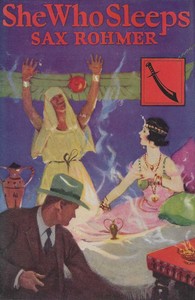
There was a stone-faced house not twenty yards ahead, and on a balcony high up before an open window she stood. She wore some kind of cloudy robe--a jewelled girdle--the dress of a Theban priestess! One hand upraised rested against the sash of the window, the other upon the curve of her hip.
She had long dark eyes which seemed to be watching him, and her lips were parted in a slight smile.…
“I am dreaming,” he said aloud. “An Egyptian princess!”
Save that it seemed to live, the beautiful figure was one of those out of a dim past which had watched over him from childhood!
And now the wheel was wrenched from Barry’s grasp--he was aware of a cry--a loud, splintering crash--a sickening blow on the skull--of no more.…
CHAPTER II. THE DIVIDING LINE
Very slowly Barry Cumberland opened his eyes--took one look straight before him--and then shut them again quickly.
Something was wrong. He could swear he had been sitting but a moment before with his back against the giant pillar of an Ancient Egyptian building, staring at a window high up in a temple wall. In the moonlight he had seen a beautiful priestess standing at this window; and he had been waiting patiently--patiently--for a black cloud to pass, a cloud that had suddenly obscured the moon and hidden the slender figure.
Yes, those were the facts, he felt fairly confident. He opened his eyes again. He saw a small, very clean white room; and he was lying in a very clean white bed. He seemed to be propped up in some way, and he experienced great difficulty in moving his head, together with great disinclination to do so because of a dull pain above his eyes.
There were some medicine bottles and cups upon a glass-topped table, and there was a tall white screen of some very glossy material. The only spot of colour in the room was a bowl filled with red roses, which also stood upon the table. He wondered idly what was behind the screen, and then closed his eyes once more.
There was some mistake. No doubt the explanation was simple enough, but his brain seemed to be tired, physically tired. He found himself incapable of grappling with the problem. In one respect, of course, he must have been wrong: In regard to the Egyptian temple. He had never been in Egypt. In his idea that he lay in this unfamiliar white room, no doubt he was wrong, also; although the red roses were suspiciously like the handiwork of his Aunt Micky.
Without Barry becoming aware of any movement, a cool hand was presently laid upon his forehead.
For the third time he raised weary lids--and found himself looking into a pair of kindly eyes, their kindliness magnified by the glasses which their owner wore. A white-capped nurse was bending over him! She was entirely dressed in white, too. Everything in the place seemed to be white, except the roses, which were red, and the nurse’s eyes, which were blue.
“Ah!” she said, speaking in a low, soothing voice which yet had a note of gaiety in it, “so you have decided to wake up.”
Barry Cumberland tried to say Yes, but only achieved a whisper. Great heavens! He had never felt so cheap in his life! What was it all about?
“Don’t bother to talk,” the soothing voice went on. “When you have had another little sleep you will feel ever so much better. I have brought you a drink.”
She held a glass to his lips. He drank, looking into the kindly, smiling eyes; and fell asleep again.
The next time he awoke, the nurse was sitting in a chair beside him, reading. Presumably it was night, for a silk-shaded lamp was lighted upon the table at her elbow.
Barry stirred slightly and turned in her direction. She looked up at once.
“Good-evening,” she said; “is there anything you want?”
“No, thank you.” His voice was very low, but at least he could make himself understand. “Except--where am I?”
“In the first place, you are quite all right,” she replied in her gentle way. “You were thrown out of your car, you know, and really had--a most lucky escape. In the second place, you are in the Elizabeth Foundation Hospital.”
“Thrown out of my car?” Barry muttered. “Elizabeth? How did I get to Elizabeth?”
The nurse looked at him doubtfully, stood up, and:
“I am not at all sure that you should be allowed to talk yet,” she said in a tone of authority. “At any rate, it is time for your medicine.”
She measured out a dose from a graduated bottle on the table, and held it to his lips. He drank, watching her, and vainly trying to grab at any one of a thousand ideas that were dancing wildly through his brain. Yes, of course!--there _had_ been a crash! He remembered, now. He had been driving the Rolls--when was it? Some time earlier in the evening, no doubt. And there was something about Egypt. Had someone been talking to him about Egypt? He could not capture this idea at all.
As the empty glass was set down:
“Please tell me,” he asked, and found that he had already more control of his voice, “did I crash near here?”
“Some little distance away,” the nurse answered, resuming her seat and smoothing a white apron with sensitive fingers.
Barry considered this reply for a long time. His brain was working with unfamiliar and amazing slowness. Then:
“Was I alone?” he inquired.
“You were alone in the car--yes.”
“You are sure there was no lady with me?”
“Then how do I come to be here?”
“You were brought here by someone who found you.”
“Do you mean a friend?” Barry asked.
And as he spoke an explanation came to him of that extraordinary pressure about his skull for which he had hitherto been unable to account. His head was tightly bandaged!
“I am afraid you are talking too much,” the nurse said with gentle sternness. “It is contrary to Dr. Barton’s orders for me to allow you to talk. But I will answer your question. The man who brought you was a stranger, and his finding you a pure accident. And now please close your eyes and stop thinking about it.”
Barry smiled, and, in regard to closing his eyes, obeyed. But he did not stop thinking about it. He lay there endeavouring to capture those maddeningly elusive ideas which scampered about his mind like so many rabbits. Yes--he had crashed in the Rolls. He had been bound for New York. He remembered so much, clearly. He could not remember why he was bound for New York, nor from where; but New York had been his objective. He opened his eyes.
“How was I dressed when I was brought in?” he inquired.
“You were wearing your dinner clothes,” the nurse replied distinctly, raising her eyes from the book which she had resumed reading. “Please ask no more questions, because I shall be unable to answer them. In ten minutes I am going to turn the light out and leave you. So try to get to sleep.”
“Thank you,” said Barry, and continued his reflections.
He had been wearing his dinner clothes. Where on earth could he have been coming from? He opened his eyes, another point having occurred to him which might help to throw light upon the problem. But, slowly turning his head aside and noting the firm little chin of the girl as she bent over her book, he hesitated and did not ask the question. Nevertheless, he determined to remain awake until he had the facts in order. With which idea firmly in mind, he immediately fell asleep again.
When next he awakened, morning sunlight flooded the room, and he saw, standing beside the white-capped nurse, a cheery-looking, gray-haired man, having a very ruddy complexion.
“Good-morning, Mr. Cumberland,” said the cheery man in a cheery voice.
“Good-morning,” Barry replied--and, in the act of speaking, knew that he was himself again and that he had not been himself during those earlier conversations with the nurse.
He raised his hand to his bandaged skull. It was singing and throbbing, but that curious dull pain had gone.
“My name is Dr. Barton,” the other went on. “Feel better?”
“Rather!” said Barry. “What the deuce happened to me? Did I try to take a high jump or something?”
“Not exactly,” Dr. Barton replied, sitting on a rail at the end of the bed and addressing Barry over his shoulder. “You seem to have tried to climb a tree.”
Barry grinned feebly.
“How’s the Rolls looking?” he inquired.
“That I can’t tell you,” was the reply. “I understand it has been towed to a garage some miles from here.”
But, even as he listened to Dr. Barton’s answer, Barry’s mind had been actively at work. A phantom that had been haunting him took human shape. He recalled every circumstance that had led up to the accident. His smashed car ceased to interest him. His own condition became a very trivial matter. One thing, and one thing only, he wanted to know, and:
“I remember it all clearly,” he said. “I had lost my way. One point I _must_ clear up.”
“Well, get busy with it,” the genial doctor directed, “because we are going to have you out of bed, presently, and see how you feel on your feet.”
“Splendid,” Barry replied. “What I want you to tell me is this: the exact spot at which the crash took place.”
Dr. Barton shook his head.
“I haven’t the faintest idea!”
“What!” Barry exclaimed. “But whoever brought me here must have known where he found me!”
“No doubt,” Dr. Barton admitted, “but he didn’t think it necessary to mention the fact.”
“Perhaps you don’t understand,” Barry went on patiently, “that it’s rather important. Could you possibly ring up this Good Samaritan and arrange for me to see him?”
“We _could_--if we knew his number.”
“Didn’t he leave it?”
“He left nothing!” was the astonishing answer. “He drove you here in a Studebaker--it was a Studebaker, wasn’t it, Nurse?” The nurse confirmed his statement with a nod; and: “In a Studebaker,” Dr. Barton continued, “at somewhere around ten o’clock. Dr. Perry was in charge and admitted you. You looked like a serious case, you understand. You’re not, but you looked like it. Who you were we found out from your cards, license, and what not. Then this dark horse in the Studebaker faded out.”
“Faded out?” Barry echoed.
“Precisely!” Dr. Barton inclined his head in solemn fashion. “Faded out. He didn’t leave so much as his best wishes.”
“Do you mean you have no means of tracing him?”
The novel opens with Barry Cumberland driving through a sudden mountain storm, his impulsive decision to leave a club party setting a pattern of irrational behavior. The darkness is described as having an "unfamiliar quality," and a house glimpsed through a gap in trees resembles "a drawing by Sidney Sime." This atmospheric, almost supernatural description establishes a tone where the natural world seems charged with hidden significance. Barry's character is introduced through his abrupt changes of plan, which annoy friends but don't harm his popularity—a detail that hints at a privileged, charismatic figure whose whims carry weight.
The Excavation and the Ritual
The excavation scenes in the Egyptian desert are marked by meticulous planning and mounting tension. The archaeologist Danbazzar insists on a careful protocol: the inner sarcophagus lid must not be raised until the team is dressed as Ancient Egyptians, and they must remain silent. He argues that the sleeper, Princess Zalithea, last saw the world "in the days of the Pharaohs" and would be terrified by "wild-eyed devils" in modern clothes. This concern for the perspective of the ancient woman adds a layer of psychological realism to the supernatural premise.
The moment the lid is raised reveals a painted figure of a girl holding a Lotus flower, with the Ankh symbol at her head and feet. Barry recognizes her as "the girl of his dreams," a coincidence that pushes him toward a crisis of belief. The narrative treats this recognition as a shock—"This was madness!"—rather than a romantic revelation, emphasizing the uncanny rather than the sentimental.
Contrasts of Setting and Mood
The story moves between two sharply contrasting settings: the modern, affluent world of New York and the ancient, mysterious landscape of Egypt. The opening chapter's stormy drive through the mountains, with its "black as the pall of Avalon" cloud and "treacherous byways," establishes a sense of danger and isolation. Later, the excavation camp in the desert becomes a place of feverish excitement, where "excitement ran higher than ever" and the workers labor "like men whose lives depended upon their speedy success."
These settings are not merely backdrops but active forces. The storm in New York seems to foreshadow the supernatural events in Egypt, while the desert's heat and dust amplify the physical and emotional strain. The contrast between Barry's comfortable life—driving a Rolls, belonging to a club—and the gritty, obsessive work of the excavation highlights the tension between modern rationality and ancient mysteries.
Patterns of Impulse and Obsession
Barry Cumberland is defined by sudden, irrational impulses. He leaves a party "for no reason that he could have defined," driven by "a sudden irrational impulse." This pattern recurs in his reaction to the painted sarcophagus: he feels "sick" and believes he might "swoon," a visceral response that goes beyond mere surprise. The narrative links his emotional state to the supernatural, suggesting that his dreams have somehow anticipated the discovery.
Other characters also exhibit obsessive behavior. Danbazzar is consumed by the ritual's details, while Professor Blackwell, Barry's father, defers to Danbazzar's expertise despite his own knowledge. The group's collective agreement to dress as Ancient Egyptians—"Everybody agreed"—shows how the excavation's logic overrides individual skepticism. The pattern of impulse and obsession drives the plot forward, creating a sense of inevitability as the characters commit to actions they cannot fully explain.
Readers should pay attention to the novel's use of visual and sensory details—the quality of darkness, the texture of a painted lid, the weight of a cigar rolled between fingers. These details ground the fantastical premise in a tangible world. The story does not rush to explain its mysteries; instead, it lets the tension build through careful observation and the characters' own uncertainty. The contrast between the modern and the ancient is not just a setting but a central conflict, and the narrative's power lies in how it makes both worlds feel equally real and equally strange.
That strange pull between fascination and unease, where an old power feels almost personal—I kept thinking of it after finishing the book about Barry and Princess Zalithea. The Insidious Dr. Fu Manchu — Themes and Context carries that same quiet dread, the sense of something ancient watching from the dust. It lingered with me in a similar way, soft but persistent.
Alexander Carter
3 weeks agoCarter Adams
1 month agoGrayson Baker
1 week agoJames Williams
1 week agoHow will you remember this book?
Save your reaction, strongest insight, and memorable passage.
Victoria Smith
2 weeks ago