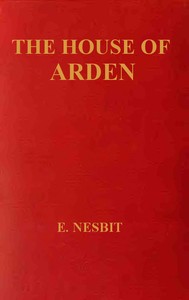
The House of Arden: A Story for Children — Inside the Classic
Edition facts
Before opening The House of Arden: A Story for Children — Inside the Classic, the edition data offers a quick orientation: 79,493 words, 5 hr 46 min estimated reading time, and 11 detected text sections.
The text analysis averages about 16.4 words per sentence, while the detected sections provide another way to judge how the source is divided.
Project Gutenberg metadata also associates the work with “Siblings -- Juvenile fiction,” connecting these edition facts with the source record’s subject description.
Calculated from edition completeness, EPUB availability, text structure and catalogue metadata. Not a user rating.
How this score is calculated
- Description quality20 pts
- Title & short description10 pts
- Source metadata20 pts
- Text length15 pts
- Chapters / structure15 pts
- EPUB file integrity20 pts
Total of 100 points, scaled to a 2.5-5.0 range. Editions with an empty description or a missing EPUB file are not scored.
Read the Text
ed down on them accordingly. And very often the lodgers’ children were the sort of children on whom anybody might have looked down, if it were right and kind to look down on any one. And when Master Reginald Potts, of Peckham, puts his tongue out at you on the parade and says, right before everybody, “Lodgings! Yah!” it is hard to feel quite the same to him as you did before.
When there were lodgers—and there nearly always were, for the house was comfortable, and people who had been once came again—the children and their aunt had to live in the very top and the very bottom of the house—in the attics and the basement, in fact.
When there were no lodgers they used all the rooms in turn, to keep them aired. But the children liked the big basement parlour room best, because there all the furniture had belonged to dead-and-gone Ardens, and all the pictures on the walls were of Ardens dead and gone. The rooms that the lodgers had were furnished with a new sort of furniture that had no stories belonging to it such as belonged to the old polished oak tables and bureaux that were in the basement parlour.
Edred and Elfrida went to school every day and learned reading, writing, arithmetic, geography, history, spelling, and useful knowledge, all of which they hated quite impartially, which means they hated the whole lot—one thing as much as another.
The only part of lessons they liked was the home-work, when, if Aunt Edith had time to help them, geography became like adventures, history like story-books, and even arithmetic suddenly seemed to mean something.
“I wish you could teach us always,” said Edred, very inky, and interested for the first time in the exports of China; “it does seem so silly trying to learn things that are only words in books.”
“I wish I could,” said Aunt Edith, “but I can’t do twenty-nine thousand and seventeen things all at once, and——” A bell jangled. “That’s the seventh time since tea.” She got up and went into the kitchen. “There’s the bell again, my poor Eliza. Never mind; answer the bell, but don’t answer _them_, whatever they say. It doesn’t do a bit of good, and it sometimes prevents their giving you half-crowns when they leave.”
“I do love it when they go,” said Elfrida.
“Yes,” said her aunt. “A cab top-heavy with luggage, the horse’s nose turned stationward, it’s a heavenly sight—when the bill is paid and—— But, then, I’m just as glad to see the luggage coming. Chickens! when my ship comes home we’ll go and live on a desert island where there aren’t any cabs, and we won’t have any lodgers in our cave.”
“When I grow up,” said Edred, “I shall go across the sea and look for your ship and bring it home. I shall take a steam-tug and steer it myself.”
“Then I shall be captain,” said Elfrida.
“No, I shall be captain.”
“You can’t if you steer.”
“Well, do, then!” said Elfrida; “and while you’re doing it—I _know_ you can’t—I shall dig in the garden and find a gold-mine, and Aunt Edith will be rolling in money when you come back, and she won’t want your silly old ship.”
“Spelling next,” said Aunt Edith. “How do you spell ‘disagreeable’?”
“Which of us?” asked Edred acutely.
“Both,” said Aunt Edith, trying to look very severe.
When you are a child you always dream of your ship coming home—of having a hundred pounds, or a thousand, or a million pounds to spend as you like. My favourite dream, I remember, was a thousand pounds and an express understanding that I was not to spend it on anything useful. And when you have dreamed of your million pounds, or your thousand, or your hundred, you spend happy hour on hour in deciding what presents you will buy for each of the people you are fond of, and in picturing their surprise and delight at your beautiful presents and your wonderful generosity. I think very few of us spend our dream fortunes entirely on ourselves. Of course, we buy ourselves a motor-bicycle straight away, and footballs and bats—and dolls with real hair, and real china tea-sets, and large boxes of mixed chocolates, and “Treasure Island,” and all the books that Mrs. Ewing ever wrote, but when we have done that we begin to buy things for other people. It is a beautiful dream, but too often, by the time it comes true—up to a hundred pounds or a thousand—we forget what we used to mean to do with our money, and spend it all in stocks and shares, and eligible building sites, and fat cigars and fur coats. If I were young again I would sit down and write a list of all the kind things I meant to do when my ship came home, and if my ship ever did come home I would read that list, and—— But the parlour bell is ringing for the eighth time, and the front-door bell is ringing too, and the first-floor is ringing also, and so is the second-floor, and Eliza is trying to answer four bells at once—always a most difficult thing to do.
The front-door bell was rung by the postman; he brought three letters. The first was a bill for mending the lid of the cistern, on which Edred had recently lighted a fire, fortified by an impression that wood could not burn if there were water on the other side—a totally false impression, as the charred cistern lid proved. The second was an inquiry whether Miss Arden would take a clergyman in at half the usual price, because he had a very large family which had all just had measles. And the third was THE letter, which is really the seed, and beginning, and backbone, and rhyme, and reason of this story.
Edred had got the letters from the postman, and he stood and waited while Aunt Edith read them. He collected postmarks, and had not been able to make out by the thick half-light of the hall gas whether any of these were valuable.
The third letter had a very odd effect on Aunt Edith. She read it once, and rubbed her hand across her eyes. Then she got up and stood under the chandelier, which wanted new burners badly, and so burned with a very unlighting light, and read it again. Then she read it a third time, and then she said, “Oh!”
“What is it, auntie?” Elfrida asked anxiously; “is it the taxes?” It had been the taxes once, and Elfrida had never forgotten. (If you don’t understand what this means ask your poorest relations, who are also likely to be your nicest, and if they don’t know, ask the washerwoman.)
“No; it’s not the taxes, darling,” said Aunt Edith; “on the contrary.”
I don’t know what the contrary (or opposite) of taxes is, any more than the children did—but I am sure it is something quite nice—and so were they.
“Oh, auntie, I _am_ so glad,” they both said, and said it several times before they asked again, “What is it?”
“I think—I’m not quite sure—but I think it’s a ship come home—oh, just a quite tiny little bit of a ship—a toy boat—hardly more than that. But I must go up to London to-morrow the first thing, and see if it really is a ship, and, if so, what sort of ship it is. Mrs. Blake shall come in, and you’ll be good as gold, children, won’t you?”
“Yes—oh, yes,” said the two.
“And not make booby traps for the butcher, or go on the roof in your nightgowns, or play Red Indians in the dust-bin, or make apple-pie beds for the lodgers?” Aunt Edith asked, hastily mentioning a few of the little amusements which had lately enlivened the spare time of her nephew and niece.
“No, we really won’t,” said Edred; “and we’ll truly try not to think of anything new and amusing,” he added, with real self-sacrifice.
“I must go by the eight-thirty train. I wish I could think of some way of—of amusing you,” she ended, for she was too kind to say “of keeping you out of mischief for the day,” which was what she really thought. “I’ll bring you something jolly for your birthday, Edred. Wouldn’t you like to spend the day with nice Mrs. Hammond?”
“Oh, _no_,” said Edred; and added, on the inspiration of the moment, “Why mayn’t we have a picnic—just Elf and me—on the downs, to keep my birthday? It doesn’t matter it being the day before, does it? You said we were too little last summer, and we should this, and now it is this and I have grown two inches and Elf’s grown three, so we’re five inches taller than when you said we weren’t big enough.”
“Now you see how useful arithmetic is,” said the aunt. “Very well, you shall. Only wear your old clothes, and always keep in sight of the road. Yes; you can have a whole holiday. And now to bed. Oh, there’s that bell again! Poor, dear Eliza.”
A Clapham cub, belonging to one of the lodgers, happened to be going up to bed just as Edred and Elfrida came through the baize door that shut off the basement from the rest of the house. He put his tongue out through the banisters at the children of the house and said, “Little slaveys.” The cub thought he could get up the stairs before the two got round the end of the banisters, but he had not counted on the long arm of Elfrida, whose hand shot through the banisters and caught the cub’s leg and held on to it till Edred had time to get round. The two boys struggled up the stairs together and then rolled together from top to bottom, where they were picked up and disentangled by their relations. Except for this little incident, going to bed was uneventful.
Next morning Aunt Edith went off by the eight-thirty train. The children’s school satchels were filled, not with books, but with buns; instead of exercise-books there were sandwiches; and in the place of inky pencil-boxes were two magnificent boxes of peppermint creams which had cost a whole shilling each, and had been recklessly bought by Aunt Edith in the agitation of the parting hour when they saw her off at the station.
They went slowly up the red-brick-paved sidewalk that always looks as though it had just been washed, and when they got to the top of the hill they stopped and looked at each other.
“It can’t be wrong,” said Edred.
“She never told us not to,” said Elfrida.
“I’ve noticed,” said Edred, “that when grown-up people say ‘they’ll see about’ anything you want it never happens.”
“I’ve noticed that, too,” said Elfrida. “Auntie always said she’d see about taking us there.”
“We won’t be mean and sneaky about it,” Edred insisted, though no one had suggested that he _would_ be mean and sneaky. “We’ll tell auntie directly she gets back.”
“Of course,” said Elfrida, rather relieved, for she had not felt at all sure that Edred meant to do this.
“After all,” said Edred, “it’s _our_ castle. We _ought_ to go and see the cradle of our race. That’s what it calls it in ‘Cliffgate and its Envions.’ I say, let’s call it a pilgrimage. The satchels will do for packs, and we can get half-penny walking-sticks with that penny of yours. We can put peas in our shoes, if you like,” he added generously.
“We should have to go back for them, and I don’t expect the split kind count, anyhow. And perhaps they’d hurt,” said Elfrida doubtfully. “And I want my penny for——” She stopped, warned by her brother’s frown. “All right, then,” she ended; “you can have it. Only give me half next time you get a penny; that’s only fair.”
“I’m not usually unfair,” said Edred coldly. “Don’t let’s be pilgrims.”
“But I should like to,” said Elfrida.
Edred was obstinate. “No,” he said, “we’ll just walk.”
So they just walked, rather dismally.
The town was getting thinner, like the tract of stocking that surrounds a hole; the houses were farther apart and had large gardens. In one of them a maid was singing to herself as she shook out the mats—a thing which, somehow, maids don’t do much in towns.
“Good luck!” says I to my sweetheart, “For I will love you true; And all the while we’ve got to part, My luck shall go with you.”
“That’s lucky for us,” said Elfrida amiably.
“We’re not her silly sweetheart,” said Edred.
“No; but we heard her sing it, and he wasn’t here, so he couldn’t. There’s a sign-post. I wonder how far we’ve gone? I’m getting awfully tired.”
“You’d better have been pilgrims,” said Edred. “_They_ never get tired, however many peas they have in their shoes.”
“I will now,” said Elfrida.
“You can’t,” said Edred; “it’s too late. We’re miles and miles from the stick shop.”
“Very well, I shan’t go on,” said Elfrida. “You got out of bed the wrong side this morning. I’ve tried to soft-answer you as hard as ever I could all the morning, and I’m not going to try any more, so there.”
“Don’t, then,” said Edred bitterly. “Go along home if you like. You’re only a girl.”
“I’d rather be only a girl than what _you_ are,” said she.
“And what’s that, I should like to know?”
Elfrida stopped and shut her eyes tight.
“Don’t, don’t, don’t, don’t!” she said. “I won’t be cross, I won’t be cross, I won’t be cross! Pax. Drop it. Don’t let’s!”
“Quarrel about nothing,” said Elfrida, opening her eyes and walking on very fast. “We’re always doing it. Auntie says it’s a habit. If boys are so much splendider than girls, they ought to be able to stop when they like.”
“Suppose they don’t like?” said he, kicking his boots in the thick, white dust.
“Well,” said she, “I’ll say I’m sorry first. Will _that_ do?”
“I was just going to say it first myself,” said Edred, in aggrieved tones. “Come on,” he added more generously, “here’s the sign-post. Let’s see what it says.”
It said, quite plainly and without any nonsense about it, that they had come a mile and three-quarters, adding, most unkindly, that it was eight miles to Arden Castle. But, it said, it was a quarter of a mile to Ardenhurst Station.
“Let’s go by train,” said Edred grandly.
“No money,” said Elfrida, very forlornly indeed.
“Aha!” said Edred; “now you’ll see. _I’m_ not mean about money. I brought my new florin.”
“Oh, Edred,” said the girl, stricken with remorse, “you _are_ noble.”
“Pooh!” said the boy, and his ears grew red with mingled triumph and modesty; “that’s nothing. Come on.”
So it was from the train that the pilgrims got their first sight of Arden Castle. It stands up boldly on the cliff where it was set to keep off foreign foes and guard the country round about it. But of all its old splendour there is now nothing but the great walls that the grasses and wild flowers grow on, and round towers whose floors and ceilings have fallen away, and roofless chambers where owls build, and brambles and green ferns grow strong and thick.
The children walked to the castle along the cliff path where the skylarks were singing like mad up in the pale sky, and the bean-fields, where the bees were busy, gave out the sweetest scent in the world—a scent that got itself mixed with the scent of the brown seaweed that rises and falls in the wash of the tide on the rocks at the cliff-foot.
“Let’s have dinner here,” said Elfrida, when they reached the top of a little mound from which they could look down on the castle. So they had it.
Two bites of sandwich and one of peppermint cream; that was the rule.
And all the time they were munching they looked down on the castle, and loved it more and more.
“Don’t you wish it was real, and we lived in it?” Elfrida asked, when they had eaten as much as they wanted—not of peppermint creams, of course; but they had finished them.
“It is real, what there is of it.”
“Yes; but I mean if it was a house with chimneys, and fireplaces, and doors with bolts, and glass in the windows.”
“I wonder if we could get in?” said Edred.
“We might climb over,” said Elfrida, looking hopefully at the enormous walls, sixty feet high, in which no gate or gap showed.
“There’s an old man going across that field—no, not that one; the very green field. Let’s ask him.”
So they left their satchels lying on the short turf, that was half wild thyme, and went down. But they were not quite quick enough; before they could get to him the old man had come through the field of young corn, clambered over a stile, and vanished between the high hedges of a deep-sunk lane. So over the stile and down into the lane went the children, and caught up with the old man just as he had clicked his garden gate behind him and had turned to go up the bricked path between beds of woodruff, and anemones, and narcissus, and tulips of all colours.
His back was towards them. Now it is very difficult to address a back politely. So you will not be surprised to learn that Edred said, “Hi!” and Elfrida said, “Halloa! I say!”
The old man turned and saw at his gate two small figures dressed in what is known as sailor costume. They saw a very wrinkled old face with snowy hair and mutton-chop whiskers of a silvery whiteness. There were very bright twinkling blue eyes in the sun-browned face, and on the clean-shaven mouth a kind, if tight, smile.
“Well,” said he, “and what do _you_ want?”
“We want to know——” said Elfrida.
“About the castle,” said Edred, “Can we get in and look at it?”
“I’ve got the keys,” said the old man, and put his hand in at his door and reached them from a nail.
“I s’pose no one _lives_ there?” said Elfrida.
“Not now,” said the old man, coming back along the garden path. “Lord Arden, he died a fortnight ago come Tuesday, and the place is shut up till the new lord’s found.”
“I wish _I_ was the new lord,” said Edred, as they followed the old man along the lane.
“An’ how old might _you_ be?” the old man asked.
“I’m ten nearly. It’s my birthday to-morrow,” said Edred. “How old are you?”
“Getting on for eighty. I’ve seen a deal in my time. If you was the young lord you’d have a chance none of the rest of them ever had—you being the age you are.”
“What sort of chance?”
“Why,” said the old man, “don’t you know the saying? I thought every one knowed it hereabouts.”
“I ain’t got the wind for saying and walking too,” said the old man, and stopped; “leastways, not potery.” He drew a deep breath and said—
“When Arden’s lord still lacketh ten And may not see his nine again, Let Arden stand as Arden may On Arden Knoll at death of day. If he have skill to say the spell He shall find the treasure, and all be well!”
“I _say_!” said both the children. “And where’s Arden Knoll?” Edred asked.
“Up yonder.” He pointed to the mound where they had had lunch.
Elfrida inquired, “What treasure?”
But that question was not answered—then.
“If I’m to talk I must set me down,” said the old man. “Shall we set down here, or set down inside of the castle?”
Two curiosities struggled, and the stronger won. “In the castle,” said the children.
The excerpts from The House of Arden show E. Nesbit grounding a time-travel fantasy in the everyday squabbles and observations of two children. Edred and Elfrida, the current Lord Arden and his sister, do not simply stumble into adventures; they reason about them. When a bit of plaster from a past journey reappears in Edred's shoe, he argues that if plaster can travel through time, so could a camera. This close reasoning, as the narrator notes, 'commanded Elfrida's respect.' The children's investigations are not limited to magic: they tour the cottages near Arden Castle, noting leaky thatch, ill-fitting doors, and the wages of the householders. The excerpts thus present a story where the fantastic and the social are intertwined.
Sibling Logic and Quarrel-Averting
The excerpts repeatedly highlight the relationship between Edred and Elfrida as a driving force. Their dialogue is sharp and competitive: when Edred deduces the plaster's significance, Elfrida retorts, 'You're getting quite clever, aren't you?' and he fires back, 'I can be clever sometimes, same as you can.' The narrator then steps in to note that 'it is very annoying to have our thoughts read.' Crucially, the children recognize when a quarrel is imminent and deliberately stop short. Edred calls out 'Fielded!' and Elfrida agrees, 'It wasn't a quarrel; nobody could say it was a quarrel.' This self-awareness about their own dynamics is a recurring motif, suggesting that the magical adventures are partly a way to channel their energy away from conflict.
Social Observation Through a Child's Eyes
The excerpts devote considerable space to the children's unsentimental survey of the poor cottagers. The narrator explains that 'poor people are very friendly and kind to you when you are a child' and will reveal details they would hide from adults. Edred and Elfrida learn 'what wages the master of the house got, what there was for dinner, and what, oftener, there wasn't, how many children were still living, and how many had failed to live.' They catalogue physical decay: 'where the rain came through the rotten thatch,' 'where the boards didn't fit,' and windows that 'were, as often as not, not made to open at all.' This passage grounds the fantasy in a concrete social reality, showing that the children's adventures are not merely escapist but also educational in a practical, empathetic sense.
Costume as a Portal to History
When the children decide to visit the time of James I, they do not rely solely on magic. They consult 'Green's History Book' to see what people wore, then search the attic chests for appropriate clothes. The description is precise: Edred wears 'full breeches, puffed out like balloons, and a steeple-crowned hat, and a sort of tunic of crimson velvet, and a big starched ruff.' Elfrida endures 'long, tight stays with a large, flat-shaped piece of wood down the front, and very full, long skirts over a very abrupt hoop.' The discomfort is noted—the ruff is 'more uncomfortable even than your Eton collar.' This attention to material detail suggests that for Nesbit, historical immersion begins with the body: the children must feel the past before they can inhabit it.
The excerpts from The House of Arden reveal a story that balances the whimsical—a talking mole, time travel—with the concrete: plaster in a shoe, leaky roofs, starched ruffs. Readers may find that the children's investigative approach to both magic and social conditions offers a model of engaged curiosity. The catalog subjects of treasure, magic, and history are present, but the excerpts suggest that the real treasure may be the children's growing understanding of their own world and its past.
Reading about Edred and Elfrida rummaging through the plaster and old histories, I remembered my own dusty attic discoveries, how a single object could make the past feel suddenly close. The King's Sons — Inside the Classic once gave me that same quiet ache of time folding, as if I were standing just outside a story, listening.
There are no reviews for this eBook.
How will you remember this book?
Save your reaction, strongest insight, and memorable passage.