
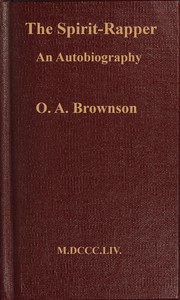
The spirit-rapper; an autobiography — Text and Context
Edition facts
The catalog record for The spirit-rapper; an autobiography — Text and Context provides practical reading context through 103,952 words, 7 hr 32 min estimated reading time, and 29 detected text sections.
The text analysis averages about 23.9 words per sentence, while the detected sections provide another way to judge how the source is divided.
Project Gutenberg metadata also associates the work with “Spiritualism,” connecting these edition facts with the source record’s subject description.
Calculated from edition completeness, EPUB availability, text structure and catalogue metadata. Not a user rating.
How this score is calculated
- Description quality20 pts
- Title & short description10 pts
- Source metadata20 pts
- Text length15 pts
- Chapters / structure15 pts
- EPUB file integrity20 pts
Total of 100 points, scaled to a 2.5-5.0 range. Editions with an empty description or a missing EPUB file are not scored.
Read the Text
CHAPTER I. THE FIRST LESSON 1
CHAPTER II. GUESSES 10
CHAPTER III. FURTHER EXPERIMENTS 22
CHAPTER IV. AN EXPLOSION 33
CHAPTER V. SOME PROGRESS 46
CHAPTER VI. TABLE TURNING 61
CHAPTER VII. A LESSON IN PHILANTHROPY 71
CHAPTER VIII. A LESSON IN WORLD-REFORM 91
CHAPTER IX. THE CONSPIRACY 112
CHAPTER X. MR. COTTON IS PUZZLED 133
CHAPTER XI. WORTH CONSIDERING 154
CHAPTER XII. A MISSIONARY TOUR 173
CHAPTER XIII. THE TOUR CONTINUED 184
CHAPTER XIV. ROME AND THE REVOLUTION 199
CHAPTER XV. THE ULTERIOR PROJECT 218
CHAPTER XVI. A REBUFF 239
CHAPTER XVII. A GLEAM OF HOPE 245
CHAPTER XVIII. RELIGIOUS MONOMANIA 257
CHAPTER XIX. MESMERISM INSUFFICIENT 275
CHAPTER XX. SHEER DEVILTRY 290
CHAPTER XXI. SPIRIT-MANIFESTATIONS 303
CHAPTER XXII. SUPERSTITION 316
CHAPTER XXIII. DIFFICULTIES 329
CHAPTER XXIV. LEFT IN THE LURCH 347
CHAPTER XXV. CONCLUSIONS 363
CHAPTER XXVI. CONVERSION 387
------------------------------------------------------------------------
CHAPTER I. THE FIRST LESSON.
My days are numbered; I am drawing near to the close of my earthly pilgrimage, and I must soon take my final departure,—whither, I dread to think. But before I go I would leave a brief record of some incidents in my worse than unprofitable life. A few who have known me, and will have the charity to breathe a prayer at my grave, may be glad to possess it; and others of my countrymen, who know not what to think of the marvellous phenomena daily and hourly exhibited in their midst, or are vainly striving to explain them on natural principles, may find it neither uninteresting nor uninstructive.
Of my exterior life I have not much to record, for though few have played a more active or important part in the great events of the past few years, my name has rarely been connected with them before the public. I was born in a small town in Western New York. My parents were honest agriculturists from Connecticut, and descended from ancestors who, with Hooker, founded the colony of Hartford. They were among the early settlers of what used to be called the “Holland Purchase,” and, till emigrating to the new world west of the Genesee, were rigid Puritans. Like most emigrants from the land of “steady habits,” they were intelligent, moral, industrious, and economical, and, as a matter of course, soon prospered in this world’s goods, and became able to give their only son the best education the State could furnish, and to leave him a competent estate. I made my preparatory studies at Batavia, and entered, at seventeen, the Freshman class of Union College, Schenectady. I remained at college four years, a diligent, if not a brilliant student, and graduated at the close with the highest standing, and the general love and esteem of my classmates.
My early predilection was for the mathematical and physical sciences. The moral and intellectual sciences were not much to my taste. I took no great interest in them. They struck me as vague, uncertain, and unprofitable. I preferred what M. Comte has since called _Positive Philosophy_. I soon mastered mathematics, mechanics, and physics, as far as they were taught in our college, but I found my greatest delight in chemistry, which, by its subtle analyses, seemed to promise me an approach to the vital principle and to the essences of things.
On leaving college I studied—not very profoundly—medicine, and took my degree, less with a view to professional practice, in which I never engaged, than with a view to general science. After taking my degree as Doctor of Medicine, I resumed and extended my college studies, entered largely into the study of natural history, physical geography, zoölogy, geology, mineralogy, and indeed all the ’ologies, then so fashionable that one must have a smattering of them if he would woo successfully his sweetheart. I paid some attention to Gall and Spurzheim’s new science of Phrenology, when Spurzheim visited this country, where he died, and was much interested in it till I had the misfortune to listen to a course of lectures in its exposition and defence, by George Combe, Esq., the great Scottish phrenologist. That course upset me, and I have since abandoned Phrenology, save so far as I find it taught by Plato in his Timæus, and only laughed at its pretensions and its adherents.
I was arrested, for a moment, by Boston Transcendentalism, but I could not make much of it. Its chiefs told me that I was not spiritual enough to appreciate it, and that I was too much under the despotism of the understanding to be able to rise to those empyrean regions where the soul asserts her freedom, and sports with infinite delight in all the luxury of the unintelligible. I thought they talked metaphysics, what neither their hearers nor themselves could understand; and finding myself very little enlightened by their intelligible unintelligibility, their dark utterances, and their Orphic sayings, I gave them up, and returned to my laboratory.
About 1836, I made the acquaintance of Dr. P——, or, as he claimed to be, the Marquis de P——, a native of one of the French West India Islands, but brought up and educated at Paris, where he had been a Saint-Simonian, and a chief of the _savans_ of the new religion. The decision of the French courts in 1833, that Saint-Simonism was not a religion, and therefore that its chiefs were not priests, and entitled to a salary from the state, dispersed the new sect, and he soon after came to the United States, and commenced, though with a very imperfect knowledge of our language, and very little facility in speaking it, a course of lectures in several of our eastern cities, on Mesmerism, or, as he preferred to call it, Animal Magnetism. His appearance was by no means prepossessing, and his manners, though unpretending, were very far from indicating that exquisite grace and polish which are supposed, for what reason I know not, to be peculiar to the Frenchman; but he was a serious, earnest-minded man, who in several branches of science had made solid studies. I knew him well, and esteemed him much.
At that time I had paid not much attention to Mesmerism. I had heard of Mesmer indeed, of his extraordinary pretensions, and the wonderful phenomena which he professed to produce by his rod and tub; but I had supposed that the matter had been put at rest for all sensible persons by the famous report of the French Academy in 1784, signed, among others, by Bailly the astronomer, and our own Franklin. I supposed that every scientific man acquiesced in the conclusion of that report, that the extraordinary phenomena exhibited by magnetism were to be ascribed to the imagination, and that from the date of that report magnetism had ceased to occupy the attention of the scientific. I was therefore surprised, nay, scandalized, to find a man of real science, and, as I wished to believe, of real worth, professing faith in what I had been led to regard as an exploded humbug, and which, at the very best, could have no practical utility beyond illustrating the deceptive power of the imagination, and the sad consequences which might result to those weak-minded people who become dupes to their own disordered fancy.
Dr. P—— assured me that I was mistaken both as to the bearing and as to the effect of the famous report of the French Academy. That report, he said, concedes the reality of the mesmeric phenomena, and only declares that the assertion of Mesmer, that they are produced by means of a subtle fluid analogous to electricity or magnetism, was not proven or demonstrated by the experiments the commission witnessed; which gives no uneasiness to any animal magnetist in our day, because now no one pretends to explain those phenomena by means of such a fluid. It is true, he said, the commission, in their published report, assert that the phenomena are to be explained by the imagination; but in a private report, addressed to the king, they say, that “it is impossible not to recognize in them a _great power_ which agitates and subjects the patients, and of which the magnetizer appears to be the depositary.” This, contended Dr. P——, is by no means compatible with the theory which ascribes them to the imagination, for that theory supposes the cause that produces them to be in the magnetized, since it is to their imagination, not to that of the magnetizer, that they are to be ascribed; but in this secret report, the power which produces them is assumed to be in the magnetizer, “of which,” it says, “he who magnetizes seems to be the depositary.” For these, as well as other reasons, he said, the report of the Academy was not regarded by magnetists as any authority against Animal Magnetism as understood and practised at the present time.
Moreover, he assured me, that the report of the Academy had not settled the question, or seriously checked the cultivation or the progress of Animal Magnetism. It had at no moment ceased to be studied and practised, chiefly for its therapeutic effects, and, as he proved to me, was at the time firmly held and practised by large numbers of the most upright, benevolent, learned, and scientific members of the medical profession in France, Germany, and Great Britain. It had continued to make progress, and was now very generally held and respected on the continent of Europe. If I would not be behind my age, if I would not remain ignorant of a very curious and interesting class of phenomena, I must, he insisted, investigate and make myself acquainted with Animal Magnetism. I should do it as a lover of science; I should do it more especially as a lover of my race, as a friend of humanity; for I might rest assured that Animal Magnetism is the most facile and powerful means ever yet discovered of solacing, and to a great extent curing, a thousand ills that flesh is heir to.
My curiosity, I confess, was excited, and I resolved to investigate the subject. Dr. P—— had picked up, somewhere in Rhode Island, a somnambulist, an honest, simple-minded young woman, of no great strength of intellect, and very little education or knowledge. She was sickly, and suffering from some nervous affection. He had found her very susceptible to the mesmeric influence, and he made her the subject of numerous experiments. He had brought her, in the winter of 1836-7, to Boston, and there exhibited her to his class. Spending that winter in the same city, I consented one afternoon to be present at his experiments. There were some twenty or thirty gentlemen present on the occasion, mostly lawyers, physicians, ministers, and literary and scientific gentlemen of distinction, all disbelievers in Mesmerism, and on the alert to detect the least sign of deception or complicity.
The Doctor introduced his patient, who took her seat in an arm-chair placed in the centre of the room, and, without any visible sign from Dr. P——, was in a few minutes apparently fast asleep. Her breathing was regular, her pulse natural, and her sleep sound and tranquil. Was it sleep? It was, as far as we could ascertain, and sleep accompanied by complete insensibility. We resorted to every imaginable contrivance to awaken her. One tickled her nose with a feather, another shook her with all his might, another discharged a pistol close to her ear, another stuck pins and needles into her flesh,—all without the least effect. There was no quivering or shrinking, no muscular contraction, and to the rudest proofs she was as insensible as a corpse. We all exhausted our inventive powers in vain, and stood astounded, unwilling to trust our own senses, and yet unable to detect the least conceivable deception or collusion. We none of us knew what to think or say. We were taken all aback.
Various written questions, after we had given over trying to awaken her, were handed to Dr. P——, which he put to her mentally, without a word or sign that we could any of us discern, and to which she instantly answered. One question was, the time of the day; she answered, and answered correctly, much more so than most gentlemen’s watches present. To every question put she answered, and so far as any of us knew, or could ascertain, with perfect accuracy. The Doctor at length told her he thought she had slept long enough, and would do well to wake up. Instantly she was wide awake, and apparently unconscious of all that had passed. She remained awake for some time, when Dr. P—— said to her, “I will you to go to sleep again for just fifteen minutes, and then to wake up.” Instantly she dropped asleep. One or two of the company took the Doctor into a different part of the room, got him into an angry discussion, and made him forget the order he had given. I stood by the somnambulist holding my watch in my hand, and to my astonishment, precisely at the expiration of fifteen minutes, she awoke. Various other experiments were tried, various severe tests were put;—some of them with complete success, others, indeed, proved total failures; and after a session of about three hours the party broke up and went to their several homes, some two or three converted, the greater part satisfied that there was and could be no collusion or deception, and yet wholly sceptical as to the alleged magnetic power.
It is no easy matter to give full credit to the reality of the mesmeric phenomena, or to admit the alleged facts, and when forced to do so by a mass of testimony which it is impossible to resist, nothing is more natural than that we should suggest various hypotheses to account for them. Of all these hypotheses no one, to those who have been eye-witnesses of the mesmeric phenomena, is less satisfactory than that which attributes them to a species of juggling or sleight-of-hand, or to collusion between the magnetized and the magnetizer. Whatever may be the jugglery or connivance in particular cases, or whatever be the real solution of the problem, we must, as a general rule, admit the good faith of the parties. The man who could produce by address or skill, by art, the wonderful phenomena produced by the mesmerizer, who could so successfully elude the scrutiny of the most acute and intelligent witnesses, and so effectually deceive the senses of all classes, would have no motive to practise mesmerism, for he could produce more excitement, and gain more notoriety, and more money as a professed juggler. It is very easy for those who have never seen the mesmeric phenomena, to set them down as a mere cheat, which they, if present, could very easily have detected, but it is very possible that they who have witnessed them are as able to detect an imposition as would be these critics themselves, and are far better judges than they are, not having seen them, unless we are to suppose that the blind can in some cases see better than those who have eyes. Among the innumerable witnesses of these phenomena there may be as careful and as intelligent observers as those who emit their oracles with solemn gravity on matters of which they confessedly know nothing. Academicians and members of royal and scientific societies are no doubt very respectable personages, but they are not always the best observers in the world. I would trust “Jack” to distinguish between a seal or horse-mackerel and the sea-serpent, much quicker than I would Professor Owen or Professor Agassiz. Learned academicians and members of scientific societies, whether of Paris or London, Berlin or Philadelphia, are the easiest people in the world to impose upon. A clever lad could pass off upon them a sucker for a pike, and a crawfish for a lobster. But they need not judge all the world by themselves. Human testimony is not yet become wholly worthless. There is a cloud both of competent and of credible witnesses in almost every country, to the reality of the mesmeric phenomena, and to the good faith, the simplicity, and trustworthiness of both mesmerizers and mesmerized. Whatever be the agent that actually produces these extraordinary phenomena, we must seek it elsewhere than in mere jugglery, sleight-of-hand, trickery, or fraud.
I do not give the results of my first experiments as any thing very wonderful. They would excite little attention now. Mesmerism is much more advanced than it was in the hands of my French friend. It is true, there were rumors even then of far more marvellous phenomena, strange stories of clairvoyance or second-sight were whispered, and strange revelations of an invisible world, not recognized by received science, were hinted; but my friend would not heed them. He was a rationalist, and would not hear of any thing not explicable on natural principles. But what I witnessed convinced me of the reality of the magnetic sleep, and of the subjection of the somnambulist to the will of the mesmerizer, or that one person can, under certain circumstances, exercise an absolute control over the organs of another, and render the somnambulist, during the magnetic sleep, absolutely insensible to all save the mesmerizer. Here was certainly a marvellous power; what was it? Was it, as Bailly and Franklin’s Report of 1784 asserted, the imagination? Singular effect of imagination that would put a person asleep at another’s will, render her completely insensible—dead to all the world but the mesmerizer; make her go to sleep and wake up at the time specified, answer questions only mentally put, and with a promptness and an accuracy wholly impossible in her normal state! A very inexplicable imagination that, and itself not less puzzling than the mesmeric phenomena themselves.
“No, it is not imagination,” insisted Dr. P——, “any more than it is a magnetic fluid, as asserted by Mesmer. It is the will of the magnetizer operating immediately on the will of the somnambulist, and through that on her organs. Or rather, it is the spiritual being in me operating immediately on the spiritual being in her, and therefore these phenomena afford an excellent refutation of materialism, and reveal a great and glorious law of human nature, recognized, though misconceived, in all ages and nations; a mighty law, but hitherto denied to human nature, and supposed to be something lying out of our sphere, superhuman, and even supernatural. Modern science began by denying the mysterious facts recorded in history, but it is beginning to accept them, and to show that they are all explicable on the principles of human nature.”
“What strikes me as most remarkable in the mesmeric phenomena,” said Mr. Winslow, a rather grave minister of the extreme left of the Unitarian denomination, who had joined Dr. P—— and myself on our way to my lodgings, “what strikes me as most remarkable in the mesmeric phenomena is, not the kind of power they reveal, but the degree. Every man who has been accustomed to public speaking, if he has observed, is conscious of a kindred power.”
“To put his audience asleep,” interposed Jack Wheatley, a young lawyer, who was usually one of my companions while in the city, “but not always to make them submissive to his will.”
“It is a mysterious power,” continued Mr. Winslow, “which the orator seems to have over his audience, a power of which he is conscious, but which is wholly unintelligible to himself.”
“But very intelligible to his hearers,” interposed Jack.
“You are impertinent, sir,” replied the minister, with offended dignity. Sometimes when I have attempted to preach, I have found myself, though perfectly familiar with my subject, hardly able to say a word. My ideas dance around and before my mind like summer insects, but at such a distance, and with such rapidity, that I strive in vain to seize them. If I do succeed in saying something, my words penetrate not my hearers; they as it were rebound, and affect only myself.”
“Indeed!” interjected the incorrigible Jack.
“Other times,” continued Mr. Winslow, not heeding Jack’s exclamation, “my ideas seem to come of themselves, to flow without effort, and to clothe themselves, without any thought or intervention of mine, in the most fitting words. I find myself elevated above myself; I am in intimate relation with the minds of my hearers. It seems that an electric current passes from them to me and from me to them, making us as it were one man. I speak with their combined force added to my own, and each of them hears and takes in my words with the united understanding of all.”
Orestes Brownson’s The Spirit-Rapper opens with a preface that disarms the critic by confessing its own formal strangeness: it is not a novel, romance, biography, dissertation, or treatise, yet contains elements of all. This generic hybridity is not mere whimsy but a deliberate tactic. Brownson, a former Universalist minister turned Catholic controversialist, aims to expose what he calls “the new superstition” of spiritualism—and the political radicalism he believes it masks—by adopting a confessional first-person frame that allows him to assert fact while disavowing fiction. The narrator, a self-styled “spirit-rapper,” claims to have witnessed the inner workings of a vast conspiracy linking mesmerists, revolutionaries, and anti-Catholic forces. The book’s tension lies in this unstable boundary: the author insists his statements are true, yet the machinery is invented, leaving the reader to weigh whether the work is a roman à clef, a satirical pamphlet, or something more unsettling.
The Confessional Frame and Its Uncertainties
The preface establishes a paradoxical contract: “There is no fiction in it, save its machinery.” Brownson presents the narrated facts as real or at least believed by him, yet the autobiographical “I” is a constructed persona. This ambiguity pervades the excerpts. The narrator describes himself as part of a cabal that manipulated public enthusiasm for Pope Pius IX, engineering a liberal frenzy they knew would collapse. He writes with the insider’s confidence—“We knew well there must come a point beyond which he could make no further concession”—but the reader cannot verify whether this is memory, invention, or polemical exaggeration. The effect is a sustained unease: the text demands to be read as testimony while flaunting its own artifice.
Political Revolution as Supernatural Manipulation
Brownson’s narrator treats spiritualism and political insurrection as twin products of the same hidden agency. The excerpts describe a coordinated effort to “get the Catholic populations of Europe so committed to the cause we pretended he favored” that the Pope would be disarmed. The language is conspiratorial and specific: “we called upon all the powers which we had prepared, visible and invisible.” Mesmerism, spirit-rapping, and liberal reform are not separate phenomena but instruments of a single assault on authority. The narrator’s approval of “grapeshot and the bayonet” as the only wise response to revolution reveals a stark authoritarianism that complicates any simple reading of the book as a defense of orthodoxy—it is, rather, a defense of order by any means.
The Rhetoric of Exposure and Its Targets
The excerpts show Brownson wielding a forensic style: he names Lord John Russell, Louis Philippe, and “the wily monarch” Napoleon III as unwitting or complicit actors. The narrator claims to have seen through the “feigned” enthusiasm for Pius IX, distinguishing between “honest, simple souls” and the shrewd cardinals who “took their pinch of snuff, shrugged their shoulders, and retired.” This layered observation—of dupes, manipulators, and silent skeptics—gives the prose a knowing, almost cynical texture. The target is not merely spiritualism but the credulity of the public and the cowardice of authority. Brownson’s narrator positions himself as one who both participated in and now exposes the deception, a stance that invites the reader to share his disillusionment without fully trusting his reliability.
Readers approaching The Spirit-Rapper should attend to the friction between its autobiographical posture and its polemical aims. Brownson’s narrator is not a character to be believed or disbelieved so much as a device for testing the limits of testimony. The book rewards attention to its shifts in tone—from sardonic analysis to apocalyptic warning—and to the precise historical references that anchor its otherwise fantastic claims. It is less a novel than a performance of unmasking, and its value lies in the questions it raises about how we distinguish fact from fiction when both serve a crusade.
I keep thinking of that voice in The Spirit-Rapper—the confidence that collapses into doubt, the way conviction scrapes against its own contradictions. It reminds me of winter nights reading The life-eater — Background and Themes, where something similar happens: a story that eats itself slowly, leaving you startled by your own trust. Old books often do this, whisper that certainty is just a door left ajar.
Wyatt Nguyen
1 week agoNoah Hill
1 week agoCharlotte Mitchell
1 week ago-
Jeffery Brown - 4 weeks ago
A fascinating and thought-provoking autobiography that delves into the mysterious world of spiritualism. The author's personal journey is told with candor and insight, offering a rare glimpse into the psychology of belief. The writing is engaging and accessible, making complex philosophical ideas easy to grasp. Whether you're a skeptic or a believer, this book will challenge your assumptions and leave you pondering long after the last page. -
Leslie Stevens - 1 week ago
This autobiography is a slog. The author spends far too much time justifying his beliefs and criticizing skeptics, which comes across as defensive and repetitive. The prose is dense and archaic, making it difficult to follow the timeline of events. While there are some interesting anecdotes, they are buried under layers of verbose commentary. A more focused and edited narrative would have made this a much better read. -
Matthew Dorothy Pham - 1 week ago
The Spirit Rapper provides an interesting account of one man's involvement with spiritualism, but the narrative is occasionally rambling and self-indulgent. The author's honesty is commendable, but his philosophical digressions can detract from the core story. It's a decent read for those curious about spiritualism, but it requires patience to get through some of the more tedious sections.
What did you think of this book?
Answer a few questions and save a private reflection on this device.
Amelia Carter
1 week ago