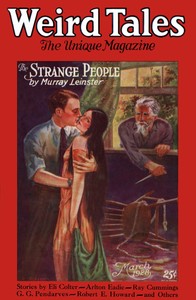
The strange people — Key Ideas to Explore
Edition facts
For The strange people — Key Ideas to Explore, the stored edition analysis reports 28,810 words, 2 hr 6 min estimated reading time, and 3 detected text sections.
The text analysis averages about 12.0 words per sentence, while the detected sections provide another way to judge how the source is divided.
Project Gutenberg metadata also associates the work with “Love stories,” connecting these edition facts with the source record’s subject description.
Calculated from edition completeness, EPUB availability, text structure and catalogue metadata. Not a user rating.
How this score is calculated
- Description quality20 pts
- Title & short description10 pts
- Source metadata20 pts
- Text length15 pts
- Chapters / structure15 pts
- EPUB file integrity20 pts
Total of 100 points, scaled to a 2.5-5.0 range. Editions with an empty description or a missing EPUB file are not scored.
Read the Text
olly, of course, but Cunningham had an ample excuse. For ten years he had toiled at a desk. He had worn a green celluloid eye-shade and added up figures in a tall ledger, or made notes in a day-book, or duly pounded out, “Yours of the fifteenth instant received and in reply would state...” at the dictation of his employer. For eight hours out of the twenty-four, for eleven and a half months out of the twelve, he made memos or orders and payments and violations imposed and repairs made, and all connected with the business of a firm which installed and repaired elevators.
And now he was free. An uncle, dimly remembered, had died without any heirs but Cunningham. Cunningham had inherited fifty thousand dollars and within ten minutes after receiving the news had resigned his job and punched his employer’s rather bulbous nose.
Now he was in quest of adventure and romance. He considered that he had earned them both. Ten years of law-abiding citizenship in New York entitled him to all of adventure he could gather, and ten years in a boarding-house earned him at least one authentic romance.
Cunningham had in his pocket the picture of a girl who lived a mile and a half from Coulters, New Hampshire. The picture had been taken four months before and her name was Maria. She was a pretty girl and had smiled at the camera without self-consciousness. That was all that Cunningham knew about her, but he had built up dreams to supply the rest. And he was quite insanely confident that where she was, there would be romance.
But romance alone would not do. There must be adventure as well. And adventure was duly promised. The picture was in the _Geographic Magazine_ which travel- and adventure-hungry folk devour. It was one of the illustrations of an article prosaically entitled _Ethnological Studies in New Hampshire_, which very soberly outlined the radical traits of New Englanders and the immigrants who are supplanting them. And Maria was a Stranger--one of a group of people who were a mystery and an enigma to all those around them.
They were two hundred people of unknown origin who spoke English far purer than the New Hampshireites around them and avoided contact with their neighbors with a passionate sincerity. They could not be classified even by the expert on races of men who had written the article. They were not Americans or Anglo-Saxons. They were not any known people. But whatever they were, they were splendid specimens, and they were hated by their neighbors, and they kept strictly away from all contact with all other folk. The New Englanders charitably retailed rumors that more than one inquisitive visitor among them had mysteriously disappeared. Strangest of all, they had appeared from nowhere just two years before. They had bought ground and paid for it in new, rough gold. And they refused violently to give any account of themselves.
This was where Cunningham was going. Where the prettiest girl in the world had smiled unconsciously at a camera just four months before. Where a magnificent unknown race was represented in the hodgepodge of New England’s later day. Where inquisitive strangers might mysteriously disappear, where certain hostility awaited too much questioning--and where the prettiest girl in the world might possibly be induced to smile.
Cunningham knew it was foolish, but he considered that he had earned the right to be a fool.
Then he looked up. The solid-looking man just opposite him had unfastened his suit-case and taken out a sheaf of magazine pages, neatly clipped together. He began to go through them as if they were totally familiar. Cunningham caught a glimpse of a picture among them, and started. It was the same article from the same magazine that had sent him here.
Then he heard a snarl, as of one who has contained himself until he can do so no longer. His head jerked around and he found himself staring at the foreigner who had seemed so angry. The man had the _Geographic Magazine_ in his hand. It was open at the page--the very page--on which the girl was pictured. But the foreigner was looking at the type. Otherwise Cunningham as one in quest of romance and adventure would have felt it necessary to interfere an instant later. Because the foreigner glared at the page as if he had read something that infuriated him past all possible control and suddenly ripped the sheet across and across again, and threw the magazine upon the floor and stamped upon it in a frenzy of rage.
He saw eyes fixed upon him, some startled and some slyly amused. He sat down quivering with wrath and pretended to stare out of the window. But Cunningham saw that his hands were clenching and unclenching as if he imagined that he had something in his grasp which he would rend to bits.
The accommodation train made innumerable stops. It stopped at “South Upton.” It puffed into motion and paused at “East Upton.” A little later it drew up grandly at “Upton.” Then it passed through “North Upton.”
The comfortable-looking man opposite Cunningham looked across and smiled.
“Now, if we stop at West Upton,” he suggested, “we can go on to a new name.”
Cunningham nodded and on impulse pulled the _Geographic Magazine_ out of his pocket and held it up.
“Same trail?” he asked.
The other man frowned and looked keenly at him. Then his face relaxed.
“I belong to the lodge,” he admitted. “Here’s my copy.”
Cunningham jerked his head at the third man.
“He had one too. He just tore it up. It seemed to make him mad.”
“That so?” The other looked steadily back at the foreign-seeming man, who was staring out of the window with his face pale with fury. “Let’s ask him.”
He caught the foreigner’s eye an instant later and held up the magazine, opened at the article on the Strange People.
“How about it? You going there too?” he asked pleasantly.
The foreigner went purple with fury.
“No!” he gasped, half-strangled with his own wrath. “I do not know what you are talking about!”
He jerked himself around in his seat until they could see only his profile. But they could see his lips moving as if he were muttering savagely to himself.
“My name’s Cunningham,” said Cunningham. “I want to see those people. They sound sort of interesting.”
“And my name’s Gray,” said the other, shifting to a seat beside Cunningham. “I’m interested, too. I want to hear them talk. Dialect, you know. It’s my hobby.”
“But they’re supposed to talk perfectly good English----” began Cunningham, when he stopped short.
The train had halted leisurely at a tiny station and the conductor was gossiping with an ancient worthy on the station platform. A single passenger had boarded the coach and entered the door. He looked unmistakably unlike the other natives in the car, though he was dressed precisely in the fashion of the average New Englander. But as he came into full view at the end of the aisle he caught sight of the foreign passenger Cunningham had puzzled over.
The newcomer turned a sickly gray in color. He gave a gasp, and then a yell of fear. He turned and bolted from the train, while the foreign passenger started from his seat and with the expression of a devil raced after him. The newcomer darted into a clump of trees and brushwood and vanished. The well-dressed passenger stood quivering on the platform of the day-coach. The conductor gaped at him. The other passengers stared.
Then the well-dressed man came quietly back inside and to his seat. Veins were standing out on his forehead from fury and his hands were shaking with rage. He sat down and stared woodenly out of the window, holding himself still by a terrific effort of will.
Gray glanced sidewise at Cunningham.
“It looks,” he observed in a low tone, “as if our trail will have some interesting developments. That man who just ran away was one of the Strange People. He looks like the pictures of them. It ought to be lively up in the hills when our friend yonder arrives. Eh?”
“I--I’ll say so,” said Cunningham joyously.
He talked jerkily with Gray as the train finished its journey. Without really realizing it, he told Gray nearly everything connected with his journey and his quest. Cunningham was busily weaving wild theories to account for the scene when the first of the Strange People appeared before the third passenger. Otherwise he might have recognized the fact that Gray was very cleverly pumping him of everything he knew. But that did not occur to him until later.
Gray looked more at ease when the train reached Bendale and he and Cunningham sought a hotel together. They saw the third man sending a telegram and, again, arranging for a horse and buggy at a livery stable. He ignored them, but his lips were pressed together in thin, cruel lines.
Cunningham was very well satisfied as he arranged for his room and for a team to take him to Coulters the next day. Ostensibly he was going to try for some fishing, though nothing larger than minnows would be found in that section. But Cunningham considered that the route to romance and adventure was beginning to offer promise.
Still, next morning both he and Gray were startled when the hotel-keeper came to them agitatedly.
“There was three strangers on the train yesterday, wa’n’t there?” he asked in a high-pitched voice that trembled with excitement.
“Yes,” said Cunningham. “Why?”
“D’ye know the other man?” asked the hotelkeeper excitedly. “Know who he was or anything?”
“No, not at all,” Cunningham answered alertly, while Gray listened.
“Would ye recognize him if ye saw him?” quavered the hotel-keeper.
“Of course,” said Cunningham. “Why? What’s the matter?”
Gray had struck a match to light a cigar, but it burned his fingers as he listened.
“He rented a horse an’ buggy last night,” quavered the native. “He drove off to Coulters way, he said. An’ this mornin’ the horse came back with him in the buggy, but he was dead.”
“Dead!” Cunningham jumped and found himself growing a trifle pale.
“Yes, dead, that’s what he is!” said the innkeeper shrilly. “Them Strange People done it! Because it looks like he was beat to death with clubs an’ maybe fifty men was on the job!”
The route to romance led through Bendale to Coulters, but now there was a dead man in the way. It had taken youth and hope and several other things to set out as Cunningham had done in the first place. The quest of a pictured smile among a strange people in unfamiliar country is not a thing the average young man can bring himself to. He will be afraid of looking foolish. But to continue on the quest when one has just seen a dead man the girl’s own people have killed, more courage still is needed.
Cunningham was not quite so joyous now. He had gone with Gray to identify the foreigner. He had turned sick at the expression on the man’s face. He had promised to stay within call for the inquest. And then he and Gray had gone on to Coulters.
Cunningham was not happy. Here was adventure, but it was stark and depressing. And romance. The pictured face was no less appealing and no less ideal. But the picture had been taken four months before. In the interval what might not have happened? Many people were concerned in the killing of the foreigner. Did the girl of the photograph know of it? Was she in the secret of the death that had been dealt out? Did she know who had killed the man, or why?
“You’d a lot better have stayed behind, Cunningham,” said Gray, as their team jogged over the country road to the summer boarding-house where they were to stay. “I don’t think this is going to be pleasant from now on. No place for a romance-hunter.”
“You’re not staying back,” Cunningham observed. “And you’re just following a hobby.”
“Umph. That dialect business. Yes,” said Gray. His lips twitched grimly. “But a hobby can be as exacting as a profession. Still, I didn’t expect to come up here and run slap into a first-class murder.”
Gray puffed on his cigar and slapped the horses with the reins.
“The pleasantest part,” he added, “is that we shall probably be just about as unwelcome as that chap was last night.”
Cunningham did not answer, and they drove in silence for a long time.
Discomforting thoughts assailed Cunningham. He knew as clearly as anyone that it was absurd to grow romantic about a girl merely from a picture. But though it may be absurd, it is by no means uncommon. The obtaining of autographed photographs from Hollywood ranks with radio as a national occupation. Cunningham was not disturbed by the comparative idiocy of traveling several hundred miles and running into some danger just to see a girl whose picture haunted his dreams. But the thought of finding her involved in such an unpleasant mess as the killing of the foreigner; that was different.
A tidy-minded person would have abandoned the quest at once. He would have abandoned the clearly marked trail to romance and high adventure and gone home. A man who acted upon sober common sense would have done the same thing. But such persons do not ever find romance and very rarely even the mildest of adventures. It takes folly and belief to come at romance!--such folly as enabled Cunningham presently to see his duty clear before him.
Maria needed someone to protect her. She was a Stranger, and the native New Hampshireites hated the Strange People cordially. Cunningham had heard enough at the police station that morning to know that the investigation of the foreigner’s killing would be close to a persecution. But if Cunningham were there, near enough to protect the girl who had smiled so shyly yet so pleasantly at the camera, why----
Gray grunted suddenly.
“There’s our boarding-house,” he said, pointing with the whip. “I suppose the Strange People live up in the hills yonder.”
Cunningham stared up at green-clad giants that were tumbled here and there and everywhere in inextricable confusion and grandeur. Hill and valley, vale and mountain, reared up or dipped down until it seemed that as far as the eye could reach the earth had once been a playground of Titans.
A four-square, angular building of typical New England build lay beside the road at the foot of the hills.
“They came here,” grunted Gray, waving his whip. “They had gold, rough gold, to buy ground with. Where did they come from and why did they pick out this part of the world to settle in? The soil’s too thin to grow anything much but hay. The ground’s so rough you have to sow your fields with a shotgun. The biggest crops are stones and summer boarders.”
“I’m wondering,” said Cunningham, whose thoughts had wandered as his eyes roved the heights, “I’m wondering were they knew that chap that was killed.”
“Where they knew him?”
“The Stranger on the train recognized him at first glance. But that chap had a copy of the _Geographic Magazine_ and he’d found where they were from that. He had learned about them just as we did.”
Gray frowned. Then he looked respectfully at Cunningham.
“You’re right. They knew him somewhere, a couple of years ago. But where?”
“The article says nowhere.”
And the article did. According to the writer, the Strange People were an enigma, an anomaly, and a mystery. And they had just proved that they could be a threat as well.
The livery team drew up before Coulters’ solitary building. It was a crossroads post-office and summer hotel with a dreary general store tucked under one wing.
A man was sitting on the porch, smoking. He was watching them intently and as they alighted he rose to greet them.
One glance made Cunningham exclaim under his breath. This man was the counterpart of the foreigner on the train--the one who had been killed. The same olive skin, the same keen and venomous eyes, and even the same too-full lips with their incongruous suggestion of cruelty. He was dressed, too, in the same immaculate fashion from meticulously tailored clothes to handmade boots.
“How do you do?” he said politely. “I’ve been hoping to find you here. You reached Bendale on yesterday’s train?”
Gray’s face was quite impassive.
The foreigner exhibited half a dozen magazine pages. They were the ones containing the article on the Strange People which had brought both Gray and Cunningham to the spot.
“I believe you recognize this?”
Gray nodded, watching the man keenly.
“Before you arrange for rooms,” suggested the foreigner, smiling so that his teeth showed unpleasantly, “I would like to speak to you a moment. My brother saw you on the train. He telegraphed for me to meet you here. I may add that I had myself driven all night over very bad roads to get here, and I probably ruined a car in trying to meet you.”
“Well?” asked Gray shortly.
The foreigner reached into his pocket and pulled out a thick wallet. He opened it, and an incredible mass of yellow-backed bills was exposed to view.
“In the first place,” he said pleasantly, “I would like to offer each of you a present--let us say, five thousand dollars apiece--just to go home and forget that you ever saw that magazine article or ever heard of the Strange People in the hills up there.”
Gray turned to the buckboard and began to hand down his suitcases. The last of them was on the ground before he spoke.
“I’m afraid we can’t do business,” he said without expression. “I am here on a matter of scientific interest. I want to study their dialect. By the way, have you had any news from Bendale this morning?”
The foreigner shook his head impatiently.
“News? No. But if I make it ten thousand----”
“I’m afraid not,” said Gray pleasantly. “I’m not in a money-making business. My friend Cunningham may be willing to take you up.”
But Cunningham tossed his own suit-cases down.
“No,” he said contentedly. “I came here for fun. For adventure, if you choose to put it that way. And anything I’m offered so much to stay out of must be too much fun to miss.”
The foreigner gnawed at his fingertips as they started for the hotel.
“Wait a moment,” he said urgently. “Perhaps we can still come to some agreement. You wish to study dialect? You wish to find adventure? We may still work together.”
“How?” Gray put down his suitcases to light a cigar, while he gazed abstractedly at the foreign-looking man.
“I--I--er--my name is Vladimir,” said the foreigner nervously. “I will promise you five thousand dollars each and all assistance in your separate desires. You”--he spoke to Gray--“you will have all opportunities to hear them talk and study their speech. And you, er, you shall have all the adventures the hills afford. If only you will, er, help us to maintain a certain, er, discretion.”
Cunningham found himself disliking this man extremely.
“Discretion?” he demanded. “You mean keep our mouths shut?”
Vladimir beamed at him.
“Ah, yes! You are a young man. Adventure? There are pretty girls in the hills. I will give them orders. You will find them fascinating. And five thousand dollars in addition to smiles----”
“Suppose you talk plainly,” said Gray shortly, before Cunningham could speak.
“You will find my brother among the Strangers,” Vladimir told them eagerly. “You saw him on the train. Find him and tell him of the bargain I have just made with you. And he will tell you just what you may repeat or speak of what you see. And if you agree to work with us I will give you more money. Ten thousand dollars!”
“But what is the work you are planning?” asked Gray, again before Cunningham could reply. Cunningham was seething.
“It would not be wise to say. But the sheriff of the county has agreed to work with us--for a gift, of course--and will assist us with the full force of the law. If he does so, there can be no objection to your aiding us.”
“Oh,” said Gray gently. “The sheriff’s in it too?”
The opening chapter of The Strange People establishes a deliberate contrast between the ordinary and the extraordinary. Cunningham, a clerk who has spent ten years adding figures under a green celluloid eye-shade, follows a precise itinerary from his desk to the remote New Hampshire settlement of Coulters. The narrator describes his fellow passengers on the accommodation train with a cataloguer's eye: New England farmers, a French-Canadian mill-hand, and two outsiders—one a vacationing businessman, the other an immaculately dressed foreigner reading something that fills him with 'mounting rage.' These details ground the story in a recognizable world while hinting at the strangeness to come.
Diction and the Clerk’s Escape
Leinster’s diction in the early pages reinforces Cunningham’s transformation from office drudge to adventurer. The prose shifts from the dry, formulaic language of business correspondence—'Yours of the fifteenth instant received and in reply would state'—to a more urgent, sensory register. The narrator notes that Cunningham had 'toiled at a desk' for eight hours a day, eleven and a half months a year, and now he is 'free.' The contrast is sharp: the ledger’s columns versus the 'little flickering flames' of knife-blades glittering in sunlight. The author uses short, declarative sentences to convey Cunningham’s newfound decisiveness, as when he boards the train and 'thought of nothing else' but the girl whose picture he carries.
Dialogue and the Weight of Secrets
Dialogue in the excerpts is sparse but loaded with implication. Gray’s quiet warning—'Maybe it would be a good thing if Vladimir did tell what he knows'—suggests a conspiracy that Cunningham only partly understands. The exchange is clipped: 'Better stay behind,' Cunningham says; 'No,' Gray replies, 'Two of us might get her out where one wouldn’t.' The characters speak in fragments, as if afraid of being overheard. Vladimir’s 'raging astonishment' and his servant’s earlier attempt on Cunningham’s life are conveyed through action rather than exposition. Leinster lets the reader infer the stakes from what is left unsaid, a technique that heightens the tension.
Description and the Moonlit Landscape
The most vivid descriptive passages occur during the night journey into the hills. Leinster contrasts the tidy New England farmhouses and the weekly motion-picture theater of Bendale with the 'monstrous ball of the full moon' and the ring of fires on a bald peak. The Strangers’ presence is rendered through sound and light: 'half-determinate sounds which might have been singing, or chanting, or some long-continued musical wailing.' The woods become a labyrinth of 'long tunnels of blackness' with 'leopard-spots' of moonlight. A sentry crosses a patch of clear moonlight; a throwing-knife glitters. The author builds suspense through careful pacing—'breathless work'—and the constant threat of detection.
Structure and the Journey Motif
The narrative is structured as a physical journey that mirrors an emotional one. Cunningham’s route is laid out in the first paragraph: from his desk to Boston, then by train to Hatton Junction, then to Bendale, and finally by hired team to Coulters. Each stage strips away the familiar. The accommodation train’s single passenger coach and baggage car signal a narrowing of options. Once in the hills, the journey becomes a stealthy climb through sentry rings, with the goal shifting from romance to survival. The author uses the journey to compress time and intensify focus: the reader moves with Cunningham from the mundane to the mythic, from the office to the mountain-top fires.
Readers should pay attention to how Leinster balances the quotidian and the uncanny. The novel’s power lies not in the mystery of the Strangers themselves—which remains partly veiled in the excerpts—but in the way ordinary details (a green eye-shade, a weekly movie show) make the extraordinary feel real. The author’s choices in diction, dialogue, and description create a world where a clerk can become a hero, and a New Hampshire valley can harbor ancient secrets.
I remember that strange New Hampshire moonlight, how Leinster made danger feel like a secret you’re not supposed to share. There’s a similar quiet thrill in Raffles: Further Adventures of the Amateur Cracksman — Text and Context, that same sense of a life teetering between ordinary rooms and something far less safe. Odd how those old stories still feel like confidences.
There are no reviews for this eBook.
How will you remember this book?
Save your reaction, strongest insight, and memorable passage.