1

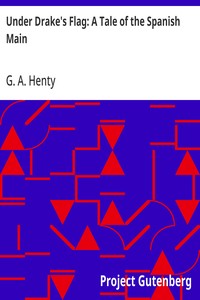
Under Drake's Flag: A Tale of the Spanish Main — Story, Setting & Ideas
(0 User reviews)
1928
Project Gutenberg
2006
Not confirmed
Adventure and adventurers -- Juvenile fiction; Seafaring life -- Juvenile fiction; Great Britain -- History -- Elizabeth, 1558-1603 -- Juvenile fiction; Drake, Francis, approximately 1540-1596 -- Juvenile fiction; Spanish Main -- Juvenile fiction
Readers of public-domain and historical texts
Project Gutenberg digital edition
en
Edition facts
Words
111,513
Reading time
485 min
Text sections
11
The catalog record for Under Drake's Flag: A Tale of the Spanish Main — Story, Setting & Ideas provides practical reading context through 111,513 words, 8 hr 5 min estimated reading time, and 11 detected text sections.
The text analysis averages about 24.9 words per sentence, while the detected sections provide another way to judge how the source is divided.
Project Gutenberg metadata also associates the work with “Adventure and adventurers -- Juvenile fiction,” connecting these edition facts with the source record’s subject description.
Source:
Project Gutenberg record #19206
An editorial note on G.A. Henty's 'Under Drake's Flag' focusing on its episodic structure, recurring images of fire and light, and movement between sea and forest settings, based on excerpts from the 1872 adventure.
Read the complete public-domain text at its original source.
Read on Project GutenbergThe opening chapter of G.A. Henty's Under Drake's Flag establishes a pattern of movement that governs the entire narrative: from the stormy Devon coast, where fishermen discuss Francis Drake's expedition, to the Spanish Main, and later into dense forests and across continents. The story shifts between sea and land, each setting demanding different skills from the young protagonists, Ned and Tom. Henty uses recurring images of fire—first as a threat, then as a gift—to mark transitions between hostile and friendly encounters. The structure is episodic, with each chapter introducing a new challenge or location, from shipwreck to forest fastness to the Pacific coast. This note examines how these structural and imagistic choices shape the reader's experience.
Episodic Movement and Scene Shifts
The novel's twenty-two chapters trace a journey that is both geographical and situational. The excerpts show a clear pattern: each chapter title signals a new phase—'The Wreck on the Devon Coast,' 'On the Spanish Main,' 'Cast Ashore,' 'In the Woods,' 'Across a Continent.' The narrative rarely lingers; it moves from the English village to shipboard battles, then to a forest camp, and later to a Pacific coast encounter. This episodic structure keeps the plot in constant motion, mirroring the restless energy of Drake's expeditions. Henty does not dwell on interior states; instead, he uses scene shifts to introduce fresh obstacles—a storm, an attack, a captivity—and then resolves them quickly before moving on. The result is a fast-paced adventure that prioritizes action over reflection.
Fire as a Recurring Image
Fire appears repeatedly in the excerpts, serving both practical and symbolic functions. Early in the story, a 'bright flame' is kindled to delight natives who had never seen fire before, earning the protagonists gratitude and safe passage. Later, a 'vast blaze' is used to illuminate a camp and signal peaceful intentions to a hostile tribe. The natives' fear of losing fire when the 'strange white beings' depart underscores the image's importance: fire represents civilization, warmth, and control over nature. Henty uses fire to mark moments of cultural contact and negotiation. It is a tool of diplomacy, a source of wonder, and a means of survival. The image recurs at key turning points, linking the English adventurers' technological superiority to their ability to navigate foreign lands.
The Forest as a Space of Testing
When the protagonists are cast ashore and retreat into the woods, the forest becomes a proving ground. The excerpts describe them improving their bows with 'glue prepared by boiling down sinews,' fashioning sleighs, and learning to hunt. The forest is neither idyllic nor purely hostile; it is a space where the lads must adapt their English skills to a new environment. Henty emphasizes practical knowledge: they 'had no fear as to their power of maintaining themselves with food' after mastering local materials. The forest also introduces the threat of other tribes, requiring constant vigilance. The chief's scouts and the 'calls of animals' heard at night create a sense of unseen danger. This setting tests the protagonists' resourcefulness and prepares them for the larger challenges of the Spanish Main.
Voice and Dialogue in Action Scenes
Henty's dialogue is functional, often used to convey information or heighten tension. In the opening, fishermen's talk establishes the expedition's fame and the difficulty of joining it: 'I prayed the captain, on my knees, to take me on board.' Later, the chief's shouted invitation—'he invited all within hearing to come forward, in peace'—demonstrates how speech acts as a bridge between cultures. The narrative voice is brisk, favoring declarative sentences and minimal description of emotion. When Ned observes the chief's orders, the text simply notes: 'Ned pointed to them inquiringly, and the chief intimated that they were now entering the hunting grounds of another tribe.' This economy of language keeps the story moving and aligns with the episodic structure, where action drives the plot rather than introspection.
Readers approaching Under Drake's Flag should attend to how Henty uses movement and recurring images to structure the adventure. The episodic chapters reward attention to setting shifts—from sea to forest to coast—and to the repeated motif of fire as a tool of encounter. The excerpts suggest that the novel is less concerned with historical accuracy than with creating a series of vivid, self-contained episodes. For those interested in Henty's method, tracing how each new location introduces a fresh test for the protagonists offers a way into the narrative's logic.
Reading Under Drake’s Flag again, I noticed how fire keeps appearing—beacon, warning, warmth—and it made me think of that quiet ridge in On the mountain — Inside the Classic, where the light feels more like a held breath than a signal. Strange how old pages can hold both kinds of glow.
There are no reviews for this eBook.
There are no comments for this eBook.
Reader reflection
Your personal reading reflection
Build a private reading journal entry for this title.
Your progress
0
/
10
2
How did the book work for you overall?
3
How likely are you to recommend this book?
4
How demanding did the text feel?
5
How did the reading compare with what you expected?
6
Did this book create an emotional response?
7
Would this book work well in a reading group?
8
How clearly were the main ideas presented?
9
In one sentence, what did you learn?
10