The abysmal invaders — Themes and Context
Edition facts
Before opening The abysmal invaders — Themes and Context, the edition data offers a quick orientation: 15,360 words, 1 hr 7 min estimated reading time, and 2 detected text sections.
The text analysis averages about 28.4 words per sentence, while the detected sections provide another way to judge how the source is divided.
Project Gutenberg metadata also associates the work with “Science fiction,” connecting these edition facts with the source record’s subject description.
Calculated from edition completeness, EPUB availability, text structure and catalogue metadata. Not a user rating.
How this score is calculated
- Description quality20 pts
- Title & short description10 pts
- Source metadata20 pts
- Text length15 pts
- Chapters / structure15 pts
- EPUB file integrity20 pts
Total of 100 points, scaled to a 2.5-5.0 range. Editions with an empty description or a missing EPUB file are not scored.
Read the Text
These were great lanes of destruction which some force had torn across the forested swamp, wide paths in which the trees had been smashed down and crushed as though by the passage of some gigantic creature or creatures. And on the mounds and spots of solid ground along these pathways of destruction they had found strange large tracks, which could have been made by no conceivable living creature but which were entirely unexplainable otherwise. Gigantic and five-toed, these tracks were sunken deep in the soft earth, and were each a full square yard in size. Wherever the lanes of smashed trees lay the great tracks had been found also, seeming to lead inward toward the center of the swamp. The two men had stared at these for a time, dumfounded, and then, not daring to venture farther into the gloomy recesses of the swamp, had hastened back to Brinton with their story.
Within minutes that story had spread over all of Brinton, and within hours it was being shouted forth by yelling newsboys in the Chicago streets. In itself the disappearance of so noted a scientist as Morton would have been startling, but coupled with the mysterious phenomena of the swamp it was sensational. By nightfall a dozen reporters and photographers had arrived in Brinton in quest of further details, and with them had come as a representative of the Northcote institution young Edward Rowan, who had been Morton's chief assistant.
Rowan and the reporters found the little town in a state of turmoil that night, the one topic of excited discussion being the phenomena of the swamp. A posse was being formed, they learned, with which to beat the swamp from end to end on the next morning, in the hope of finding the missing scientist somewhere in its recesses. Young Rowan himself instantly volunteered as a member of the posse and was accepted.
To those in Brinton, however, the disappearance of the scientist was almost a secondary consideration beside the strange tracks and pathways which had been found in the morass. Morton's disappearance, after all, might be due to his stepping into a quicksand, but no natural force or forces could account for the lanes of smashed trees and the giant tracks. No animal on earth, of course, was mighty enough to cause those tracks and pathways, yet what could have done so? Was the thing only a practical joke or hoax of some kind?
Until late that night the town's bright-lighted streets remained crowded with unaccustomed throngs of citizens arguing the matter, sometimes heatedly, or exchanging jests concerning it with passing friends. By most, indeed, the matter was treated more as an elaborate joke than anything else, yet one might have sensed also among those shifting throngs an unspoken elation, a curious pride. Whatever was behind the thing, they felt, it was at least bringing fame to Brinton. North and south and east and west, they knew, the wires would be flashing the story. All the nation would read of it, in the morning. And in the morning, too, the swamp would be searched, the thing cleared up. In the morning....
Thus ran the speech and thoughts of those in the streets that night. And strange it seems, to us, that the people in the streets of Brinton could have spoken thus, that night, could have thought thus. Incredible it seems, indeed, that of them all none ever suspected what dark horror out of long-dead ages was even then rising from behind their little mystery, what mighty, resistless menace was even then crashing gigantically through the outside night, to sweep down upon the little town in one great avalanche of destruction and death.
It is in the account of young Rowan that one finds, now, the clearest picture of the coming of the terror to Brinton. There are other accounts, for though the survivors of that terror were but few most of them have recorded their experiences; yet for the most part their narratives are too horror-stricken and incoherent to be of any real value. Rowan, on the other hand, not only saw the thing as well or better than any other single man, but set down his impressions of it in vivid style.
His narrative begins with the events already detailed, the disappearance of Dr. Morton and his own coming to Brinton. It had been some time after nightfall that he had arrived, and after making arrangements to accompany the posse into the swamp on the next morning he had ventured out into the streets of the town, which were still filled with the shuffling throngs discussing the sensation of the day. Along the streets the windows of stores were still brilliant, their proprietors taking advantage of the unaccustomed throngs, while a few raucous-voiced newsboys were selling late editions of a Chicago daily which had featured the sensation. For an hour or more Rowan strolled on through the streets and then, yawning, began to move back toward his hotel, through the thinning crowds. He had just reached the building's door when he suddenly halted.
From away toward the street's eastern end had come a sudden, high-pitched cry, a thrilling scream which was repeated in the distance by a score of voices, and then succeeded by a dull roar. Rowan stepped out into the street, gazing down its length, lit by the suspended brilliance of the street-lights. A few of the groups on the sidewalks near by had stepped out beside him, and with these he stared down the long street's length toward the source of the shouting cries.
He glimpsed, in a moment, a horde of figures running up the street toward him, a disorganized little mob which was giving utterance to a medley of hoarse shouts and screams. The mob parted, for a moment, and there roared through it a crowded automobile, racing up the street with immense speed, and past the wondering Rowan and those around him. And now he heard, simultaneously, a wild ringing of bells toward the south and a far-away crash which murmured faintly to his ears from the east. With every moment the clamor around him was increasing, the whole city awakening, and lights flashing out in windows on every side.
By then the people around him had caught the contagion of panic and were hastening away toward the west also, but Rowan held his ground until the first running figures of the mob farther down the street were racing past him. Then he reached out and seized one of these, a shabby, middle-aged man whose face was contorted with panic.
"What's the matter?" he cried, striving to make himself heard over the thunderous, increasing clamor about him. "What's happening?"
The man he held bawled something indistinguishable in his ear, and at the same time wrenched frantically loose from his grasp, hurrying on. Some hundreds of feet down the street the main body of the mob was now racing toward Rowan, and then, beyond that mob, Rowan saw by the brilliant street-lamps the cause of their panic flight.
Far down the street there was thundering toward him a gigantic creature which his eyes refused for the moment to credit, a titanic, dark thing whose tremendous, rumbling tread shook the very ground on which he himself stood. A hundred feet in length and a third of that in height it loomed, a colossal dark bulk upheld by four massive legs, tapering into a huge tail behind and carrying before it a long, sinuous neck which ended in a small, reptilian head. High up on the great thing's mighty, curving back clung some smaller creature which he could but vaguely glimpse, and down the street behind it were thundering a half-dozen more like itself, vast, incredible, charging down the street upon the madly screaming mob which fled before them. For one mad, whirling moment Rowan stared, and then he shouted aloud.
"Brontosaurs!" he cried, standing there for the moment quite unconscious of his own peril from the onward-thundering monsters. Brontosaurs! Monsters out of earth's dawn, thundering through a Twentieth Century city! Mighty dinosaurs of the Mesozoic age, the most terrible creatures ever to appear on this planet, bridging the gap of millions of years to crash through the little town! Rowan stood rigid as they thundered on toward him, heard their mighty, throaty bellows as they overtook the fleeing mob, and then saw them trampling over that mob as bulls might trample ants, smashing them beneath gigantic feet, annihilating them with sweeps of the huge tails, thundering, crashing on.
And now they were within yards of him and he found himself staggering back from the street into a crevice between two buildings at its side. The next moment the great monsters had thundered past him, their gigantic tread shaking the earth beneath him, and in that moment he glimpsed clearly the creatures who rode upon their backs. Small and manlike shapes were these, but lizardlike, too, their limbs and bodies green-scaled, their extremities armed with sharp talons, their heads thick and conical and featureless, except for the big, dark, disklike eyes and the wide-fanged mouths. And as they thundered past on their gigantic mounts he saw one raise an arm with a white globe in its grasp, saw a beam of pale and feeble light which flickered out from that globe and struck buildings to right and left, buildings which burst into great masses of flame as the pale beam touched them.
And now the great creatures had swept past him and from farther up the street came their bellowing clamor, pierced by sharp, agonized screams from the tiny running figures there. Around Rowan flames were shooting up in great roaring bursts, and beyond he saw one of the great brontosaurs rearing up against the side of a building, saw that building's walls collapse and crash beneath the huge beast's weight. From right and left came other mighty crashes throughout the city, and an unceasing, thunderous clamor of sounds, the deep and terrible bellowing of the dinosaurs as they crashed across the town, the screams of their victims trampled beneath giant feet, the hiss of the flickering beams, the roar of bursting flames. Down the street, too, was the rumbling of more of the great brontosaurs, racing up the street and past the spot where Rowan crouched, galloping gigantically to the attack.
After them came a single dark, great shape, almost as huge, a great reptilian form whose huge paws gleamed with mighty claws, whose broad-gaping mouth showed immense fangs, leaping forward in quick, gigantic hops like some giant toad, its small eyes glittering in the flame-light of the burning buildings. In a moment it had whirled past Rowan in a series of mighty hops and he glimpsed it farther up the street, pouncing upon the few surviving little figures who ran screaming for shelter, inconceivably swift and catlike in its resistless rushes. And as Rowan saw it leaping on he felt reason deserting him.
"God!" he whispered. "A tyrannosaurus!"
Crouched there at the street's edge he huddled, the buildings around him a storm of leaping flame, while down through that lane of fire there thundered into the town from the east the creatures of a long-dead age, the mighty beasts of earth's youth extinct for millions of years. Rowan was never afterward able to recall all that he saw and heard in the minutes that he crouched there. He knew that other brontosaurs rumbled past, bellowing, ridden by the lizard-creatures whose pale rays swept and stabbed in great circles of fiery destruction; that other tyrannosaurs swept by with swift and mighty leaps, pawing human victims from the wreckage at the street's sides, pouncing and whirling like gigantic cats; that other colossal reptilian shapes, their mighty, curving backs armored by great, upstanding plates, rushed past like great battering-rams of flesh and bone, crashing into buildings and through walls as though of paper, great stegosaurs that thundered on after the others who carried annihilation and death across the town; that still other huge rhinoceroslike shapes galloped past, triceratops who crashed resistlessly on with lowered heads, impaling all before them on their three terrible horns.
All of these Rowan saw, dimly, as though from a great distance, while in his ears beat all the vast roar of sound from the stricken town around him, screams and shouts and hissing cries and vast bellows, roar of flame and crash of falling walls. The great wave of destruction, the mass of the attacking monsters, had swept past and was rolling now over the town toward the west, but still Rowan crouched, motionless. Then behind him was a mounting roar of swiftly catching flame, and out toward him crept little tongues of red fire as the walls between which he crouched began to burn. Then, at last, Rowan rose to his feet and staggered out into the street.
The street-lights had vanished with the bursting of their poles and cables by the rush of the great dinosaurs, but all around him was illumined brilliantly by the light of the flaming buildings. North and south and west the city was burning, vast sheets of murky flame roaring up from it in scores of places, and by the light of those distant fires Rowan glimpsed the scores of titanic dark shapes that crashed still through streets and walls, glimpsed the play of the livid rays and heard the thin cries of those who still fled before the mighty, bellowing dinosaurs. A moment he stood at the street's center, motionless, and then above him was a whirring and flapping of colossal wings, and he looked up to see a vast, dark shape swooping swiftly down upon him.
In a single moment he glimpsed the thing, the forty-foot spread of its huge, batlike wings, the great reptilian head thrust down toward him as it swooped, white fangs gleaming and red eyes shining in the firelight, and in that flashing moment recognized the thing for what it was, a pterodactyl, a flying monster out of the dead ages. Then he saw that upon it rode one of the sealed, dark-eyed lizard-creatures, whose arm was coming up with a white globe in its grasp as its dragon-mount dove down toward Rowan.
The next moment Rowan had thrown himself suddenly aside, and as he did so felt the great pterodactyl sweep over him by a few feet, glimpsed a beam of pale light that flickered down from the upheld globe and struck the street beside him, cracking and rending the pavement there with its intense heat and scorching his own shoulder as it grazed it. Then the giant thing had passed and was flapping on to the west, while behind and above it flew others of its kind, mighty flying reptiles ridden by the lizard-creatures, whose pallid rays struck down with fire and death as they swooped on with whirring wings.
And then suddenly Rowan was running, dazed and blind with terror, down the street toward the east, between the flaming lines of buildings and over the crushed fragments of humanity which lay there. Down the street's length he ran, and out between its last buildings, and on and on into the night, crazedly, aimlessly. The roar of flames and thunderous din of the town behind him dwindled as he ran, but he did not look back, throwing himself blindly forward through the darkness, weeping and wringing his hands, stumbling, staggering on.
How long it was before the mists of terror that clouded his brain finally cleared and lifted, how long he stumbled blindly through the night, Rowan could never guess. When he finally came back to realization of his surroundings he found himself standing knee-deep in water and mud, standing in a thick forest whose dark trees formed over him a great canopy of twisted foliage, and whose floor was a swampy expanse of shallow pools and yielding sands. Far behind him there glowed feebly in the sky a glare of ruddy light, half glimpsed through the rifts in the foliage overhead, and as his eyes took in that crimson glare sudden memory came to his dazed brain.
"God!" he whispered. And again, the single syllable: "God!"
For minutes he stood there, paying no attention to his own surroundings, his mind on that tremendous and unthinkable attack which had crashed upon Brinton from the outside night, of the terrible dinosaurs and their strange riders who had descended upon the town. Whence had they come, those gigantic reptilian monsters whose like earth had not seen for hundreds of millions of years? And who, what, were those lizard-shapes who had ridden and directed them, whose pale rays had swept fiery death across the town?
Abruptly Rowan's mind snapped back to consideration of his own predicament, and swiftly he looked about him. The thick forest around him, the mud and stagnant water in which he stood, the odor of rotting vegetation in his nostrils--in a moment he recognized them.
"The swamp!" he whispered. "I came eastward from the town, and this----"
A moment he paused, glancing around and back toward the glare of red light in the sky behind, then turned and began to move forward. Through stagnant, scummy pools he splashed, feeling himself sinking once into treacherous sands but jerking out of them in swift panic, clambering over fallen trees and across ridges and mounds of solid ground, through thick tangles of shrubs and briars. Once he lay for moments on one of the mounds, panting for breath, and staring up through the twisted branches above to where the shining, unchanging constellations marched serenely across the heavens. Then he rose and pressed on, conscious only of the desire to put more and more distance between himself and the inferno of terror which Brinton had become.
Abruptly he stepped out of the close forest into a wide clear space, a broad pathway cut through that forest by some great force, in which the trees and bushes had been ground down into crushed and splintered masses. Rowan stepped into this broad lane of destruction, wonderingly, and saw that it ran east and west, apparently across the swamp. Then into his mind leapt remembrance of those great pathways of smashed trees which the searchers for Morton had found near the swamp's edge. Could it be that----?
Before he could complete the thought there came a sudden dull reverberation from the swamp to eastward, a quivering of the ground beneath him, a rumbling thunder rapidly nearing him. In sudden panic he shrank back into the forest at the broad path's edge, and the next moment their appeared in the east along that path a mighty shape, thundering down the path toward him and dimly visible in the starlight. It was a brontosaur, he saw, bearing one of the dark lizard-shapes which rode at the base of its great neck, thundering down the path toward the west in giant, earth-shaking strides. Another followed it, and another, until four had passed, and then the thunder of their great tread died away in the west, as they galloped on toward Brinton. Rowan stared after them and then, as a sudden thought flared in his brain, he crept again from the sheltering trees and moved steadily eastward into the swamp, following the great path by which the brontosaurs had come.
The path was beaten hard and flat, he found, and seemed to lead due eastward into the heart of the swamp. And as he followed it, as he crept onward, light came to his eyes from far ahead, a white brilliance which filtered faintly through the ranks of close-packed trees. Steadily Rowan crept on toward it, and then as its radiance began to strengthen he left the broad path and slipped again into the shelter of the forest, creeping forward ever more cautiously between the close-ranked trees and over the rotting, stagnant slime toward the source of the pallid light ahead.
A dull roar of sound came to his ears as he went on, a whistling, shrieking clamor as of some great wind which raged ceaselessly, louder and louder as he neared it. Through the trees ahead he glimpsed a broad open space lit by the white radiance, and dropped to his knees, crawling silently on. At last he had crept to the very edge of the open space and lay crouched in the slime behind a great tree, peering tensely forward.
The story begins not with the invasion itself, but with a deliberate admission of ignorance: 'Much of the story, no doubt, we shall never know.' This framing device immediately establishes a tone of mystery and partial revelation. The narrator then focuses on the disappearance of Dr. Walter Morton, a celebrated paleontologist whose credentials are meticulously listed—his discovery of an ichthyornis in a Kentucky cavern, his refutation of the 'dinosaur-transition' theory, and his excavation of allosaurus and stegosaurus skeletons at Salty Gulch. These concrete achievements ground the fantastic events that follow in a recognizable scientific world.
The setting of Sutter's Swamp, described as 'a place of almost incredible desolation' with 'sluggish streams and stagnant pools,' contrasts sharply with the bustling city of Brinton nearby. This juxtaposition of the ordinary and the alien prepares readers for the intrusion of prehistoric horrors into modern America.
The Scientist as Witness
Dr. Morton's account, delivered after his capture, forms the core of the exposition. He describes his systematic survey of the swamp, finding 'great bone-fragments' from dinosaurs, then witnessing a 'gigantic, slate-colored bulk' crashing through the forest—a brontosaur ridden by a lizard-man. The prose emphasizes his stunned amazement: 'Before I could recover from my amazement the thing was on me.' This moment of encounter is rendered with a journalist's precision, noting the probing-rod, the sudden crashing of trees, and the immediate capture.
Morton's subsequent examination by three lizard-men authorities reveals the invaders' origin: they are 'beings of an age dead for hundreds of millions of years,' the dominant intelligence of the Mesozoic era. They developed language, science, and the ability to subjugate dinosaurs—using brontosaurs as mounts, tyrannosaurs as war beasts, and pterodactyls for flight. The narrative here shifts from personal testimony to a concise natural history of a lost civilization.
A World Below the World
The lizard-men's descent into a cavernous space 'scores of miles down in earth's interior' is presented as a survival strategy during the cataclysm that ended the Mesozoic. They pierced a shaft and found a 'place large enough' to sustain their society. This underground realm, with its gray city and moving disk-platform, is described only in fragments—enough to suggest a functioning civilization but not fully detailed.
Hamilton uses Morton's limited perspective to maintain mystery: the reader learns only what Morton learns through gestures and diagrams. The language barrier is acknowledged, with the lizard-men's 'rasping tones' and phonetic language requiring 'rough exchange of ideas.' This restraint prevents the exposition from becoming a dry lecture, keeping the focus on the protagonist's disorientation.
Echoes of the Pulp Tradition
The story's structure—a frame narrative admitting ignorance, followed by a scientist's first-person account—was a common device in 1920s pulp science fiction, allowing authors to blend speculative concepts with a veneer of plausibility. Hamilton's use of specific paleontological terms (ichthyornis, sauropodian, ornithischian) and real locations (Northcote Museum, Salty Gulch) lends credibility to the fantastic premise.
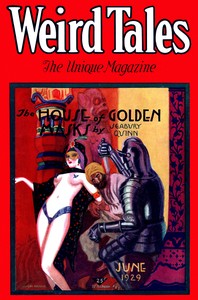
The illustration by Hugh Rankin, noted in the original Weird Tales publication, likely heightened the visual impact of scenes like 'other huge shapes galloped past, carrying annihilation and death across the town.' The prose itself is efficient, favoring action and revelation over introspection, in keeping with the magazine's demand for fast-paced adventure.
Reading the Fragments
The excerpts provided cover only the opening and a portion of Morton's testimony, leaving the full scope of the invasion and its resolution unknown. Readers should note that the narrative voice shifts from an omniscient historian to a first-person witness, creating a layered effect. The early emphasis on 'known facts' and the rejection of 'theories, suggestions, surmises' may be ironic, as the story itself is built on speculative biology.
Pay attention to how Hamilton balances scientific detail with pulp thrills: the description of the swamp's 'perpetual twilight' and 'treacherous quicksands' sets a Gothic atmosphere, while the sudden appearance of dinosaurs injects raw action. The lizard-men are given a coherent culture and history, avoiding the trap of mindless monsters.
The Abysmal Invaders exemplifies early science fiction's fascination with lost worlds and evolutionary what-ifs. Hamilton's decision to begin with a disclaimer of incomplete knowledge invites readers to treat the tale as a recovered document rather than an omniscient narrative. As you read, consider how the frame shapes your expectations: the story admits it cannot explain everything, leaving room for wonder and terror alike. The dinosaur-riding lizard-men are not merely monsters but a displaced civilization, and their invasion is both a physical threat and a challenge to human supremacy.
I have held The Abysmal Invaders for decades, its swampy secrets and half-told tales of lizard-men aging like pressed flowers. Beside it, Box-garden — Themes and Context sits quieter, yet shares that same patient humility before the unknown. Both whisper that some doors—whether mud-choked or hedged—are best left ajar, their lives continuing without our witness.
Liam Miller
1 week agoSamuel Anderson
1 month agoMichael Anderson
1 week agoGabriel Green
1 week ago-
April Payne - 1 month ago
The Abysmal Invaders has a gripping premise and delivers some exciting moments. The action sequences are well-written, and the alien concept is intriguing. However, the middle section drags a bit, and the supporting characters could have been more fleshed out. Still, a decent read for a rainy afternoon. -
Johnathan Martinez - 2 weeks ago
The Abysmal Invaders is a disappointing sci-fi entry. The plot is predictable, and the characters are clichés. The writing is mediocre, with awkward dialogue and flat descriptions. The alien invasion feels generic, and there's no real tension. I've read better stories in this genre. It feels like a first draft that needed serious editing. Not recommended. -
Andrea Hinton - 1 week ago
The Abysmal Invaders is a thrilling science fiction adventure that keeps you on the edge of your seat. The alien invasion plot is original and well-executed, with plenty of twists and turns. The characters are compelling and their struggles feel real. The pacing is perfect, and the suspense is maintained throughout. A must-read for any sci-fi fan. I couldn't put it down!
What did you think of this book?
Answer a few questions and save a private reflection on this device.
Matthew Hill
2 weeks ago