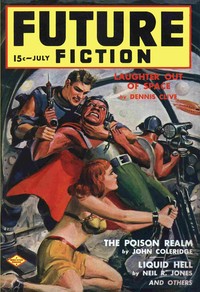
The magnificent possession — A Closer Reading
Edition facts
The source record for The magnificent possession — A Closer Reading measures this digital text at 9,357 words, 41 min estimated reading time, and 1 detected text section.
The text analysis averages about 15.1 words per sentence, while the detected sections provide another way to judge how the source is divided.
Project Gutenberg metadata also associates the work with “Science fiction,” connecting these edition facts with the source record’s subject description.
Calculated from edition completeness, EPUB availability, text structure and catalogue metadata. Not a user rating.
How this score is calculated
- Description quality20 pts
- Title & short description10 pts
- Source metadata20 pts
- Text length15 pts
- Chapters / structure15 pts
- EPUB file integrity20 pts
Total of 100 points, scaled to a 2.5-5.0 range. Editions with an empty description or a missing EPUB file are not scored.
Read the Text
“That, my friend, is ammonium oxide (NH4₂O), formed by passing _absolutely dry_ air over free ammonium metal. It is perfectly inert (the sealed case contains quite a bit of chlorine, for instance, and yet there is no reaction). It can be made as cheaply as aluminum, if not more so, and yet it looks more like gold than gold does itself. Do you see the possibilities?”
“Do I?” exploded Taylor. “It will sweep the country. You can have ammonium jewelry, and ammonium-plated table-ware, and a million other things. Then again, who knows how many countless industrial applications it may have? You’re rich, Walt--you’re rich!”
“_We’re_ rich,” corrected Sills gently. He moved towards the telephone. “The newspapers are going to hear of this. I’m going to begin to cash in on fame right now.”
Taylor frowned, “Maybe you’d better keep it a secret, Walt.”
“Oh, I’m not breathing a hint as to the process. I’ll just give them the general idea. Besides, we’re safe; the patent application is in Washington right now.”
But Sills was wrong! The article in the paper ushered in a very, very hectic two days for the two of them.
J. Throgmorton Bankhead is what is commonly known as a “captain of industry.” As head of the Acme Chromium and Silver Plating Corporation, he no doubt deserved the title; but to his patient and long-suffering wife, he was merely a dyspeptic and grouchy husband, especially at the breakfast table ... and he was at the breakfast table now.
Rustling his morning paper angrily, he sputtered between bites of buttered toast, “This man is ruining the country.” He pointed aghast at big, black headlines. “I said before and I’ll say again that the man is as crazy as a bedbug. He won’t be satisfied....”
“Joseph, please,” pleaded his wife, “you’re getting purple in the face. Remember your high blood pressure. You know the doctor told you to stop reading the news from Washington if it annoys you so. Now, listen dear, about the cook. She’s....”
“The doctor’s a damn fool, and so are you,” shouted J. Throgmorton Bankhead. “I’ll read all the news I please and get purple in the face too, if I want to.”
He raised the cup of coffee to his mouth and took a critical sip. While he did so, his eyes fell upon a more insignificant headline towards the bottom of the page: “Savant Discovers Gold Substitute.”
The coffee cup remained in the air while he scanned the article quickly. “This new metal,” it ran in part, “is claimed by its discoverer to be far superior to chromium, nickel, or silver for plating purposes, besides being ideal material for cheap and beautiful jewelry. ‘The twenty-dollar-a-week clerk,’ said Professor Sills, ‘will eat off ammonium plate more impressive in appearance than the gold plate of the Indian Nabob.’ There is no....”
But J. Throgmorton Bankhead had stopped reading. Visions of a ruined Acme Chromium and Silver Plating Corporation danced before his eyes; and as they danced, the cup of coffee dropped from his hand, and splashed hot liquid over his trousers.
His wife rose to her feet in alarm, “What is it, Joseph; what is it?”
“Nothing,” Bankhead shouted. “Nothing. For God’s sake, go away, will you?”
He strode angrily out of the room, leaving his wife to search the paper in vain for anything that could have disturbed him.
“Bob’s Tavern” on Fifteenth Street is usually pretty well filled at all times, but on the morning we are speaking of, it was empty except for four or five rather poorly-dressed men, who clustered about the portly and dignified form of Peter Q. Hornswoggle, eminent ex-Congressman.
Peter Q. Hornswoggle was, as usual, speaking fluently. His subject, again, as usual, concerned the life of a Congressman.
“I remember a case in point,” he was saying, “when that same argument was brought up in the house, and which I answered as follows: ‘The eminent gentleman from Nevada in his statements overlooks one very important aspect of the problem. He does not realize that it is to the interest of the entire nation that the apple-parers of this country be attended to promptly; for, gentlemen, on the welfare of the apple-parers depends the future of the entire fruit industry and on the fruit-industry is based the entire economy of this great and glorious nation, the United States of America.”
Hornswoggle paused, swallowed half a pint of beer at once, and then smiled in triumph, “I have no hesitation in saying, gentlemen, that at that statement, the entire House burst into wild and tumultuous applause.”
One of the assembled listeners shook his head slowly and marveled. “It must be great to be able to spiel like that, Senator. You musta been a sensation.”
“Yeah,” agreed the bartender, “it’s a dirty shame you were beat last election.”
The ex-Congressman winced and in a very dignified tone began, “I have been reliably informed that the use of bribery in that campaign reached unprecedented prop....” His voice died away suddenly as he caught sight of a certain article in the newspaper of one of his listeners. He snatched at it and read it through in silence and thereupon his eyes gleamed with a sudden idea.
“My friends,” he said turning to them again, “I find I must leave you. There is pressing work that must be done immediately at City Hall.” He leant over to whisper to the barkeeper, “You haven’t got twenty-five cents, have you? I find I left my wallet in the Mayor’s office by mistake. I will surely repay you tomorrow.”
Clutching the quarter, reluctantly given, Peter Q. Hornswoggle left.
In a small and dimly lit room somewhere in the lower reaches of First Avenue, Michael Maguire, known to the police by the far more euphonious name of Mike the Slug, cleaned his trusty revolver and hummed a tuneless song. The door opened a crack and Mike looked up.
“Yeh,” a short, wizened person sidled in, “I brung ya de evenin’ sheet. De cops are still tinkin’ Bragoni pulled de job.”
“Yeh? That’s good.” He bent unconcernedly over the revolver. “Anything else doing?”
“Naw! Some dippy dame killed herself, but dat’s all.”
He tossed the newspaper to Mike and left. Mike leaned back and flipped the pages in a bored manner.
A headline attracted his eye and he read the short article that followed. Having finished, he threw aside the paper, lit a cigarette, and did some heavy thinking. Then he opened the door.
“Hey, Slappy, c’mere. There’s a job that’s got to be done.”
Walter Sills was happy, deliriously so. He walked about his laboratory king of all he surveyed, strutting like a peacock, basking in his new-found glory. Eugene Taylor sat and watched him, scarcely less happy himself.
“How does it feel to be famous?” Taylor wanted to know.
“Like a million dollars; and that’s what I’m going to sell the secret of ammonium metal for. It’s the fat of the land for me from now on.”
“You leave the practical details to me, Walt. I’m getting in touch with Staples of Eagle Steel today. You’ll get a decent price from him.”
The bell rang, and Sills jumped. He ran to open the door.
“Is this the home of Walter Sills?” The large, scowling visitor gazed about him superciliously.
“Yes, I’m Sills. Do you wish to see me?”
“Yes. My name is J. Throgmorton Bankhead and I represent the Acme Chromium and Silver Plating Corporation. I would like to have a moment’s discussion with you.”
“Come right in. Come right in! This is Eugene Taylor, my associate. You may speak freely before him.”
“Very well,” Bankhead seated himself heavily. “I suppose you surmise the reason for my visit.”
“I take it that you have read of the new ammonium metal in the papers.”
“That’s right. I have come to see whether there is any truth in the story and to buy your process if there is.”
“You can see for yourself, sir,” Sills led the magnate to where the argon-filled container of the few grams of pure ammonium were. “That is the metal. Over here to the right, I’ve got the oxide, an oxide which is more metallic than the metal itself, strangely enough. It is the oxide that is what the papers call ‘substitute gold’.”
Bankhead’s face showed not an atom of the sinking feeling within him as he viewed the oxide with dismay. “Take it out in the open,” he said, “and let’s see it.”
Sills shook his head. “I can’t, Mr. Bankhead. Those are the first samples of ammonium and ammonium oxide that ever existed. They’re museum pieces. I can easily make more for you, if you wish.”
“You’ll have to, if you expect me to sink my money in it. You satisfy me and I’ll be willing to buy your patent for as much as--oh, say a thousand dollars.”
“A thousand dollars!” exclaimed Sills and Taylor together.
“A very fair price, gentlemen.”
“A million would be more like it,” shouted Taylor in an outraged tone. “This discovery is a goldmine.”
“A million, indeed! You are dreaming, gentlemen. The fact of the matter is that my company has been on the track of ammonium for years now, and we are just at the point of solving the problem. Unfortunately you beat us by a week or so, and so I wish to buy up your patent in order to save my company a great deal of annoyance. You realize, of course, that if you refuse my price, I could just go ahead and manufacture the metal, using my own process.”
“We’ll sue if you do,” said Taylor.
“Have you got the money for a long, protracted--and expensive--lawsuit?” Bankhead smiled nastily. “I have, you know. To prove, however, that I am not unreasonable, I will make the price two thousand.”
“You’ve heard our price,” answered Taylor stonily, “and we have nothing further to say.”
“All right, gentlemen,” Bankhead walked towards the door, “think it over. You’ll see it my way, I’m sure.”
He opened the door and revealed the symmetrical form of Peter Q. Hornswoggle bent in rapt concentration at the keyhole. Bankhead sneered audibly and the ex-Congressman jumped to his feet in consternation, bowing rapidly two or three times, for want of anything better to do.
The financier passed by disdainfully and Hornswoggle entered, slammed the door behind him, and faced the two bewildered friends.
“That man, my dear sirs, is a malefactor of great wealth, an economic royalist. He is the type of predatory interest that is the ruination of this country. You did quite right in refusing his offer.” He placed his hand on his ample chest and smiled at them benignantly.
“Who the devil are you?” rasped Taylor, suddenly recovering from his initial surprise.
“I?” Hornswoggle was taken aback. “Why--er--I am Peter Quintus Hornswoggle. Surely, you know me. I was in the House of Representatives last year.”
“Never heard of you. What do you want?”
“Why, bless me! I read in the papers of your wonderful discovery and have come to place my services at your feet.”
“Well, after all, you two are not men of the world. With your new invention, you are prey for every self-seeking unscrupulous person that comes along--like Bankhead, for instance. Now, a practical man of affairs, such as I, one with experience of the world, would be of inestimable use to you. I could handle your affairs, attend to details, see that--”
“All for nothing, of course, eh?” Taylor asked, sardonically.
Hornswoggle coughed convulsively. “Well, naturally, I thought that a small interest in your discovery might fittingly be assigned to me.”
Sills, who had remained silent during all this, rose to his feet suddenly. “Get out of here! Did you hear me? Get out, before I call the police.”
“Now, Professor Sills, pray don’t get excited,” Hornswoggle retreated uneasily towards the door which Taylor held open for him. He passed out still protesting, and swore softly to himself when the door slammed in his face.
Sills sank wearily into the nearest chair. “What are we to do, Gene? He offers only two thousand. A week ago that would have been beyond anything I could have hoped for, but now--”
“Forget it. The fellow was only bluffing. Listen, I’m going right now to call on Staples. We’ll sell to him for what we can get (it ought to be plenty) and then if there’s any trouble with Bankhead--well, that’s Staples’ worry.” He patted the other on the shoulder. “Our troubles are practically over.”
Unfortunately, however, Taylor was wrong; their troubles were only beginning.
Across the street, a furtive figure, with beady eyes peering from upturned coat collar, surveyed the house carefully. A curious policeman might have identified him as “Slappy” Egan, if he had bothered to look, but no one did and “Slappy” remained unmolested.
“Cripes,” he muttered to himself, “dis is gonna be a cinch. De whole woiks on the bottom floor, back window can be jimmied wid a toot’pick, no alarms, no nuttin.” He chuckled and walked away.
Nor was “Slappy” alone with his ideas. Peter Q. Hornswoggle, as he walked away, found strange thoughts wandering through his massive cranium--thoughts which involved a certain amount of unorthodox action.
And J. Throgmorton Bankhead was likewise active. Belonging to that virile class known as “go-getters” and being not at all scrupulous as to how he “go-got,” and certainly not intending to pay a million dollars for the secret of ammonium, he found it necessary to call on a certain one of his acquaintances.
This acquaintance, while a very useful one, was a bit unsavory, and Bankhead found it advisable to be very careful and cautious while visiting him. However, the conversation that ensued ended in a pleasing manner for both of them.
Walter Sills snapped out of an uneasy sleep with startled suddenness. He listened anxiously for a while and then leaned over and nudged Taylor. He was rewarded by a few incoherent snuffles.
“Gene, Gene, wake up! Come on, get up!”
“Eh? What is it? What are you bothering--”
“Shut up! Listen, do you hear it?”
“I don’t hear anything. Leave me alone, will you?”
Sills put his finger on his lips, and the other quieted. There was a distinct shuffling noise down below, in the laboratory.
Taylor’s eyes widened and sleep left them entirely. “Burglars!” he whispered.
The two crept out of bed, donned bathrobe and slippers, and tiptoed to the door. Taylor had a revolver and took the lead in descending the stairs.
They had traversed perhaps half the flight, when there was a sudden, surprised shout from below, followed by a series of loud, threshing noises. This continued for a few moments and then there was a loud crash of glassware.
“My ammonium!” cried Sills in a stricken voice and rushed headlong down the stairs, evading Taylor’s clutching arms.
The chemist burst into the laboratory, followed closely by his cursing associate, and clicked the lights on. Two struggling figures blinked owlishly in the sudden illumination, and separated.
Taylor’s gun covered them. “Well, isn’t this nice,” he said.
One of the two lurched to his feet from amid a tangle of broken beakers and flasks, and, nursing a cut on his wrist, bent his portly body in a still dignified bow. It was Peter Q. Hornswoggle.
“No doubt,” he said, eyeing the unwavering firearm nervously, “the circumstances seem suspicious, but I can explain very easily. You see, in spite of the very rough treatment I received after having made my reasonable proposal, I still felt a great deal of kindly interest in you two.
“Therefore, being a man of the world, and knowing the iniquities of mankind, I just decided to keep an eye on your house tonight, for I saw you had neglected to take precautions against house-breakers. Judge my surprise to see this dastardly creature,” he pointed to the flat-nosed, plug-ugly, who still remained on the floor in a daze, “creeping in at the back window.
“Immediately, I risked life and limb in following the criminal, attempting desperately to save your great discovery. I really feel I deserve great credit for what I have done. I’m sure you will feel that I am a valuable person to deal with and reconsider your answers to my earlier proposals.”
Taylor listened to all this with a cynical smile. “You can certainly lie fluently, can’t you, P. Q.?”
He would have continued at greater length and with greater forcefulness had not the other burglar suddenly raised his voice in loud protest. “Cripes, boss, dis fat slob here is only tryin’ to get me in bad. I’m just followin’ orders, boss. A fellow hired me to come in here and rifle the safe and I’m just oinin’ a bit o’ honest money. Just plain safe-crackin’, boss, I ain’t out to hurt no one.
“Den, just as I was gettin’ down to de job--warmin’ up, so to say--in crawls dis little guy wid a chisel and blowtorch and makes for de safe. Well, natur’lly, I don’t like no competition, so I lays for him and then--”
But Hornswoggle had drawn himself up in icy hauteur. “It remains to be seen whether the word of a gangster is to be taken before the word of one, who, I may truthfully say, was, in his time, one of the most eminent members of the great--”
“Quiet, both of you,” shouted Taylor, waving the gun threateningly. “I’m calling the police and you can annoy _them_ with your stories. Say, Walt, is everything all right?”
“I think so!” Sills returned from his inspection of the laboratory. “They only knocked over empty glassware. Everything else is unharmed.”
“That’s good,” Taylor began, and then choked in dismay.
From the hallway, a cool individual, hat drawn well over his eyes, entered. A revolver, expertly handled, changed the situation considerably.
“O. K.,” he grunted at Taylor, “drop the gat!” The other’s weapon slipped from reluctant fingers and hit the floor with a clank.
The new menace surveyed the four others with a sardonic glance. “Well! So there were two others trying to beat me to it. This seems to be a very popular place.”
Sills and Taylor stared stupidly, while Hornswoggle’s teeth chattered energetically. The first mobster moved back uneasily, muttering as he did so, “For Pete’s sake, it’s Mike the Slug.”
“Yeah,” Mike rasped, “Mike the Slug. There’s lots of guys who know me and who know I ain’t afraid to pull the trigger anytime I feel like. Come on, Baldy, hand over the works. You know--the stuff about your fake gold. Come on, before I count five.”
Sills moved slowly toward the old safe in the corner. Mike stepped back carelessly to give him room, and in so doing, his coat sleeve brushed against a shelf. A small vial of sodium sulphate solution tottered and fell.
With sudden inspiration, Sills yelled, “My God, watch out! It’s nitroglycerine!”
The vial hit the floor with the smashing tinkle of broken glass, and involuntarily, Mike yelled and jumped in wild dismay. And as he did so, Taylor crashed into him with a beautiful flying tackle. At the same time, Sills lunged for Taylor’s fallen weapon to cover the other two. For this, however, there was no longer need. At the very beginning of the confusion, both had faded hurriedly into the night from whence they came.
Taylor and Mike the Slug rolled round and round the laboratory floor, locked in desperate struggle while Sills hopped over and about them, praying for a moment of comparative quiet that he might bring the revolver into sharp and sudden contact with the gangster’s skull.
But no such moment came. Suddenly Mike lunged, caught Taylor stunningly under the chin, and jerked free. Sills yelled in consternation and pulled the trigger at the fleeing figure. The shot was wild and Mike escaped unharmed. Sills made no attempt to follow.
A sluicing stream of cold water brought Taylor back to his senses. He shook his head dazedly as he surveyed the surrounding shambles.
“Whew!” he said, “What a night!”
Sills groaned, “What are we going to do now, Gene? Our very lives are in danger. I never thought of the possibility of thieves, or I would never have told of the discovery to the newspapers.”
Isaac Asimov's "The Magnificent Possession" opens with a sharp contrast between the mundane and the explosive. The first line—a shouted warning about nitroglycerine—immediately establishes a world where chemical discovery carries physical danger. The story then settles into the dingy laboratory of Walter Sills, a fifty-year-old chemist whose cynical reflections on his hard, joyless life are punctuated by the precise details of his work: sodium amalgam, ammonium chloride solution, and the unstable ammonium amalgam he transforms into a new substance he calls Ammonaline. Asimov's diction here is notably technical, grounding the science fiction premise in real chemical terminology, while the dialogue between Sills and the younger, carefree Eugene Taylor reveals a tension between dedication and recklessness that will drive the plot.
Chemical Precision as Narrative Device
Asimov does not merely gesture at science; he embeds it in the story's texture. Sills explains the formation of ammonium amalgam step by step, naming reagents and observing that the compound "isn't very stable" before adding a straw-colored liquid to produce a metallic drop. This level of detail serves two purposes: it authenticates Sills as a working chemist, and it makes the eventual explosion—and the theft of his formula—feel grounded in real risk. The story's turning point hinges on a practical joke with the formula: Sills deposits fake instructions in the bank, predicting that anyone following them will cause "one heck of an explosion." The science is not window dressing but a functional part of the plot's mechanics.
Voice and the Generation Gap
The dialogue between Sills and Taylor is marked by contrasting registers. Taylor's speech is loud and carefree: "Hello, old soak," he calls, and later jokes about keeping his "beautiful brown hair." Sills, by contrast, speaks in measured, often weary sentences: "life was hard and joyless" and "I wish I had your foolish outlook on life." This vocal disparity underscores a generational divide—Sills is fifty, Taylor thirty—and also a temperamental one. Taylor anticipates trouble ("He had foreseen a possibility of this sort of thing happening") while Sills is repeatedly caught off guard. Their exchanges create a dynamic where the younger man's pragmatism balances the older man's obsessive focus on discovery.
The Setting as a Character
The story's physical environments are drawn with economical but vivid strokes. Sills' laboratory is a "dingy" space with a window overlooking the Hudson River, "ruddied in the flame of the dying sun." This image of natural beauty contrasting with the grimy workspace recurs when Sills later reflects on his "peaceful monotony" before the chaos begins. The bank is a "two-story, marble edifice," and the street outside becomes a stage for a mugging where gangsters press a gun into Sills' ribs. Asimov uses these settings to mirror Sills' internal state: the lab represents patient labor, the bank symbolizes security, and the sidewalk assault signals the intrusion of a violent world into the scientist's previously insulated life.
Pacing and the Threat of Violence
The story moves from laboratory exposition to a break-in, a police guard, and a street robbery within a few pages. Asimov compresses time through summary phrases like "A sluicing stream of cold water brought Taylor back to his senses" and direct narration: "Sills arrived home to find three policemen pacing." The threat is physical and immediate—gangsters named Mike the Slug and an unnamed companion—but the violence is mostly offstage or thwarted. The most dramatic moment is a gunshot that misses. This restraint keeps the focus on Sills' psychological reaction: he shivers, subsides, and later admits he "almost wished I had never heard of it." The pacing thus mirrors the chemist's own loss of control over his discovery.
Readers should attend to how Asimov balances technical exposition with character-driven conflict. The story's title, "The Magnificent Possession," is ironic: the possession is not the formula but the burden of knowledge. Sills' repeated wish to return to ore analysis suggests that the true cost of discovery is not labor but the loss of anonymity. The excerpts end before the final resolution, leaving open whether Sills will reclaim his formula or retreat to obscurity.
Reading Asimov’s tale of Walter Sills and his volatile secret, I found myself thinking of an older, quieter book on my shelf—Herbert Carter's Legacy; Or, the Inventor's Son — Reading Notes. Both share that curious ache: a creator holding something precious, unsure if the world’s attention is a gift or a theft. That longing feels familiar, like a half-remembered afternoon in a dusty study.
Elijah Robinson
1 week agoAmelia Martinez
1 week agoAmelia Carter
1 week agoCarter Nguyen
2 weeks ago-
Sarah Malone - 4 weeks ago
I found The Magnificent Possession to be disappointing. The plot was predictable, and the characters felt one-dimensional, lacking the depth needed to make me care about their fates. The writing is adequate, but the story fails to deliver the emotional impact it aims for. It had potential but fell flat for me. I wouldn't recommend it unless you're a die-hard fan of the genre. -
Jennifer Julie Holmes - 3 weeks ago
The Magnificent Possession has a compelling premise and strong writing, which kept me engaged for the most part. However, the pacing felt a bit uneven in the middle, with some sections dragging. Despite that, the character development is solid, and the conclusion was satisfying. If you can get past the slower moments, it's a decent read. -
Kathleen Ferguson - 1 week ago
The Magnificent Possession is a masterfully crafted story that weaves suspense and emotional depth into every page. The author's vivid descriptions and complex characters kept me fully immersed from start to finish. The twist at the end was both surprising and satisfying, leaving me thinking about it long after I closed the book. A truly remarkable read that I would recommend to anyone seeking a captivating literary journey.
How will you remember this book?
Save your reaction, strongest insight, and memorable passage.
Luke Martin
2 weeks ago