1

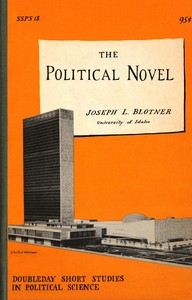
The political novel — Text and Context
(0 User reviews)
3124
Project Gutenberg
2022
Not confirmed
Fiction -- History and criticism; Politics in literature; Political fiction -- History and criticism
Readers of public-domain and historical texts
Project Gutenberg digital edition
en
Edition facts
Words
56,718
Reading time
247 min
Text sections
16
The political novel — Text and Context can be approached with a clearer sense of reading commitment from its source measurements: 56,718 words, 4 hr 7 min estimated reading time, and 16 detected text sections.
The text analysis averages about 20.6 words per sentence, while the detected sections provide another way to judge how the source is divided.
Project Gutenberg metadata also associates the work with “Fiction -- History and criticism,” connecting these edition facts with the source record’s subject description.
Source:
Project Gutenberg record #68060
Joseph Blotner's 1955 study examines how English novelists from Disraeli to Orwell use language, voice, and narrative pace to portray political life. Drawing on works such as 'Beauchamp's Career,' 'A Passage to India,' and 'Nineteen Eighty-Four,' Blotner traces shifts between emotional and restrained rhetoric, the mixing of religion with politics, and the contrasting depictions of imperial guilt versus working-class resilience.
Read the complete public-domain text at its original source.
Read on Project GutenbergJoseph Blotner's The Political Novel opens not with a grand theory but with a specific observation about how politicians in fiction speak. He notes that characters who flout maxims—not flaunt them, as a transcriber's correction points out—tend to fail, a lexical distinction that signals the book's close attention to verbal precision. Blotner's method is comparative: he moves from novel to novel, weighing how each author constructs political speech, from the revivalist fervor of a Chester Nimmo to the restrained irony of a Nevil Beauchamp.
The Rhetoric of the Platform and the Parlor
The contrast extends to the novelists' own narrative voices. In Beauchamp's Career, the dialogue between Colonel Halkett and Nevil Beauchamp is terse, ironic, and understated—'Well, sir, we must sell our opium'—while the prose around it carries a measured, almost judicial tone. Blotner implies that the novelist's choice of tempo is itself a political statement: rapid, emotional speech belongs to the demagogue; cool, ironic exchange to the aristocrat or intellectual. This observation is grounded in specific textual evidence, not in abstract claims about 'style.'
Imperial Guilt and the Weight of Sentences
By contrast, the South African novels Blotner cites, such as Too Late the Phalarope, accelerate toward tragedy. He notes the figure of Jakob Van Vlaanderen, the stern patriarch who recalls the trek into the interior, and how the narrative moves with a gathering momentum toward inevitable conflict. Blotner's insight is that pace is not merely a technical feature but a moral index: the faster the narrative moves, the less room for reflection; the slower, the more oppressive the atmosphere of guilt.
The Proles and the Persistence of Voice
This observation connects back to his earlier contrast between emotional and restrained speech. The Proles' singing is not oratory; it is pre-political, almost biological. But it is also, in Orwell's hands, the only sound that survives the Party's erasure of language. Blotner does not claim that Orwell endorses the Proles as a political force; he simply notes that the novel's structure gives them the last word, or rather the last song. The pacing of the final pages, with their shift from Winston's tortured interiority to the external, indifferent singing, is a formal choice that Blotner treats as evidence of Orwell's political ambivalence.
Blotner's study is best read as a series of linked close readings rather than a single argument. He moves quickly between novels, trusting the reader to follow the thread. Pay attention to the quotations he selects: they are often the moments when a character's voice breaks through the narrative, or when the prose itself changes speed. The book rewards those who read with the text in hand, checking each reference against the original.
Reading about Blotner’s quiet tracing of imperial guilt in A Passage to India, I keep drifting back to that odd little autobiography I once stumbled upon—the séance room politics of it, the way faith and electorate blur together. There’s something familiar in that restless voice. The spirit-rapper; an autobiography — Text and Context stayed with me for that very reason: it doesn’t argue, it simply remembers.
There are no reviews for this eBook.
There are no comments for this eBook.
Reader reflection
What did you think of this book?
Answer a few questions and save a private reflection on this device.
Your progress
0
/
10
2
How much did you enjoy the reading experience?
3
Is this a title you would suggest to others?
4
How demanding did the text feel?
5
Did it raise ideas you would like to talk about?
6
What was the strongest part of the book?
7
Could you see yourself revisiting this book?
8
Did you gain anything practical from the text?
9
In one sentence, what did you learn?
10