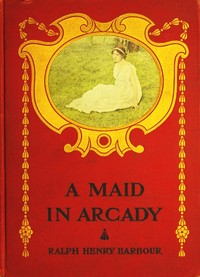
A Maid in Arcady — Reading Notes

(3 User reviews)   468
Barbour, Ralph Henry, 1870-1944, Von Rapp, Frederic J., 1877-1948 [Illustrator] Project Gutenberg 2019 Not confirmed
Man-woman relationships -- Fiction; Classicism in literature Readers of public-domain and historical texts
Project Gutenberg digital edition en

Edition facts

Words 29,583
Reading time 129 min
Text sections 15

A Maid in Arcady — Reading Notes can be approached with a clearer sense of reading commitment from its source measurements: 29,583 words, 2 hr 9 min estimated reading time, and 15 detected text sections.

The text analysis averages about 12.8 words per sentence, while the detected sections provide another way to judge how the source is divided.

Project Gutenberg metadata also associates the work with “Man-woman relationships -- Fiction,” connecting these edition facts with the source record’s subject description.

An editorial note examining Ralph Henry Barbour's diction, dialogue, and descriptive choices in a 1906 romance where a trespassing canoeist meets a woman in a secluded New England glade, blending classical allusion with modern banter.
Share
Editorial Edition Score 4.8/5

Calculated from edition completeness, EPUB availability, text structure and catalogue metadata. Not a user rating.

How this score is calculated
  • Description quality20 pts
  • Title & short description10 pts
  • Source metadata20 pts
  • Text length15 pts
  • Chapters / structure15 pts
  • EPUB file integrity20 pts

Total of 100 points, scaled to a 2.5-5.0 range. Editions with an empty description or a missing EPUB file are not scored.

Edition quality

Read the Text

of bread to the swans 113

She went to him and placed her hands on his shoulders 139

“Will you?” he repeated 213

The clear water of the little river, in which the willows were mirrored quiveringly, shallowed where a tiny bar of silver-white sand thrust the ripples aside. Thus confined, the stream sulked for a moment in a deep, pellucid pool, and then, with sudden rush and gurgle, swept through a miniature narrows and swirled about the naked roots of the willows.

With a quick plunge of the paddle Ethan guided the canoe past the threatening bar. A drooping branch swept his face caressingly as the craft gained the quiet water beyond. Here, as though repentant of its impatience, the river loitered and lapped about a massive granite bowlder, tugging playfully at the swaying ferns and tossing scintillant drops upon the velvety moss. To the left, the fringe of woodland which, in friendly gossip, had followed the little river for a quarter of a mile, parted where a second stream, scarcely more than a brook, flowed placidly into the first. Reinforced, the river widened a little and went slowly, musically on under the drooping branches, alternately sun-splashed and shadowed, until it disappeared at a distant turn. But the canoe did not follow. Instead it rocked lazily by the bowlder, while the ripples broke gently against its smooth sides.

To the bole of an old willow which dropped its leaves in autumn upon the white sand-bar was nailed a weather-gray board, on which faded letters stated:

Ethan observed the warning meditatively. In view of his later course of action let us credit him with that hesitation. At length, with a faint smile on his face, he turned the nose of the canoe toward the smaller stream and his back to the sign.

To have observed him one would scarcely have believed him capable of deliberately committing the dire crime of trespass. There was something about his good-looking face which bespoke honesty. At least, it would have been difficult to credit him with underhand methods; it seemed easier to believe that if he ever did commit a crime it would be in such a superbly open and above-board fashion as to rob it of half its iniquity. Not that there was anything of classical beauty about his face. His eyes were a shade of brown, his nose was perhaps a trifle too short to reach the standard of the Grecians, his mouth, unhidden by any mustache, did not to any great extent suggest a Cupid’s bow. His chin was aggressive. For the rest, he had the usual allowance of hair of a not uncommon shade of brown, and showed, when he laughed which was by no means infrequently――a set of very white and very capable looking teeth. And yet I reiterate my former adjective; good-looking he was; good-looking in a healthy, frank, happy and rather boyish way that was eminently satisfying.

If the sign on the old willow was right, and he really was trespassing, I have no excuse to offer, or at least none that my conscience will allow me to suggest. I can’t plead ignorance for him, for the simple reason that he had seen the sign and read it and that he knew all about trespass――or as much as was taught in the three-year course at the Harvard Law School, which he had finished barely a fortnight ago.

Meanwhile he has been sending the canoe quietly along the winding water path, dipping the paddle with easy, rhythmic swings of his shoulders, pushing the blade astern through the clear water and swinging it, flashing and dripping, back for the next stroke. He had tossed his light cloth cap into the bottom of the canoe and had laid his coat over a thwart. The summer morning sunlight, slanting through the branches, wove quickly vanishing patterns in gold upon his brown hair. The tiny breeze, just a mere breath from the southwest, fragrant with the odor of damp, sun-warmed soil and greenery, stirred the sheer white shirt he wore and laid it in folds under the raised arm.

The brook was rather shallow; everywhere the pebbled bottom was visible. It was a whimsical brook, full of sudden turns and twistings; rounding tiny promontories of alder and sheepberry, dipping into quiet bays where bush honeysuckles were dripping sweetness from their pale yellow funnels, skirting curving beaches of white sand where standing armies of purple flags held themselves stiffly at attention and restrained the invasion of the eager, swaying fern-rabble.

He had gone several hundred yards by this time against the slow current, and now there was evident a change in the foliage lining the banks, even in the banks themselves. Artifice had aided nature. Pink and white and yellow lilies dotted the stream, while at a little distance a slender, graceful stone bridge arched from shore to shore. Woodbine clustered about it and threw cool, trembling leaf-shadows against the sunlit stones. The arch framed a charming vista of the brook beyond. The canoe slipped noiselessly under the bridge and the strip of shadow rested gratefully for an instant on Ethan’s face. On the left there was a momentary break in the foliage and a brief glimpse of a wide expanse of velvety turf. Then another turn, the canoe brushing aside the broad lily-pads, and the end of the journey had come, and, sitting with motionless paddle, he gazed spellbound.

The banks of the stream fell suddenly away on either side and the canoe glided slowly and softly into a miniature lake. It was perhaps twenty yards across at its widest place and much more than that in length. Occasionally a far-reaching branch threw trembling shadows on the water, but for the most part the trees stood back from the margin of the pool and allowed the fresh green turf to descend unhampered to the water’s edge. At a point farthest from where Ethan had entered a little cascade tumbled. On all sides the ground sloped slightly upward, and in one place a group of larches crowned the summit of a knoll and mingled their delicate branches far above the neighboring maples. Almost concealed among them an uncertain gleam of white caught at moments through the trees to the right suggested a building of some sort――perhaps the marble temple of the divinity, who, seated on the bank with her bare sandaled feet crossed before her, observed the intruder with calm, dreamy, almost smiling unconcern.

It was a beautiful scene into which Ethan had floated. Overhead was a blue sky against which a few soft white clouds hung seemingly motionless as though, like Narcissus, they had become enamored of their reflections in the pool there below. On a tiny islet in the pool, dwarf willows caressed the water with the tips of their pendulous branches. Further on a trio of white swans sunned themselves, and about the margin the bosom of the pool was carpeted with lily-pads and starred with a multitude of fragrant blooms, white, rose-hued, carmine, pale violet, sulphur-colored and blue. The gauze wings of darting dragon-flies caught the sunlight, insects hovered above the flower-cups and in the branches around many a feathered cantatrice was singing her heart out. And for background there was always the varied green of encircling trees.

Yes, it was very beautiful, but Ethan had no eyes for it. With paddle still suspended between gunwale and water he was staring in a fashion at once depicting surprise, curiosity, and admiration at the figure on the grass. And what wonder? Who would have thought to find a Grecian goddess under New England skies? Ethan’s thoughts leaped back to mythology and he sought a name for her. Diana? Minerva? Venus? Iris? Penelope?

And all the while――a very little while despite the telling――his eyes ranged from the sandaled feet to the warm brown hair with its golden fillet. A single garment of gleaming white reached from the feet to the shoulders where it was caught together on either side with a metal clasp. The arms were bare, youthfully slender, aglow in the sunlight. And yet it was to the eyes that his gaze returned each time. “Minerva!” his thoughts triumphed, “‘Minerva, goddess azure-eyed!’” And yet in the next instant he knew that while her eyes were undeniably blue she was no wise Minerva. Such youthful softness belonged rather to Iris or Daphne or Syrinx.

And all the while――just the little time it took for the canoe to glide from the stream well into the pool――she had been regarding him tranquilly with her deep blue eyes, her bare arms, stretching downward to the grass, supporting her in an attitude suggesting recent recumbency. And now, as the craft brushed the lily-pads aside, she spoke.

“Do you not fear the resentment of the gods?” she asked gravely. “It is not wise for a mortal to look upon us.”

“I crave your mercy, O fair goddess,” he answered. “Blame rather this tiny argosy of mine which, propelled by hands invisible, has brought me hither. I doubt not that the gods hold me in enchantment.” He mentally patted himself on the back; it wasn’t so bad for an impromptu!

She leaned forward and sunk her chin in the cup of one small hand, viewing him intently as though pondering his words.

“It may be so,” she answered presently. “What call you your frail vessel?”

“From this hour, Good Fortune.” Her gaze dropped.

“Will you deign to tell me your name, O radiant goddess?” he continued. She raised her eyes again and he thought a little smile played for a moment over her red lips.

“I am Clytie,” she answered, “a water-nymph. I dwell in this pool. And you, how are you called?”

He answered readily and gravely: “I am Vertumnus, clad thus in mortal guise that I may gain the presence of Pomona. Long have I wooed her, O Nymph of the Pool.”

“I too love unrequited,” she answered sadly. “Apollo has my heart. Though day by day I watch him drive his fiery chariot across the heavens he sees me not.”

She arose and turned her face upward to the sun. Slowly she raised her white arms and stretched them forth in tragic appeal.

“Apollo!” she cried. “Apollo! Hear me! Clytie calls to you!”

Such a passion of melancholy longing spoke in her voice that Ethan thrilled in spite of himself. Unconsciously his gaze followed hers to the blazing orb. The light dazzled his eyes and blinded him for a moment. When he looked again toward the bank it was empty, but between the trees, along the slope, a white garment fluttered and was lost to sight.

“Clytie!” he called in sudden dismay. And again.

A wood-thrush in a nearby tree burst into golden melody. But Clytie answered not.

The Roadside Inn at Riverdell sprawls its white length along the old post-road over which many years ago the coaches swayed and rattled between New York and Boston. The Roadside, known in those days as Peppit’s Tavern, has changed but little. The front room over the porch, has held notable guests: Washington, Hancock, Adams, Lafayette and many more. On the tap-room windows you may still find the diamond-etched initials of by-gone celebrities. And much of the old-time atmosphere remains.

The room into which Ethan had his bag taken after his return from his adventure in Arcady was low-ceilinged and dim. The two small windows, one overlooking the dilapidated orchard at the rear and the little river beyond, the other revealing the murmuring depths of a big elm, afforded little light. The floor was delightfully uneven; Ethan went downhill to the washstand and uphill again to the old mahogany bureau. The wide fire-place held a pair of antique andirons coveted by many a visitor, and the narrow shelf above was adorned with an equally desirable brass candlestick and a couple of opaque white glass vases which, ancient as they were, post-dated the shelf itself by half a hundred years. The bedstead, of mahogany, with rolling footboard, had made concessions to modernity. The pegs along the side, from which ropes had once been stretched, remained, but an up-to-date wire spring and hair mattress had superseded the olden furnishings.

Ethan lighted a cigarette, unstrapped his bag and took out a leathern portfolio. With this on his knee, he sat at one of the open windows and scrawled a note.

“Dear Vin, I am sending my man Farrell on to you with the machine with orders to place it at your disposal. Make what use you can of it. I think it is all right now, though it went back on us this morning about two miles north of here. Funny place for it to bust, wasn’t it; looks as though it meant me to pay a visit here, eh? Well, I’m humoring it. I’ve decided to stay here for a day or two at the Roadside. I want to brush up a bit on mythology. Very interesting subject, mythology, Vin. Just when I’ll follow the machine I can’t say yet; possibly in a day or two. Make my excuses to your mother and sisters; invent any old story you like. You might say, for instance, that Vertumnus, fickle god, has transferred his affections from Pomona to a water-nymph. But you needn’t if you’d rather not. I don’t care what you say. Expect me when you see me.

With a smile as he thought of his friend’s perplexity on reading the note, Ethan folded it and tucked it into an envelope. Then addressing it to “Mr. Vincent Graves, The Boulders, Stillhaven, Mass.,” he sealed it, dropped it into his pocket and made his way downstairs to dinner.

After dinner a big blue touring-car chugged its way southward along the shaded road, with Farrell at the wheel and Ethan’s note in Farrell’s pocket. Ethan watched it disappear. Then, drawing a chair to the edge of the porch, he set himself in it, put his heels on the railing, stuffed his hands into his pockets and asked himself with a puzzled smile why he had done it.

The grass grew tall and lush under the gnarled old apple-trees back of the Inn, and the straggling footpath which led to the landing was a path only in name. By the time he had gained the river Ethan’s immaculate white shoes were slate-colored with dew. The canoe rested on two poles laid from crotches of the apple trees, which overhung the stream. Ethan lifted it down and dropped it into the water. With paddle in hand he stepped in and pushed off down-stream.

On his left the orchard and garden of the Inn marched with him for a way, giving place at length to a neck of woodland. On his right, seen between the twisted willows, stretched a pleasant view of meadows and tilled fields in the foreground, and, beyond, the gently rising hills, wooded save where along the base the encroaching grasslands rose and dipped. A couple of sleepy-looking farmhouses were nestled in the middle-distance and the faint _whir-r-r_ of a mowing machine floated across the meadows. In the high grass daisies were sprinkled as thickly as stars in the Milky Way, and buttercups thrust their tiny golden bowls above the pendulous plumes of the timothy, foxtail, and fescue. The blue-eyed grass, too, was all abloom, like miniatures of the blue flags which congregated wherever the spring floods had inundated the meadows.

The sand-bar came in sight and the little river began to fuss and fret as it gathered itself for what it doubtless believed to be an awe-inspiring rush. The canoe bobbed gracefully through the rapids and swung about in the pool below. Ethan winked soberly at the sign on the willow tree and dipped his paddle again. The canoe breasted the lazy current of the brook.

It was just such a day as yesterday. The little breeze stirred the rushes along the banks and brought odors of honeysuckle. Fleecy white clouds seemed to float on the unshadowed stretches of the stream. On one side a sudden blur of deep pink marked where a wild azalea was ablossom. Again, a glimpse of white showed a viburnum sprinkling the ground with its tiny blooms. Cinnamon ferns were pushing their pale bronze “fiddle-heads” into the air. Now and then a wood lily displayed a tardy blossom. Near the stone bridge a kingfisher darted downward to the brook, broke its surface into silver spray and arose on heavy wing.

Once past the bridge and with only a single winding of the brook between him and the lotus pool, Ethan trailed his paddle for a moment while he asked himself whether he really expected to find the girl waiting for him. Of course he didn’t, only――well, there was just a chance――――! Nonsense; there was not the ghost of a chance! Oh, very well; at least there was no harm in his paddling to the lotus pool――barring that he was trespassing! He smiled at that. He smiled at it several times, for some reason or other. Then he dipped his paddle again and sent the “Good Fortune” gliding swiftly over the sunlit water of the pond. And when he looked there she was, seated on the bank, just as――and he realized it now――he had expected all along that she would be!

But it was not Clytie he saw; not unless the fashions have changed considerably and water-nymphs may wear with perfect propriety white shirtwaist suits and tan shoes. It was not impossible, he reasoned; for all he knew to the contrary, the July number of the Goddesses’ Home Journal――doubtless edited by Minerva――might prescribe just such garments for informal morning wear. At all events, being less _bizarre_ than the flowing peplum of yesterday, Ethan――whose tastes in attire were quite orthodox――liked it far better. The effect was quite different, too. Yesterday she might have been Clytie; to-day reason cried out against any such possibility; she was a very modern-appearing and extremely charming young lady of, apparently, twenty or twenty-one years of age, with a face, at present seen in profile, piquant rather than beautiful. The nose was small and delicate, the mouth, under a short lip, had the least bit of a pout and the chin was softly round and sensitive. This morning she wore her hair in a pompadour, while at the back the thick braids started low on her neck and coiled around and around in a perfectly delightful and absolutely puzzling fashion. Ethan liked her hair immensely. It was light brown, with coppery tones where the sunlight became entangled. She was seated on the sloping bank, her hands clasped about her knees and her gaze turned dreamily toward the cascade which sparkled and tinkled at the upper curve of the pool. As the canoe had made almost no sound in its approach, she was, of course, ignorant of Ethan’s presence. And yet it may be mentioned as an interesting if unimportant fact that as he gazed at her for the space of half a minute a rosy tinge, all unobserved of him, crept into her cheeks. He laid his paddle softly across the canoe, and,――――

“Greetings, O Clytie!” he said.

She turned to him startledly. A little smile quivered about her lips.

“Good morning, Vertumnus,” she answered. Perhaps his gaze showed a trifle too much interest, for after a brief instant hers stole away. He picked up the paddle and moved the canoe closer to the shore.

“I’m very glad to find you have not yet taken root,” he said gravely.

“Taken root?” she echoed vaguely.

“Yes, for that was your fate at the last, wasn’t it? If I am not mistaken you sat for days on the ground, subsisting on your tears and watching the sun cross the heavens, until at last your limbs became rooted to the ground and you just naturally turned into a sunflower. At least, that’s the way I recollect it.”

“Oh, but you shouldn’t tell me what my fate is to be,” she answered smilingly.

“Forearmed is forewarned; no, I mean the other way around!” he replied. “Maybe if you just keep your feet moving you’ll escape that fate. It would be awfully uncomfortable, I should say! Besides, pardon me if it sounds rude, sunflowers are such unattractive things, don’t you think so?”

“Yes, I’m afraid they are. The fate of Daphne or Lotis or Syrinx would be much nicer.”

“What happened to them, please?”

“Why, Daphne was changed to a laurel; have you forgotten?”

“No, but how about the other ladies?”

“Lotis became a lotus and Syrinx a clump of reeds. Pan gathered some and made himself pipes to play on.

Barbour opens A Maid in Arcady with a landscape so precisely rendered that the river itself seems to have a temperament: it “sulked” in a pool, then “swept through a miniature narrows” and “swirled about the naked roots of the willows.” The prose lingers on sensory details—the paddle’s plunge, a drooping branch that “swept his face caressingly,” and the “scintillant drops” tossed upon moss. This is not mere scene-setting; it establishes a world where nature is animate and the boundary between the ordinary and the idyllic is porous. The protagonist, Ethan, paddles past a “PRIVATE PROPERTY! NO TRESPASSING!” sign, a legal notice that he deliberately ignores, and the narrative follows him into a space that feels both forbidden and enchanted.

Diction and the Animate Landscape

Barbour’s word choices consistently attribute will and emotion to the natural world. The stream “sulked,” the river “loitered and lapped,” and later the water “tugged playfully” at ferns. These verbs blur the line between setting and character, making the environment an active participant. The effect is heightened by precise physical description: the “bar of silver-white sand,” the “pellucid pool,” and the “massive granite bowlder” are rendered with a naturalist’s eye. Yet the language never becomes clinical; it remains lyrical, as when the river goes “slowly, musically on under the drooping branches, alternately sun-splashed and shadowed.” This fusion of accuracy and personification creates a pastoral tone that is both grounded and dreamlike, preparing the reader for a story where the mundane and the mythical may intersect.

Dialogue as a Tool of Character and Tension

The excerpted dialogue reveals a sharp, playful dynamic between Ethan and the unnamed woman. When Ethan takes her hand, she does not swoon; instead she remarks, “If we are going to hold hands for any length of time, perhaps we had better sit down and be comfortable.” The line deflates his romantic intensity with cool pragmatism, and Barbour underscores Ethan’s embarrassment with a “wave of burning color” across his face. Their subsequent banter about finding a mutual acquaintance—a mock ritual of introduction—showcases a verbal sparring that is both witty and revealing. She initiates a game: “Are you acquainted in Stillhaven, Mr. Parmley?” and they trade invented names (Penniwells, Graveses) with ironic gravity. This exchange does not advance the plot but establishes their intellectual equality and her refusal to be swept away by sentiment. The dialogue is crisp, natural, and laced with humor, suggesting that Barbour values repartee as much as romance.

Classical Allusion and the Arcadian Frame

The title A Maid in Arcady invokes the classical pastoral ideal of Arcadia, a utopian realm of rustic simplicity. Barbour reinforces this through the setting: a hidden stream, a willow-shaded pool, and a woman who appears almost mythic. The frontispiece caption—“Who would have thought to find a Grecian goddess under New England skies?”—makes the allusion explicit. Yet the narrative undercuts pure idealization. The heroine is not a passive nymph; she is late for church, practical, and quick with a retort. Ethan, for his part, is a trespasser who must negotiate both legal and social boundaries. The Arcadian frame thus becomes a lens through which Barbour examines the collision of fantasy and reality. The pastoral setting is not an escape but a stage for a modern, self-aware courtship, where classical motifs are invoked only to be gently mocked.

Structure and the Art of Hesitation

Barbour’s narrative structure in the opening chapter is built around moments of pause. Ethan hesitates before ignoring the “No Trespassing” sign, and the narrator explicitly notes: “In view of his later course of action let us credit him with that hesitation.” This authorial intrusion signals that choices matter. The canoe “rocked lazily” while the protagonist deliberates, and the prose itself slows to match his indecision. Later, when the woman’s hand goes “limp and inert,” the silence that follows is filled with Ethan’s internal turmoil—his heart “threatened to choke him.” Barbour uses these beats of stillness to heighten emotional stakes, contrasting them with the rapid, witty dialogue that follows. The rhythm of the prose—alternating between descriptive languor and conversational speed—mirrors the push-and-pull of attraction and resistance, making the reader feel the weight of each unspoken thought.

Readers approaching A Maid in Arcady should attend to the way Barbour balances the idyllic with the ironic. His heroine is no passive maiden; she meets romantic gestures with cool practicality and a sharp tongue. The landscape, though beautiful, is never merely decorative—it acts, reacts, and frames the action. Pay particular attention to the moments of silence and hesitation, where the narrative slows to let character and consequence breathe. These choices, rather than plot twists, give the story its texture.

Reading note about Barbour’s glade—sunlight, mild banter, the quiet ache of a borrowed hour—I found myself drifting back to that other book, Cities in the air — Inside the Classic; its high balconies hold the same hushed, golden distance, a place where time seems politely to pause, waiting for someone to remember it. Strange how two old rooms echo.

John Thomas
1 week ago

Harper Lee
1 month ago

Carter Flores
2 weeks ago

4
4 out of 5 (3 User reviews )

Add a Review

Your Rating *
  • ...
    Jesse Craig Garrison - 1 month ago
    {'review_type': 'Positive', 'text': "A Maid In Arcady is a delightful escape into a pastoral world that feels both timeless and refreshing. The prose is lyrical and evocative, painting vivid pictures of the countryside and its inhabitants. The gentle romance and the protagonist's personal growth are beautifully rendered. This book is a treasure for those who appreciate quiet, introspective narratives with a touch of humor and heart."}

  • ...
    Pamela Michael Ortega - 4 weeks ago
    {'review_type': 'Neutral', 'text': "A Maid In Arcady is a charming pastoral novel with beautiful descriptions and a simple, heartwarming story. The protagonist is likable, and the setting is idyllic. However, the plot is minimal and may not satisfy readers who prefer more action or conflict. The pacing is leisurely, almost to a fault. Still, it's a pleasant read for a lazy afternoon."}

  • ...
    Steven Castillo - 3 weeks ago
    {'review_type': 'Negative', 'text': 'A Maid In Arcady is a tedious read with a thin plot that fails to engage. The characters are flat and lack motivation, and the narrative meanders without direction. The writing is overly flowery, detracting from any emotional impact. The ending is anticlimactic and unsatisfying. This book may appeal to some, but for me, it was a struggle to finish.'}


Reader reflection

What did you think of this book?

Answer a few questions and save a private reflection on this device.

Your progress 0 / 10
1

Where are you in your reading?

2

How much did you enjoy the reading experience?

3

Would you recommend this book to another reader?

4

Did the language feel accessible?

Related eBooks