Cities in the air — Inside the Classic

(0 User reviews)   61
Hamilton, Edmond, 1904-1977, Paul, Frank R. (Frank Rudolph), 1884-1963 [Illustrator] Project Gutenberg 2024 Not confirmed
Science fiction; War stories; Aeronautics -- Fiction; Cities and towns -- Fiction Readers of public-domain and historical texts
Project Gutenberg digital edition en

Edition facts

Words 49,708
Reading time 217 min
Text sections 5

The catalog record for Cities in the air — Inside the Classic provides practical reading context through 49,708 words, 3 hr 37 min estimated reading time, and 5 detected text sections.

The text analysis averages about 30.0 words per sentence, while the detected sections provide another way to judge how the source is divided.

Project Gutenberg metadata also associates the work with “Science fiction,” connecting these edition facts with the source record’s subject description.

Edmond Hamilton's 1929 serial pits American air-cruiser captain Martin Brant against a combined European-Asiatic attack. The excerpts show a first-person war narrative focused on aerial city-states, escape from captivity, and the physical details of floating urban life, rather than the broader utopian or aeronautical themes the catalog suggests.
Share
Editorial Edition Score 4.7/5

Calculated from edition completeness, EPUB availability, text structure and catalogue metadata. Not a user rating.

How this score is calculated
  • Description quality20 pts
  • Title & short description10 pts
  • Source metadata20 pts
  • Text length15 pts
  • Chapters / structure15 pts
  • EPUB file integrity20 pts

Total of 100 points, scaled to a 2.5-5.0 range. Editions with an empty description or a missing EPUB file are not scored.

Edition quality

Read the Text

Federation had expected, had feared for decades. It had not been more than thirty years since the third Air War of 2039. Three mighty nations alone now shared the world between them; the American Federation, comprising the whole North and South American continents, with New York as its capital; the European Federation, which included all Europe west of Caucasus and all Africa, its center at Berlin; and the Asiatic Federation, which held all Asia and Australasia for the brown and yellow races, with Peking as its capital.

And though for three decades now there had been peace between them, it had been an uneasy peace dictated by the fact that each feared to attack another lest he be attacked by the third. The great navies of air-cruisers of the three mighty Federations had patrolled the air in ceaseless vigilance, their air-forts ever watchful. Lately, however, it had become apparent to all that a rapprochement had taken place between the European and Asiatic Federations, and such an alliance could only mean an attack upon our own, the American. So we had stood even more vigilantly upon the watch, and now that for which we had waited had come at last, and the two great Federations had launched their two mighty fleets upon us.

Gazing ahead, as our cruiser drove onward, I was as silent as Macklin, at the wheel beside me, and as young Hilliard, who had come up into the bridge-room from beneath. Far beneath us the green plains were rolling swiftly backward, as our motors hummed their unceasing song of power. Those great electric motors drew their current in limitless quantities from the electrostatic or atmospheric electricity surrounding the earth, by means of great transformers that changed it from electrostatic to current electricity to give us a power that could hurl us forward with almost unlimited endurance and speed. Connected as they were to our great horizontal tube-propellers, which were set in the cruiser's walls and which moved it forward by drawing immense volumes of air at vast speed through themselves from ahead, those motors could fling us on at more than a thousand miles an hour. This utmost force, as our indicators told us, was shooting us eastward now.

Beneath us the green plains had given way to the great tumbled folds and peaks of the Alleghanies. Somewhere to the south lay Pittsburgh, and to the north Cleveland and Buffalo, but being headed directly to New York, we therefore did not see them. Beneath us we could make out in swift flashes of vision masses of the air-traffic between those cities, great passenger-liners and bulky freight-carriers and slender private craft, but in our own military-craft level there moved only a few cruisers like our own racing eastward toward New York in answer to the alarm. With these, however, there was small danger of collision.

Now the Alleghanies had dropped behind and we were rocketing over the rolling, pleasant countryside that lies between them and the eastern Appalachians. As we shot on I gazed downward, over the green and silent and empty landscape rushing beneath us, and wondered momentarily what a citizen of fifty years ago would have thought to see this once-populous land over which we were speeding lying as lifeless and deserted beneath us as it was now. Then it had given way to the greater folds and ridges of the Appalachians, and then, as we shot on and over their tumbled masses, Macklin lifted his hand from the wheel to point ahead.

"The air-forts!" he said.

Swiftly they were looming before us as we rushed on toward them, giant domed cubes of dull metal, each five hundred feet in width, that hung in a great, curving line in mid-air before us, five miles above the green land. At intervals of five miles they hung, floating motionless there in a great grim chain or ring, the metal sides and dome of each bristling with great heat-guns like those of our own cruisers, and with narrow openings from which the occupants could gaze forth. Each of these great air-forts, we knew, was suspended thus high above the ground by the gravity-repelling effect of the cosmic rays. It had been but fifty years since the machinery had been discovered which directed the great power of the cosmic rays to overcome the force of gravity. It had been found that the rays could be collected and their power concentrated in the structures that they were to support. Dynamic towers were used for the collection of this great limitless energy.

In a great ring they hung before us, the line of them curving away vastly to right and left, a great ring that encircled and defended New York, as air-forts hang in rings about all air-cities for defence. Then as we drove toward the nearest of these great fortresses of the air, there came from the distance-phone before me its sharp challenge.

Swiftly I replied to that challenge and then we were driving past the air-fort, past the openings in its walls through which we could see those inside standing ready at the great heat-guns. We heard faintly their cheers as we flashed past them toward the east; we cheered ourselves somewhat by the sight of the air-forts. They could maneuver in space in any direction, though at only a fraction of the speed of the air-cruisers. They would form a stubborn defence for New York, we knew, though incapable of meeting alone a swift invading fleet. But now far ahead, as we rushed within the mighty ring of the air-forts, we glimpsed the gray gleam of the Atlantic's vast expanse, stretching away to the east, the green, irregular coastline, the narrow little island, between a larger island and that coast, that had been the site of the New York of fifty years before. Green and deserted as all the countryside behind us it lay now, but I glanced at it only, looking up as there came a low exclamation from Hilliard, beside me.

Full before us lay the mighty city, now, waxing with each moment greater as we raced on toward it. The air about and beneath us was filled with the great swarms of cruisers like our own and of merchant-traffic that was converging from north and west and south upon it. For the moment we three gazed toward it, forgetful of the peril that had brought us to it. We were caught and entranced as always by the splendid and superb beauty of this New York. For it was a New York immeasurably different from that city upon the earth, that decades ago had born its name. It was a city, not of the earth, but of the air.

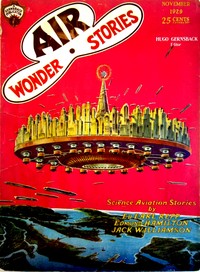
It was a city whose close-clustered spires and towers and pyramids had been gathered together upon a vast metal disk-like base, and hung suspended five miles above the green earth! It was circular in form and of five miles diameter, the colossal metal base or disk upon which it rested more than a thousand feet in thickness, the metal buildings and towers that rose from that base and were integral with it soaring for five thousand feet farther upward! A colossal city floating there in the air, with its streets and buildings swarming with activity, with thronging hordes, and with great masses of fear-driven craft speeding through the air toward it from all directions.

A city of the air! Suspended by huge batteries of great electrostatic motors in its base, motors that drew the exhaustless energy of earth's atmospheric electricity from countless slender pinnacles that soared from the central plaza; whence the current was conducted along cables within the pinnacles to the giant motors beneath. The cities too were suspended by the gravity-repelling quality of the collected cosmic rays. To this had mankind come, at last. The flimsy airplanes of a good century before, with their little endurance records of weeks and months in the air, had given way to the great electric-driven cruisers which drew their power from the static about them, and which could stay aloft indefinitely. And then had come the great air-forts, held aloft in the same way, and finally, when the great air-wars had made life upon the ground so unsafe as to approach suicide, then had come the construction of giant metal cities, on huge metal bases, that contained enough great motors and tube-propellers to hold themselves in any direction at moderate speed.

Such now were all the cities of earth; Chicago, San Francisco, Buenos Aires, Berlin and Tokio. Great cities that hung always in mid-air, usually near the sites of those vanished cities of earth from which they had gained their names. But the air-cities could move from place to place now and then for better climate or defence. These great cities held within them all the world's population; the earth beneath being used only for the mining of metallic ores and the minerals used in the creation of the synthetic foods and fabrics now universal.

The great cities were each protected by a ring of air-forts, and also by great batteries of heat-guns set within their own walls. A hundred of such huge air-cities there were in the American Federation, holding in their colossal masses of clustered sky-flung towers an average of five million inhabitants each. And in the European and Asiatic Federations combined, I knew, there were more than two hundred mighty cities of the air.

Now, though, it was the huge air-city of New York that held all our attention, and as we rushed closer toward it I saw that above it, above the panic-driven masses of air-craft that were swirling down to take refuge within it, there hung squadron upon squadron of cruisers like our own, over two thousand in number, hanging there in grim, motionless ranks, as though unconscious of the swarming, fear-driven activity in the huge city beneath them. From every quarter other cruisers were arriving to join those squadrons, cruisers that came like our own from patrols over the green inland plains, from above the icy Labrador wastes, from over the jungle-bordered Caribbean coasts, all rushing to answer the call to arms. As our own ship neared the city, we headed down toward the central plaza.

"Straight down to the central plaza, Macklin," I said. "The First Air Chief will be there and orders are to report to him first."

Macklin had already slowed our ship's speed, and now as we drove to a position beside the aspiring central pinnacle, with its clustered points, the city's static-tower, he turned the power of our motors completely from our horizontal tube-propellers, into our vertical ones, which held us motionless in mid-air. Then, as he slowly decreased that power, we sank smoothly down until in a moment more we had come to rest upon the smooth central plaza among a score or more of other cruisers. These rested in a great ring about the plaza's edge, their crews waiting within them, but at the center of that ring, beside the mighty static-tower's base, stood a little group of men, the First Air Chief, Yarnall, and his squadron-commanders.

As our cruiser came to rest I opened the door beneath the bridge-room, and stepped onto the metal plaza and across it toward that group. Around the great plaza, I noted, were vast, seething crowds, thousands upon thousands of the mighty air-city's inhabitants. Other thousands were gazing down toward us from the towers that soared around us into the golden afternoon sunlight. These people, watching us and the mighty fleet hanging grimly far above, were silent, but from beyond them there came to my ears from far across the air-city's mighty mass, the dull roar of millions of blended voices, in unceasing, excited shouts. Then I reached the First Air Chief and the group before him, my hand snapped to a salute, which Yarnall silently returned. And then, gazing for a moment in silence from one to another of us, his strong face and gray eyes grave, he began to speak to us.

"You, the squadron-commanders of our eastern forces," he said, "know why you have been summoned here, why I, under the orders of the Federation's Central Council, have summoned here you and all the cruisers that wait above us. The great European Federation fleet, twice as large as our forces, is rushing westward over the Atlantic toward us, and within the hour we must meet that fleet in battle."

He paused, and in the silence that ensued the dull, dim roar of the great city about us seemed suddenly infinitely remote from our ears. Then the First Air Chief went on.

"Within the hour we must meet that fleet in battle and as we go out to meet it our western forces will be going out from San Francisco, under the command of the Second Air Chief, to meet the Asiatic Federation fleet racing eastward toward it. And upon those two battles rests now the fate of our nation. If they are lost, if either of them is lost, within days our nation will be but a memory, our cities annihilated. If the two approaching fleets are defeated and beaten back, then we shall have won for ourselves a respite in which we can prepare to meet the great enemies that crowd now upon us. So I say to you, the Central Council says to you, that this battle must not be lost!

"The fleet that we must meet has twice the number of cruisers of our own, and there have been rumors of some new method being prepared by them with which to attack us, now or later. We have to aid us only the air-forts about this city, which have been equipped with a new device. I have ordered them to move east of the city to lie between it and the enemy. This great air-city itself, when we go out from it, will move inland at its highest speed away from the battle, just as Boston and Charleston and Miami and San Francisco and Los Angeles and all our great air-cities, north and south. There will be, therefore, none but our cruisers gathered above and our air-forts massing eastward to fight this battle upon which the Central Council has staked our fate.

"But great as these odds are against us, this battle must not be lost! We are the sons of the Americans who fought through the First and Second and Third Air Wars, who reared this nation out of the blood of a thousand air battles until now its hundred air-cities hold in their power a third of all the world. And now that the rest of that world comes against us, the Last Air War begins. My word to you is this: Fight only as those men before you fought, and before tomorrow the European Federation fleet shall have been beaten back--or the last of our cruisers and our air-forts and ourselves will have perished!"

There was silence as the First Air Chief ceased, and then from us assembled commanders there broke a great cheer, a cheer that was taken up by the massed thousands around the plaza and that spread like fire over all the great air-city about us. Then we all returned toward our waiting cruisers, the First Air Chief toward his own, and a moment later his cruiser, with its three parallel stripes of silver running from stem to stern distinguishing it from all others, was rising smoothly upward, followed by our own. Upward we shot, a vast roar coming up to us from the mighty floating city beneath us. Then our score or more of ships were taking their places each at the head of its squadron of a hundred ships, while the First Air Chief in his silver-striped flagship rushed to a position at the head of all. There we hung, the dull, great roar coming unceasingly up to us from the city below, and then as an order sounded from the distance-phones of all the fleet we were moving forward, eastward, out from over the great air-city, from over the green coastline, out over the gray expanse of the Atlantic.

With Macklin and Hilliard again beside me as our own cruiser moved forward at its squadron's head, we three turned to glance back. We saw New York, its mighty towers splendid against the descending sun, moving also, but slowly westward and away from us, away from the coming battle, dwindling to a dark spot and vanishing as we raced on outward over the gray Atlantic. Now we were racing above the great air-forts that had massed in a great double line a score of miles out from the coast, high above the waters. Over these too we sped, at steadily mounting speed, until with great motors droning, crews shouting as they ran our heat-guns out from tops and sides and keels, winds whining shrill about us, our great fleet reached its maximum speed toward that great oncoming battle by which our Federation was to stand or fall.

The Battle Over the Atlantic

Gazing ahead, Macklin and Hilliard and I stood together in the bridge-room of our cruiser. The squadron which we headed was at the lead of one of our fleet's great columns. Far behind us stretched its ships, flashing forward at uniform speed. Then from the distance-phone before us came the First Air Chief's voice.

"Squadrons 1 to 6 take up scouting positions!" he ordered.

Instantly the first six squadrons of the two columns, our own one of the first, leapt forward and out from the two great lines of the main fleet. Our own and another squadron moved straight ahead, past the silver-striped flagship of the First Air Chief, until our two hundred ships had spread out into a great, thin fringe that was flying forward miles before the main body of our fleet. Two of the other four squadrons drove to right and left of the fleet, spreading there in the same way, the remaining two taking up positions high above and far beneath our two great columns. Thus, with its great lines of scouts fringing it and protecting it from surprise on all sides, our great fleet drove on toward the east over the gray and endless plain of the Atlantic, holding at Yarnall's orders a speed of eight hundred miles an hour.

The crimson descending sun flaming in the heavens behind us, the great gray ocean stretching endlessly beneath us, we rushed on through empty sea and sky. By then Hilliard had gone down to take up his position with the crew beneath, but Macklin and I still stared into the great empty vista before us. With the drone of our great motors and those of the scouts flying beside us, we seemed like a great flight of bees. Beneath there was no sound now from the crew, a silence that told of the tenseless, of expectancy. But still before us was no sign of the great fleet that we had come out to meet, and almost it seemed that in spite of our certain information as to its course we had missed it, since already we were some hundreds of miles out to sea. Then suddenly, as I gazed ahead, I caught my breath, and the next moment had turned swiftly to the distance-phone.

"Squadron 1 reporting," I said rapidly. "The scouts of the European Federation fleet are in sight and are heading toward us!"

For there ahead a great line of dark dots had appeared suddenly in the empty sky, a great fringe of dark dots that were rushing toward us and that were becoming quickly larger! With each moment that they raced toward us they became larger, until they had come plain to our eyes as long torpedo-shaped cruisers like our own. They differed from our own only in that their bridge-rooms, instead of being raised like our own, were sunk flush with their upper-surfaces, only their transparent forward-windows showing. They were the scouts of the European fleet, and at the same time I saw them they must have seen us, for they changed their course slightly. So racing straight toward us were five hundred cruisers opposing the two hundred of our far-flung line. On and on they came, and I saw momentarily far behind them a great cloud of other cruisers, the mighty main body of the European fleet. I shouted the information into the distance-phone. Then the next moment the speeding line of cruisers before us had rushed straight into our own onrushing line!

Edmond Hamilton's Cities in the Air (1929) opens not with a floating metropolis but with a war dispatch: Captain Martin Brant receives orders that the European and Asiatic Federations have allied against the American Federation. The story's first-person narration immediately establishes a military-adventure frame, with Brant commanding an air-cruiser and racing toward New York. The catalog subjects list "Cities and towns" and "Aeronautics" as primary, but the excerpts focus far more on combat, espionage, and escape than on urban or aeronautical theory. The floating cities appear mainly as backdrops for tactical action—plazas, towers, and streets suspended miles above earth—rather than as subjects of detailed speculation.

War Story, Not City Story

The catalog tags Cities in the Air with "War stories" and "Science Fiction," which the excerpts support, but also with "Cities and towns" and "Aeronautics." The latter two are misleading if taken as central themes. In the provided text, the air-city is described only in passing: "great mass of towers and streets and thronging crowds which hung here miles in the air above the earth." The narrative energy goes into Brant's escape plan—stealing uniforms, overpowering guards, timing the dusk—not into explaining how the city floats or how its society works. The word "electrostatic tower" hints at technology, but Hamilton does not elaborate. Readers expecting a utopian or sociological exploration of airborne urbanism will find instead a brisk, action-driven plot where the city is a setting for a prison break and a fleet battle.

Tense, Physical Prose

Hamilton's prose in these excerpts is concrete and sensory, built around physical tension and precise movement. The escape sequence relies on verbs of sudden action: "shot suddenly," "leaped," "wrenching," "stripping." The narrator notes the "long shadows of sunset," the "metal door" clicking open, and the guards' "heat-pistols." This is not speculative or philosophical writing; it is a thriller in the air. The dialogue is functional—orders and exclamations—and the characters are sketched through their reactions: Macklin "imperturbable as ever," Connell with "burning" eyes, Hilliard "eager and tense." The voice is that of a military professional, not a dreamer. This style aligns with the 1929 pulp origins (the story appeared in Air Wonder Stories) and suggests a readership seeking adventure rather than world-building.

What the Catalog Omits

The catalog subjects do not mention the story's clear geopolitical framework: three federations (American, European, Asiatic) in a global war. The excerpts show a world of rival air fleets, distance-phones, and "First Air Chiefs." Nor do the subjects capture the first-person, retrospective framing—Brant tells the story after the fact, creating a sense of memoir. The catalog also omits the element of captivity and escape, which occupies a substantial portion of the provided text. These gaps matter because they shape reader expectations: the catalog suggests a story about cities and flight, but the excerpts deliver a war narrative with a narrow focus on one captain's mission. The "Science Fiction" tag is accurate, but the science is minimal, limited to the premise of floating cities and heat-pistols.

Readers approaching Cities in the Air should set aside expectations of detailed aeronautical or urban speculation. The excerpts reveal a fast-paced war adventure, heavy on physical action and light on explanation. The floating city is a stage, not a subject. Hamilton's strength here is in building suspense through concrete, moment-by-moment description—the weight of a guard's arm, the click of a door, the fading light of dusk. Those who enjoy pulp-era military SF with a first-person narrator and a straightforward escape-and-battle plot will find the story engaging, while those seeking a treatise on airborne civilization may be disappointed.

Years later, I still think of Martin Brant floating above the world, not in triumph but in wary watchfulness. There’s a particular dread in being surrounded by sky. That same quiet unease, the sense of invaders who belong to a different element entirely, lingers in The abysmal invaders — Themes and Context. Both books understand that home can be a fragile, suspended thing.

There are no reviews for this eBook.

0
0 out of 5 (0 User reviews )

Add a Review

Your Rating *
There are no comments for this eBook.

Reader reflection

How will you remember this book?

Save your reaction, strongest insight, and memorable passage.

Your progress 0 / 10
1

Where are you in your reading?

2

How much did you enjoy the reading experience?

3

Would you recommend this book to another reader?

4

How much effort did this book require?

Related eBooks